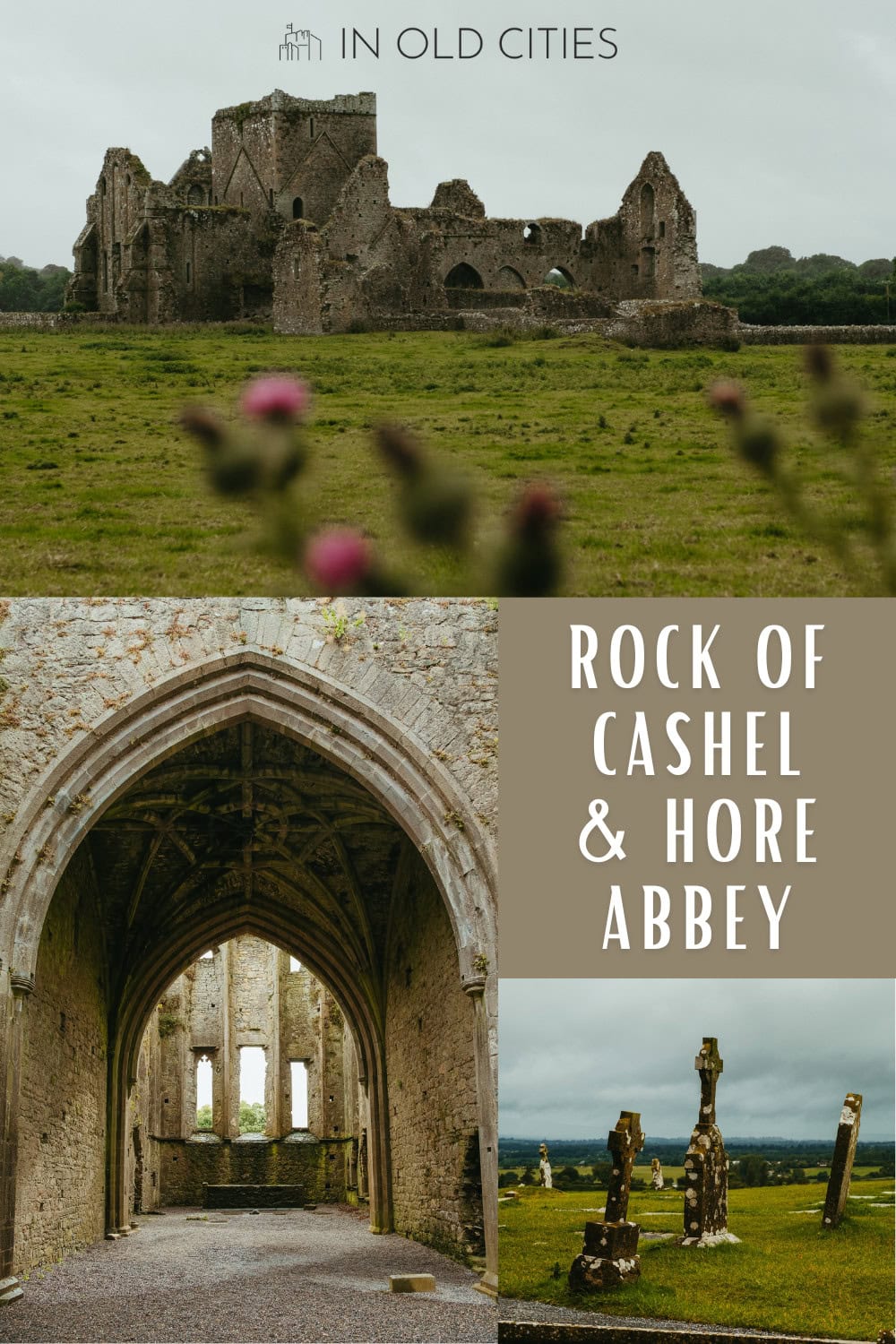
What to Know About Visiting the Rock of Cashel and Hore Abbey
Ireland is timeless and atmospheric for many reasons, but near the top of that list is its plethora of historic ruins. One of Ireland’s most famous and picturesque sites is the Rock of Cashel, which has a rich history of royal and religious significance.
But the Rock of Cashel isn’t the only interesting site in the area. Just down the hill from the Rock of Cashel lies Hore Abbey, a ruined monastery. Spoiler alert: from my experience, any visit to the Rock of Cashel isn’t complete unless you’ve also checked out Hore Abbey!
Here’s what you need to know about visiting both the Rock of Cashel and Hore Abbey in one wonderful trip.
This post contains affiliate links. If you make a purchase or a booking through one of these links, I may receive a small commission at no extra cost to you. Thanks for supporting In Old Cities in this way!
What Is the Rock of Cashel?
The Rock of Cashel is a limestone hill containing one of Ireland’s best collections of medieval buildings.
The history of the buildings on the Rock of Cashel begins centuries ago, when Ireland was not a country but a collection of kingdoms. At that time, Cashel was the capital of the Kingdom of Munster, and the King of Munster ruled from the Rock of Cashel. Legend even holds that in the 5th century, Saint Patrick traveled to Cashel and converted the King of Munster to Christianity at the Rock of Cashel.
In the early 12th century, the King of Munster donated the fortress to the Catholic church. Subsequently, a cathedral, a chapel, and other buildings were added to the site.
These are the buildings that can best be seen today. While they are not wholly intact, they have been substantially reconstructed and restored.
What Is Hore Abbey?
Hore Abbey is a ruined monastery located just beside the base of the Rock of Cashel. In fact, there is a great view of Hore Abbey from the Rock of Cashel site!
The abbey was founded as a Benedictine monastery in 1266, but in 1272, the controversial Archbishop of Cashel gave it to the Cistercians. (According to an apocryphal story relayed on a sign at the site, the Archbishop banished the Benedictines because he dreamed that they planned to kill him.)
Hore Abbey was dissolved as a monastery in the 16th century. Today, visitors can freely walk around its intriguing ruins.
How to Visit the Rock of Cashel and Hore Abbey
Here’s what you need to know about reaching, entering, and exploring the Rock of Cashel and Hore Abbey.
Arriving at the Rock of Cashel
The easiest way to reach the Rock of Cashel is to drive. As you arrive at the Rock of Cashel, partway up the hill is a public parking lot. This is a ticketed lot with hourly rates. Note that there are toilets available beside the parking lot.
From the parking lot, you’ll need to walk a brief distance up to the entrance of the historic site. If you have mobility issues, be aware that it’s a short but somewhat steep walk.
If you need (or want) to use public transit rather than driving, you can take the X8 bus to Cashel, then walk about half a kilometer up to the site from the town of Cashel.
There is a ticket booth at the entrance to the Rock of Cashel site. Tickets cost €8 per adult, with discounts for seniors, students, and children. (You can confirm current ticket prices and opening hours, or even buy your tickets in advance, here.)
Notably, there is a section of the Rock of Cashel site that requires an additional ticket. This is Cormac’s Chapel, which contains partially preserved Romanesque frescoes. You can only enter Cormac’s Chapel with a guided tour, for which there are limited tickets that can only be purchased in person. Also, the last tour of the day starts at 2:30 pm! So, if you are interested in visiting Cormac’s Chapel, I recommend arriving at the Rock of Cashel early in your day to ensure you snag one of those tickets.
Once you have purchased your ticket, you can enter the site and explore the buildings and their surroundings (other than Cormac’s Chapel!) as you please. If you prefer, there are guided tours available at certain times (ask at the ticket counter when the next tour is!).

Exploring the Rock of Cashel
The Rock of Cashel contains several 12th- and 13th-century buildings worth exploring.
In my opinion, the most impressive and interesting part of the Rock of Cashel is the cathedral, with its huge arches and tall stone walls.
You will see that the cathedral has no roof. In the 18th century, the Anglican Archbishop of Cashel destroyed the roof of the cathedral. This decision was criticized at the time (and since), but I must say that the lack of a roof adds a certain majesty to the empty cathedral space. (Though I’m certainly no fan of destroying historic buildings!)

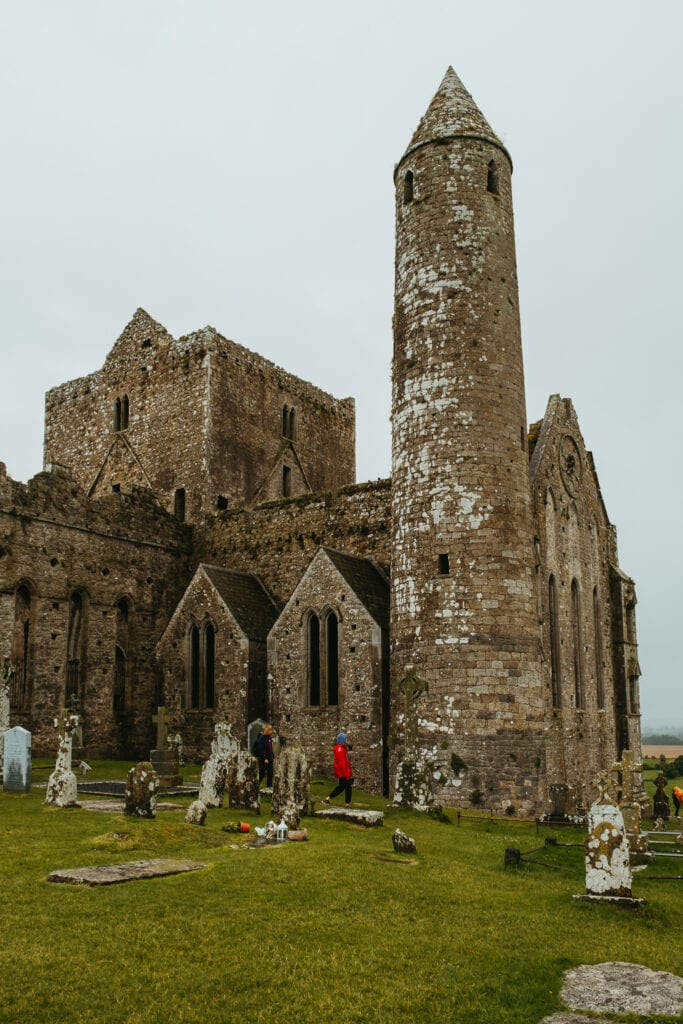
You can also see a tall, round tower, a replica of Saint Patrick’s Cross, and more. Don’t miss the Hall of Vicars, where there is a small museum and some information on recent royal visits to the Rock of Cashel.
The graveyard, which is placed around the buildings on the Rock of Cashel, is worth exploring not only for a look at the graves (some of which are very old), but also for the wonderful views of Hore Abbey and the surrounding countryside. Be prepared for wind and rain, which are common in Ireland and amplified by the site’s position on the top of a hill!

In our case, the weather conditions were a great introduction to Ireland, anyway, since the Rock of Cashel was our very first stop after landing in Dublin and setting off for the south!
Walking to Hore Abbey from the Rock of Cashel
After you are done visiting the Rock of Cashel, head back toward the direction of the parking lot. However, rather than returning to the lot, take a sharp right onto a small path that runs between a stone wall and the Rock of Cashel site. (Look for the brown sign pointing to Tipperary Heritage Way!)
Follow this path down to the road and take a right onto the road. Continue this way until you have an opportunity to turn left toward Hore Abbey (which will be visible to you at this point). Take the left and follow that narrow road to the entrance to Hore Abbey.
If you are unable to walk to Hore Abbey, there is a VERY small area near the entrance to Hore Abbey where you can park your vehicle. (I do not advise that you drive to Hore Abbey if you can walk, as space is extremely limited!)
There is a short lane through the field that will lead you to the ruins of Hore Abbey. Be on the lookout for cowpies and other animal droppings, as farm animals sometimes graze in this area!
From the beginning of the lane beside the Rock of Cashel, the walk to Hore Abbey takes about 10 to 15 minutes.
Exploring Hore Abbey
Hore Abbey is a lovely site to explore. There’s not much in the way of historical information, but you can take your time walking around the buildings and envisioning what they once were.
Like the Rock of Cashel, I particularly enjoyed the cathedral spaces, with their empty windows, mossy corners, and huge stone walls pointing toward the sky.
Don’t forget to look up, too; there are wonderful and interesting views of the Rock of Cashel to be found from several places around the Hore Abbey site. I especially enjoyed looking for spots with interesting natural frames of the Rock of Cashel, or where I could feature something like plants in the foreground of the photo with the Rock of Cashel in focus in the background.


Rock of Cashel vs. Hore Abbey: Which Is Better?
It’s easy to visit both the Rock of Cashel and Hore Abbey, even in just a short amount of time, but what if you’re extra pressed for time and are only able to visit one?
If you only have time to visit the Rock of Cashel OR Hore Abbey, I recommend choosing Hore Abbey. Here’s why:
Hore Abbey is much quieter, and free to enter.
Like the Rock of Cashel, Hore Abbey contains picturesque ruins in the Irish countryside. Sure, it’s not as intact as the buildings on the Rock of Cashel (which have, after all, been reconstructed to some extent), and it’s not perched up on a hill, but Hore Abbey still offers an interesting look at classic Irish ruins, and it’s quite beautiful.
Unlike the Rock of Cashel, Hore Abbey is free! And it’s much, much quieter. While the Rock of Cashel was swarmed by fellow tourists, we walked around Hore Abbey completely on our own, which was quite refreshing. There is something special about gazing at Irish ruins in true peace and quiet.
Hore Abbey also has a wonderful view of the Rock of Cashel!

In short, visit both the Rock of Cashel and Hore Abbey if time and your budget allow. But if you can only choose one, I’d vote for Hore Abbey.
Rock of Cashel and Hore Abbey: Interactive Map
Below is a map with the locations included in this post. To use this map during your own trip to Ireland, click the star next to the map’s name (which saves the map to your account). You can then find and use the map from your Google Maps app by going to “Saved,” then “Maps.”
Where to Stay Near the Rock of Cashel and Hore Abbey
If you’d like to stay near these historic sites, I recommend sleeping in the town of Cashel. Staying in Cashel would allow you to get to the Rock of Cashel first thing in the morning, before it’s swarmed by day trippers, which would make the whole experience a lot more peaceful and enjoyable.
Cashel is just down the hill from the Rock of Cashel, and is walkable from both sites. Consider these lodging options:
- B&B | Rockville House B&B is just a 5-minute walk from the Rock of Cashel and boasts a full Irish breakfast each morning.
- HOTEL | Baileys Hotel, located in a Georgian building on Cashel’s Main Street, has rooms with views of the Rock of Cashel and includes a restaurant and bar.
- LODGE | O’Briens Cashel Lodge is located just steps away from the entrance to Hore Abbey and offers both a self-serving kitchen and a continental breakfast.
- APARTMENT | This 3-bedroom apartment on Main Street is perfect for families or groups of friends and includes a washing machine and fully equipped kitchen.
Another option is simply to stop at the Rock of Cashel and Hore Abbey on the way to another destination. Because you can visit both of these sites in a few hours total, it’s easy to make them a stop along a day of driving, rather than a destination in and of themselves.
That’s what we did. We landed at Dublin’s airport early in the morning, picked up our rental car, and drove to the Rock of Cashel (which took a little less than 2 hours). After exploring the Rock of Cashel and Hore Abbey, we returned to our vehicle and drove to the extremely charming town of Kinsale (my favorite stop in Ireland!), where we spent the night.
More Information About Ireland
THINGS TO DO | Planning a trip to Ireland and trying to figure out where to start? Check out these 10 wonderful things to do in Ireland.
CLIFFS OF MOHER | Visiting the Cliffs of Moher is one of the best things to do in Ireland, but most people don’t venture far from the visitors’ center. Get away from the crowds and hike the entire Cliffs of Moher Coastal Walk!
COASTAL DRIVES | Ireland has some famous coastal drives around its stunning peninsulas, including the Slea Head Drive and the Ring of Kerry. But which of these two wonderful drives is better?
pin this post