How to Visit Delft and Haarlem in One Day (…and Should You?)
One of the best things to do during a trip to Amsterdam is hop on a train and visit other lovely towns and cities in the Netherlands. Because the country is so small, and the train system is so excellent, it’s incredibly easy and worthwhile to experience more of the Netherlands by taking day trips from Amsterdam.
Two popular destinations for day trips from Amsterdam include Delft and Haarlem. These cities are actually on the same train line, making it easy to visit both Delft and Haarlem in one day. This is what I did while visiting Amsterdam!
This itinerary makes for a fast-paced but rewarding day. In this post, I’ll tell you exactly how to visit Delft and Haarlem in one day from Amsterdam.
Stick around until the end of the post, when I’ll also tell you whether I think you should visit Delft and Haarlem in one day.
TIP: This map contains the locations mentioned in this blog post. To save it to your own Google Maps account, click the star next to the map’s name. You can then find and use the map from your Google Maps app by going to “Saved,” then “Maps.”
Delft and Haarlem in One Day: An Itinerary
Here are detailed instructions for how to see the best of both Delft and Haarlem in just one day.
8 am: Train to Delft
Since you have a very busy day ahead of you, I recommend getting an early start and heading to Delft around 8 am.
When I did this itinerary, I bought three one-way train tickets (Amsterdam to Delft, Delft to Haarlem, Haarlem to Amsterdam).
However, I think it might be possible to buy a round-trip ticket from Amsterdam to Delft and then just stop off at Haarlem (since Delft and Haarlem are on the same train line, and Haarlem is on the way form Delft to Amsterdam). This is definitely possible elsewhere in Europe (and I have done it), and it would save a few euros compared to buying three one-way tickets.
The only reason I was unsure in this case is that at train stations in the Netherlands, you must scan your ticket when entering and exiting the station. My concern was that the scanner would not let me through at Haarlem if my train ticket did not say Haarlem on it.
I did not have time to ask a station attendant about this, so I didn’t risk it. I will say, at one point in the Netherlands I accidentally scanned the wrong ticket at a station and nothing happened, so my sense is that you possibly just need to have a ticket, and the scanners don’t care about which ticket you’re holding.
To find the right track in Amsterdam, look for trains to Vlissingen.
Trains from Amsterdam to Delft leave approximately every 30 minutes, and cost about €15.30 if you buy the one-way ticket. The journey takes about an hour.
9 am: Molen de Roos
When you arrive in Delft, head toward Molen de Roos, a windmill strangely located along the road around town. Delft’s only surviving windmill, Molen de Roos still operates as a flour mill. If you are visiting on a Wednesday, Thursday, or Saturday, you can even enter the windmill and see its operations (or purchase some products).

The walk from Delft’s train station to Molen de Roos takes 10-15 minutes.
9:30 am: Oude Kerk
From the windmill, head into Delft’s historic center. It’s a beautiful area with narrow streets, picturesque canals, and centuries-old buildings.
Your first stop is Oude Kerk, meaning Old Church. It is indeed quite old, dating back to the 13th century. One look at the church tower and you won’t be surprised: it leans nearly 2 meters to the side. (Don’t worry, it’s stable now!)

To enter Oude Kerk, you will need to buy a ticket. It gets you into both Oude Kerk and Nieuwe Kerk (which you’ll visit later in this itinerary), so make sure to hold onto your ticket. A regular adult ticket costs €8.00, though you can also buy a ticket to climb the Nieuwe Kerk tower if it is open. (It was closed during my visit to Delft due to strong winds.)
Oude Kerk, like many other historic churches in the Netherlands, now essentially functions as a museum in addition to a working church. It’s really beautiful, with stark white walls, brightly colored stained glass, and a gorgeous wooden ceiling. Throughout the church are exhibits about the history of Delft, as well as the church itself.
Notably, the painter Vermeer, who lived his whole life in Delft, is buried in Oude Kerk (his tombstone is part of the floor).


If you’re interested in Delft history, you could easily spend an hour in Oude Kerk (and may need to adjust this itinerary accordingly). If you just want to look around the church, plan on 15-30 minutes for your visit.
10 am: Brunch
Next, find a place to fuel up with some brunch. (If you’re not hungry, or feeling pressed for time, you can put this off until later.)
Delft has lots of lovely cafes, including quite a few with canalside seating. I ate at Bombina, which serves a pretty decent eggs benedict.
11 am: Nieuwe Kerk & Grote Markt
When you’re ready to get moving again, head toward Delft’s main square. It’s quite long, featuring Delft’s town hall at one end and the imposing Nieuwe Kerk at the other. Lining the sides are shops and restaurants, including lots of places you can buy Delftware — the famous blue and white pottery that originates from Delft.
If you have more than half a day in Delft, or want to otherwise adjust this itinerary, you could visit the Royal Delft Museum, where you can see how Delftware is made.


Walk into Nieuwe Kerk and scan your ticket once again.
Like Oude Kerk, Nieuwe Kerk (“New Church”) is gorgeous, with unusual brick walls and glorious colored light shining in through the stained glass windows.
Nieuwe Kerk is most famous, however, for holding the royal crypts of the Netherlands. The crypts themselves are not open to the public. However, certain members of the royal family are entombed on the main floor. Most notably, William of Orange is buried in an elaborate mausoleum that occupies the space where an altar would typically sit. You can follow a guided path around the church and see the tombs and exhibits about their occupants.


12 pm: Beestenmarkt & Maria van Jessekerk
On your way to the east side of town, where you’re heading next, walk through Beestenmarkt — a beautiful square filled with huge old trees.
If you skipped brunch earlier, and you have some time, this would be a great place to grab lunch on a nice day.

If you like, you can also pop into Maria van Jessekerk — a beautiful Catholic church just around the corner from Beestenmarkt.
Keep in mind that this itinerary has lots of other churches on it. If you’re on the verge of church fatigue or you’re running behind schedule, you might want to skip this.
12:30 pm: Oostpoort
Follow the canals to the east side of town, where you’ll find Delft’s last remaining city gate, Oostpoort.
Oostpoort is a 15th-century gate with striking towers. It’s a reminder that Delft was once one of the best-defended cities in the Netherlands — there used to be nine gates and a city wall! Now, of course, Delft is one of the most charming cities in the Netherlands.
For the best view of Oostpoort, take the bridge across the canal and walk to the small grassy area.

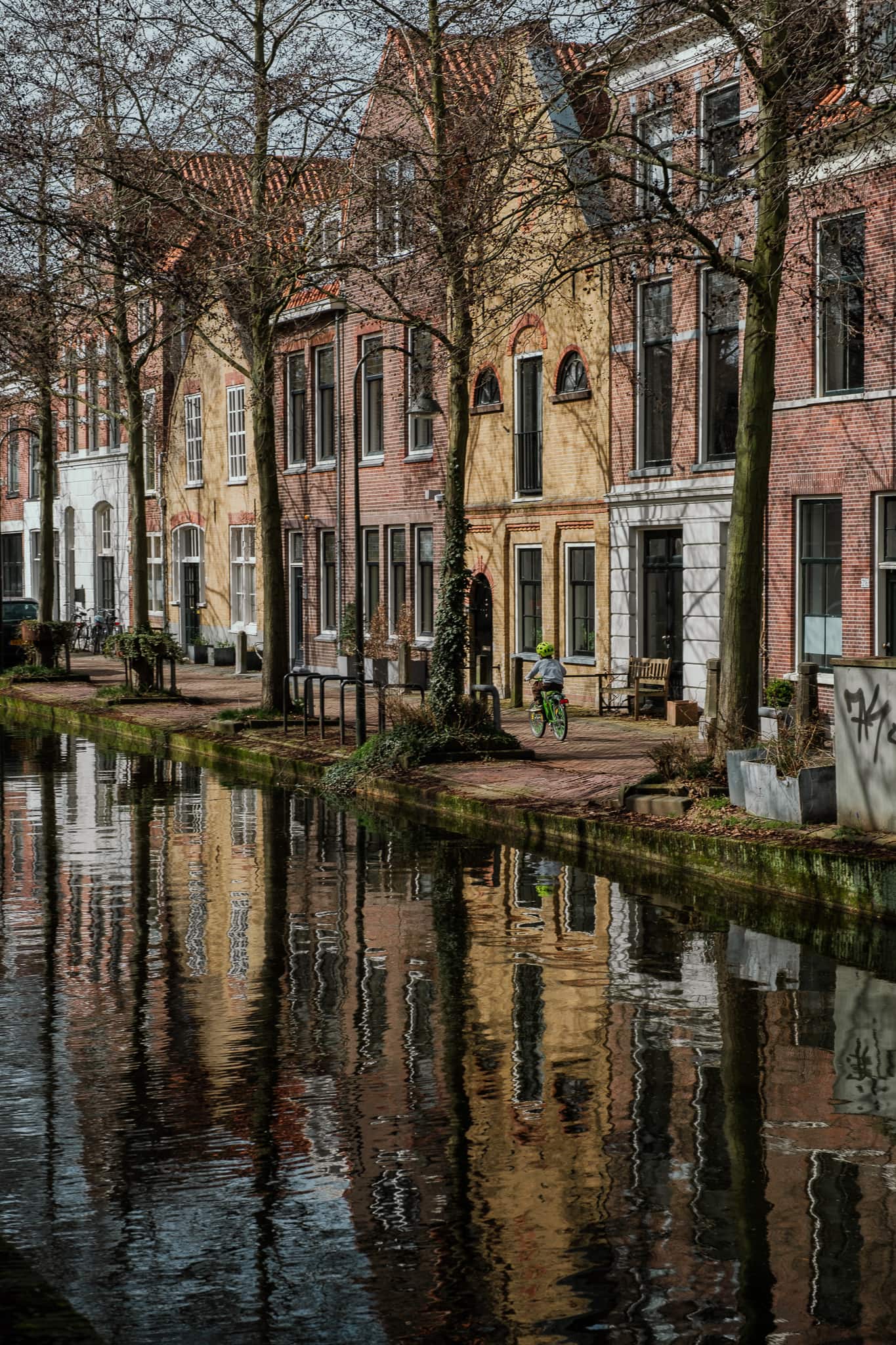
Oostpoort is nice to see and the walk to get there (along a canal, through residential areas) lets you see some new sides of Delft. However, if you’re short on time or just want to give this itinerary a little more breathing room, this is a good item to cut, since Oostpoort is out of the way.
1 pm: Train to Haarlem
For better or worse, it’s time to leave Delft and head to Haarlem. Walk back to Delft’s train station and catch the next train to Haarlem.
Trains from Delft to Haarlem run every 30 minutes and cost about €11.60 for a one-way, second-class ticket. The journey takes 45 minutes.
I recommend that you check the train schedules in advance so you know which train you want to take to Haarlem (and can make sure you’re at Delft’s station on time). This is especially true if your first destination in Haarlem is the Corrie ten Boom House, since you will need to arrive in time for your reservation there.
2 pm: Corrie ten Boom House
Corrie ten Boom and her family lived in Haarlem during World War II. Members of the Dutch Resistance, the ten Booms were dedicated to aiding Jews and others who were targeted by the Nazis. Their work took a variety of forms, but they are most famous for harboring Jews in a tiny hidden room in the ten Boom house and helping to smuggle them to safety. It’s estimated that the ten Booms helped to save around 800 Jews during the Holocaust.
Unfortunately, in 1944, a Dutch informant told the Nazis that the ten Booms were hiding Jews in their home, and the house was raided. Though the hiding place was not discovered, the Nazis did find Dutch Resistance materials, as well as extra food ration cards (which the family had distributed to Jews). On this basis, Corrie, her sister, and her father were all arrested. The 84-year-old father, Casper ten Boom, died days later. Corrie and her sister Betsie were sent to the Ravensbrück concentration camp, where Betsie also died.
Corrie, incredibly, survived Ravensbrück and spent the remainder of her life traveling the world to tell the story of her family and their Christian faith. She published a bestselling book, The Hiding Place, and became a world-famous public speaker.
Today, you can visit the ten Boom House and see the famous hiding place for yourself. Tours of the home last about one hour. Reservations are absolutely required, as the tours are small and infrequent and tickets are quite limited. (That said, if you fail to get a reservation, you can arrive a few minutes before a tour and they may let you join the group if other people with tickets do not show up. This happened in my group.) Reserve your place here.
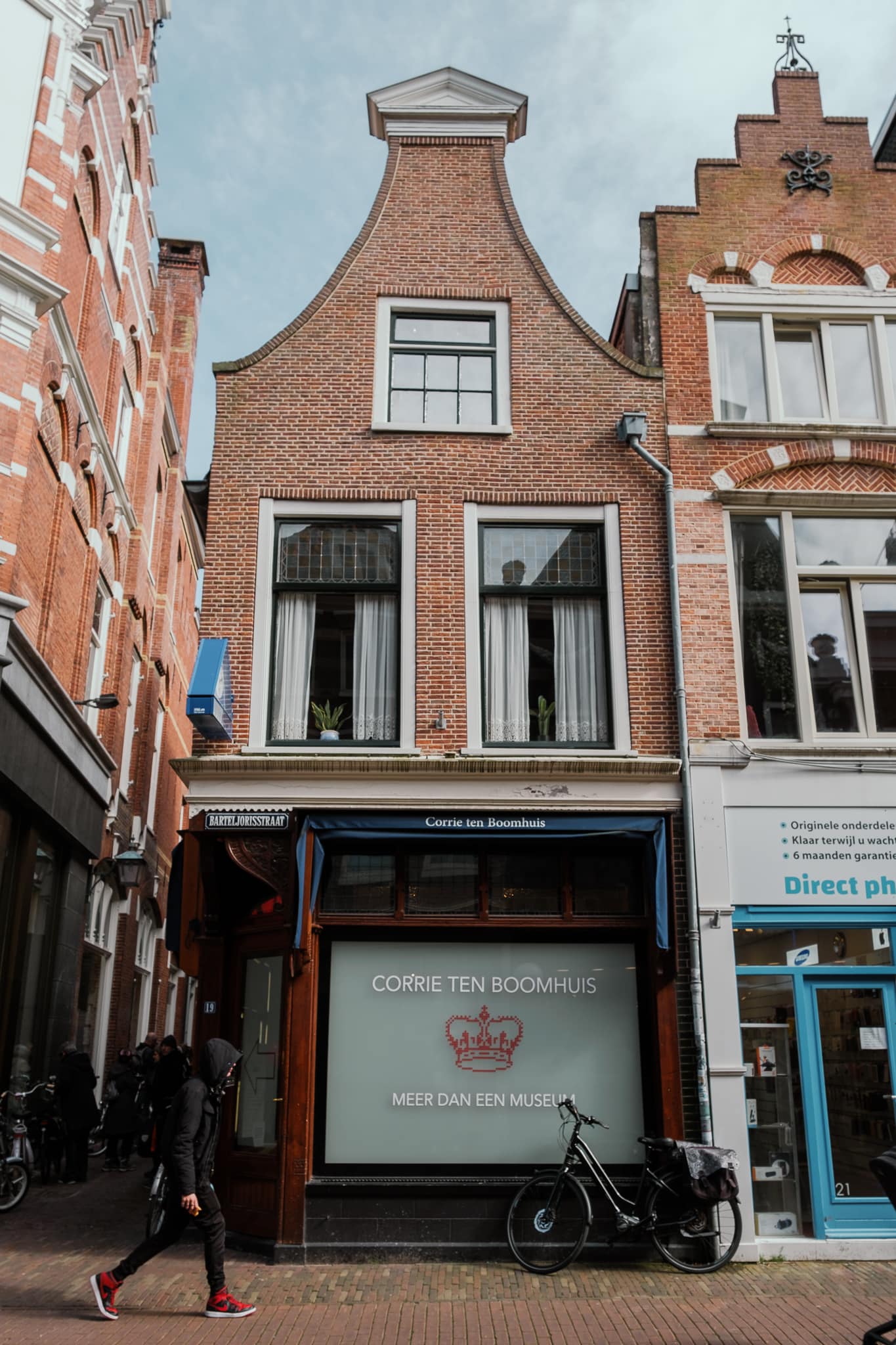
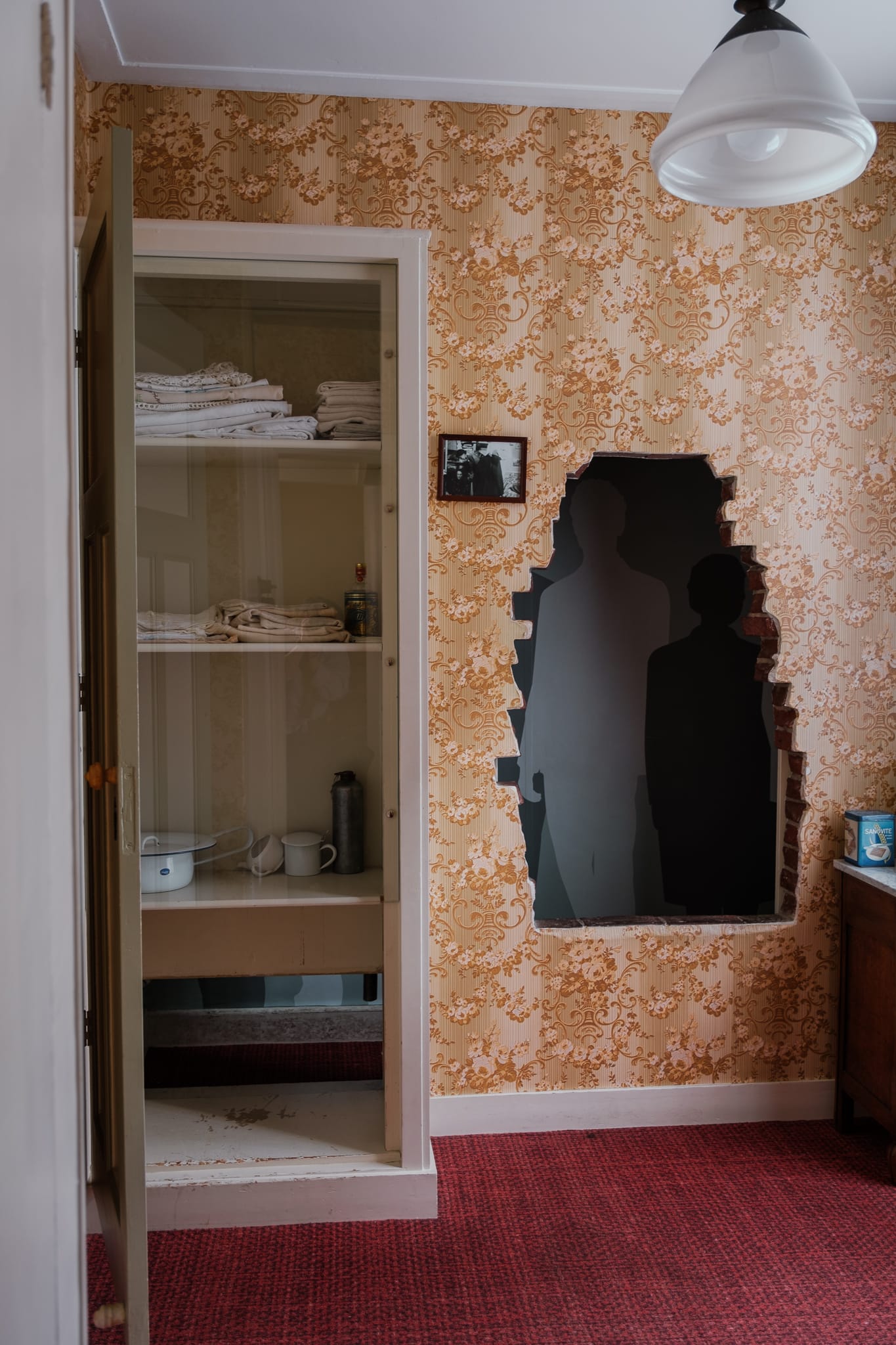
The ten Boom House is free to visit, but you can donate at the end if you wish. (In my tour, at least, there was no pressure to donate.) In case it would impact your decision to donate, be aware that the home is now owned and operated by the Corrie ten Boom Fellowship, which in turn is part of Friends of Zion, a Christian Zionist organization.
A WORD OF WARNING ABOUT THE TEN BOOM HOUSE
On that note, a few words of caution. Unfortunately, from my experience, it is very evident that the primary goal of those running the Corrie ten Boom House is not to preserve and share history. Rather, it is to evangelize.
Given that the ten Booms were devout Christians and that their faith motivated their actions during the Holocaust, it is not surprising that the museum dedicated to their legacy would include some religious elements.
However, to say the tour of the ten Boom House “includes some religion” would be a massive understatement. Every aspect of the tour tied back to Christian faith in some way — and not just faith in general, but a particular theology that is likely to be actively off-putting (or even offensive) for many people who don’t share it (which includes some Christians).
Specifically, my tour leader espoused both Christian Zionism and Left Behind-style eschatology, including warnings that a global dictator is soon coming to rule over the whole world, as well as musings on the importance of Christian evangelism to Muslims (with no acknowledgement that some group members could be Muslims).
The tour ended with a 10-minute sermon about the necessity of becoming a Christian in order to be ready for the trials of the end times and the return of Jesus to Jerusalem.
Throughout the tour, my leader also peppered in all sorts of other personal theories (presented as fact) about topics such as what country is the worst to live in today (North Korea, she says) and what motivated Hitler and the Nazis to perform their atrocities (the occult, according to her).
Personally, I didn’t expect any of this beforehand, and so I was quite disoriented by the experience. However, if you know what to expect going in, and either (1) already share the theology I’ve recounted above, or (2) feel confident that you can withstand any discomfort/offense from the type of tour I’ve described, the ten Boom House may still be worth your time.
3 pm: Grote Markt & St. Bavo’s Church
Just a few steps away from the Corrie ten Boom House is Haarlem’s main square, Grote Markt. Its most prominent features are the city’s town hall and St. Bavo’s Church (also called Grote Kerk).
With your entry ticket to St. Bavo’s, you will receive a map that provides information about many of the architectural and historical highlights of the church.
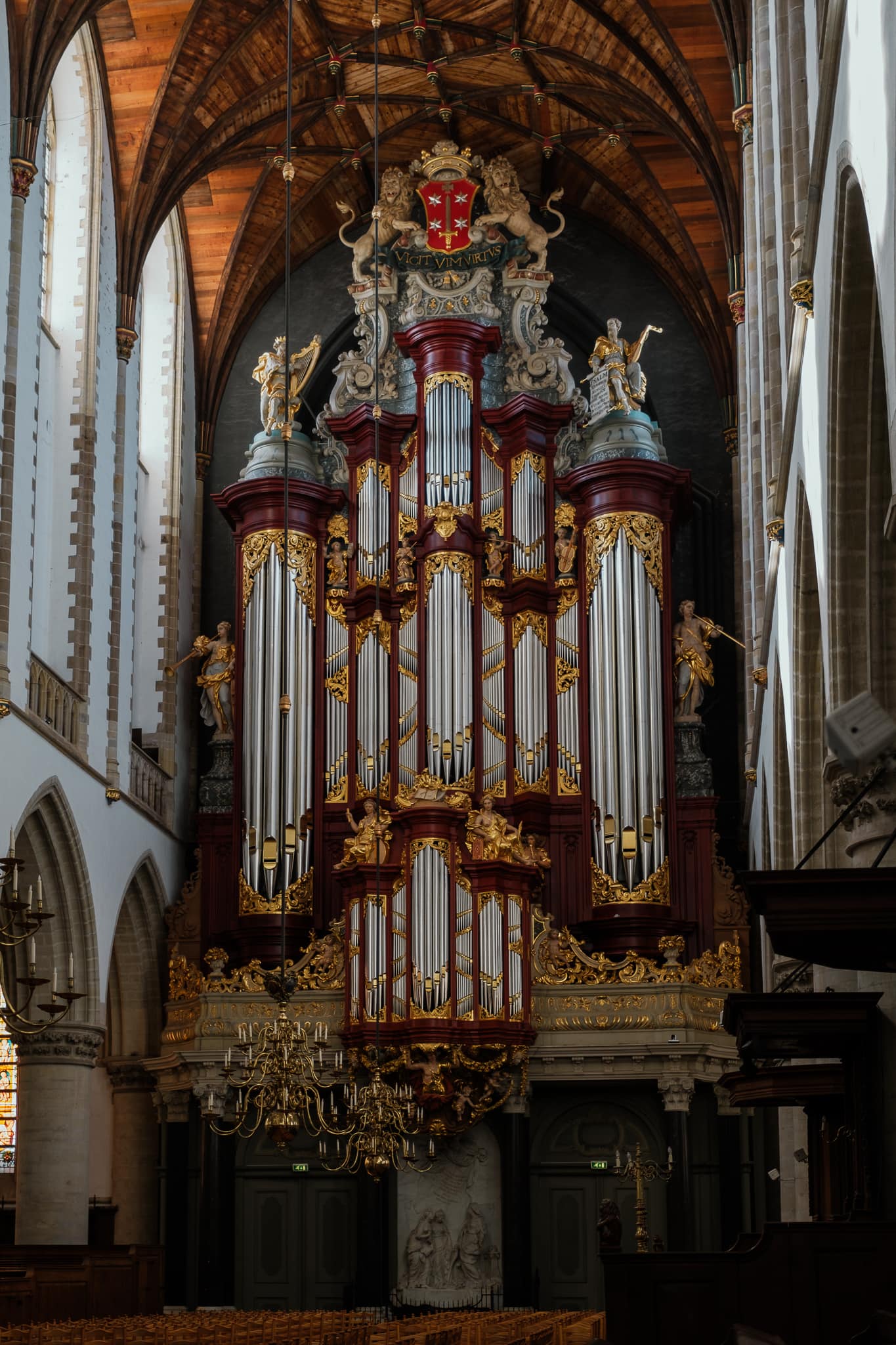
For me, the most striking part of the church is the absolutely massive organ. At nearly 100 feet tall (!), and with more than 5000 pipes, the St. Bavo’s organ makes a huge impression. I hate when writers use the phrase “mouth dropped open,” because how often does that happen, really, but I am afraid to report that my mouth truly did drop open when I saw this organ.

4 pm: St. Bavo’s Cathedral
From St. Bavo’s, walk toward…St. Bavo’s! Bavo is the patron saint of Haarlem, so it’s not too surprising that multiple churches bear his name.
In this case, we’re heading toward a Catholic cathedral outside of the central old town of Haarlem. Now, St. Bavo’s Cathedral is out of the way, and this is a busy day. If you’d rather take some time to relax in Grote Markt or maybe check out a museum (like the Teylers or the Frans Hals), instead of seeing another church, that’s perfectly understandable.
But I do recommend a visit to St. Bavo’s Cathedral if you’re up for it. It’s one of the largest churches in the Netherlands, and it’s quite unique.


Note that it’s possible to climb up to the organ — there are not many steps and the staircase is very wide — which offers a fabulous view across the length of the cathedral.
Be aware that you can also climb the tower at St. Bavo’s Cathedral. However, the last entrance is at 4 pm, so if you want to do this, you will need to reorder this itinerary.
5 pm: Molen de Adriaan
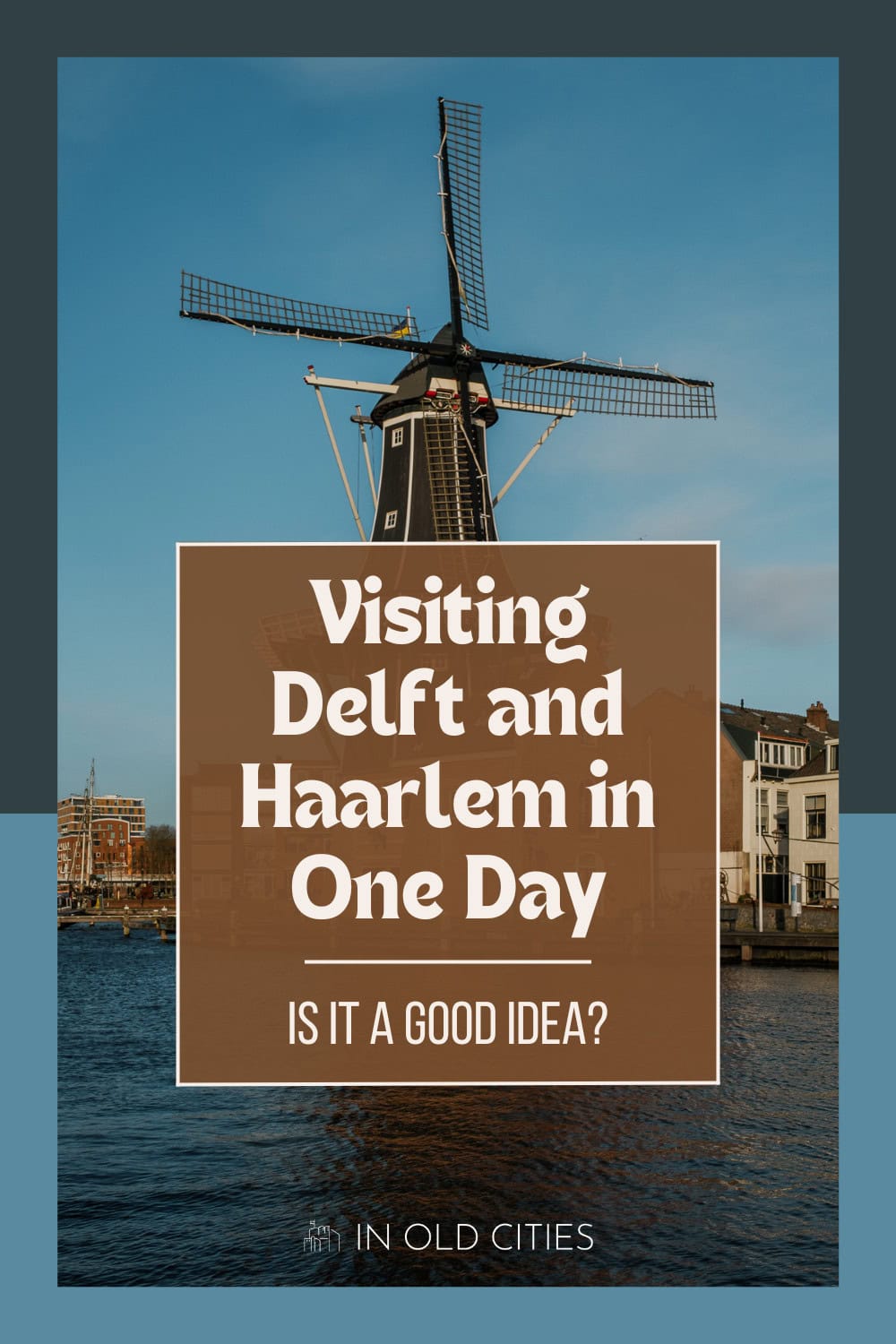
Like Delft, Haarlem has a windmill in the city center. Haarlem’s Molen de Adriaan is a 2002 reconstruction, however, as the original windmill burned down in the 1930s.
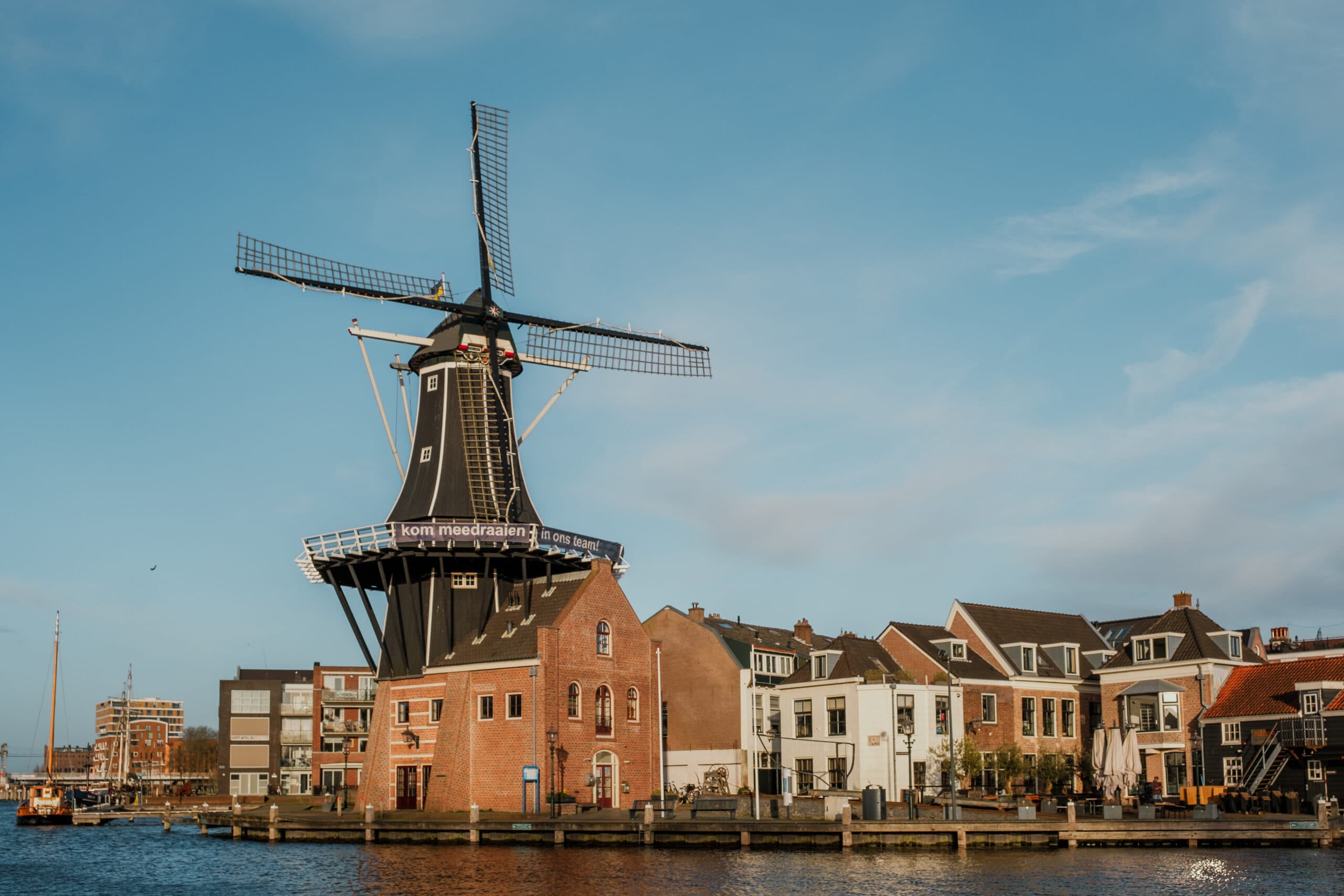
You’ll find the best views of the windmill across the river, approximately here. There are some benches in this spot, making it a nice place to rest your feet after a long day of walking.
6 pm: Dinner in Haarlem
Before heading back to Amsterdam, grab dinner. I ate at Jetties, a spacious and casual spot with lots of healthy options (which is always nice to find while traveling!). With its big windows and location near the train station, it was also a great place for people watching.
7 pm: Train to Amsterdam
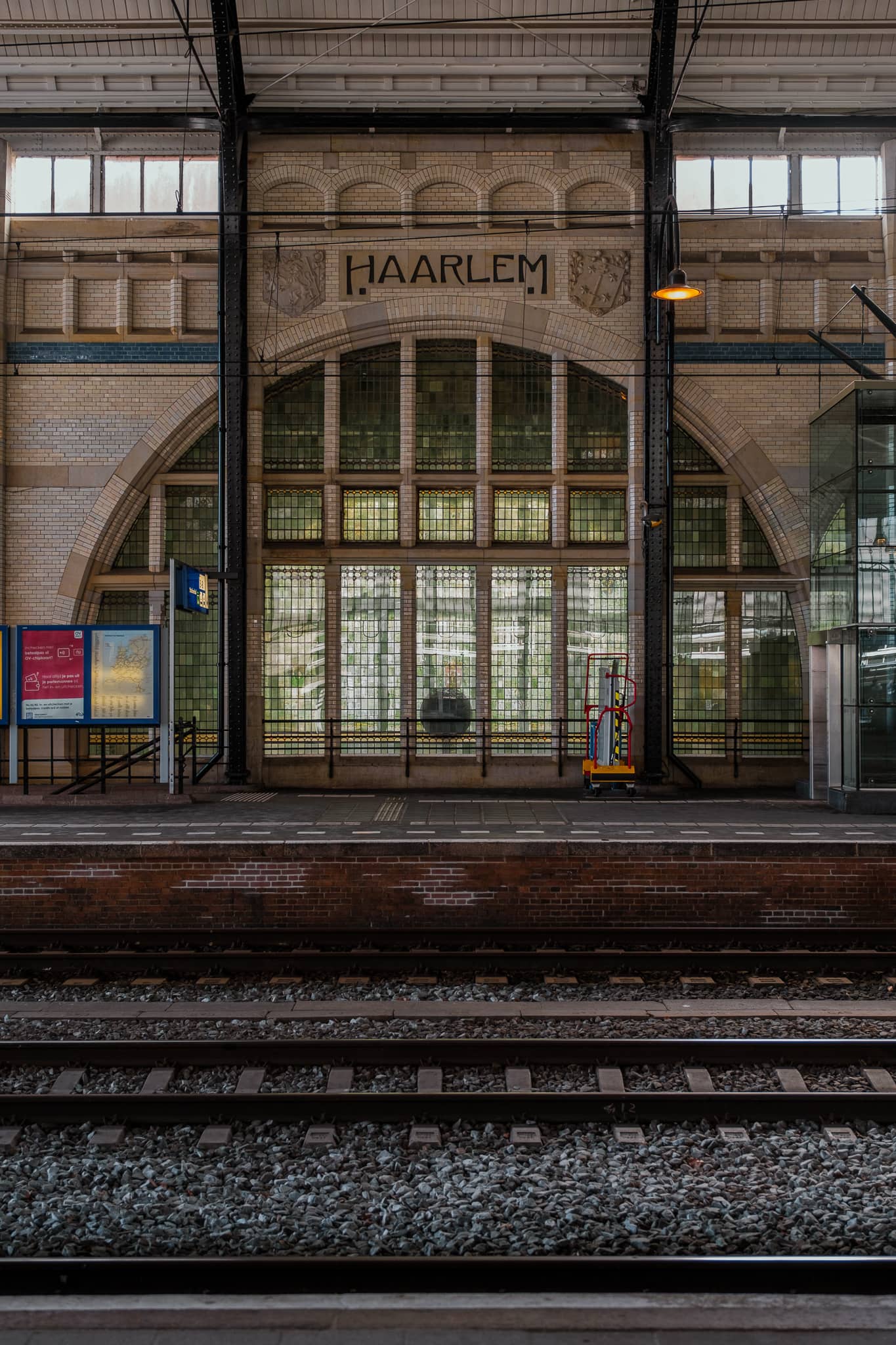
When you’re ready to say farewell to Haarlem, return to the train station and catch the next train to Amsterdam.
Trains from Haarlem to Amsterdam run every 10 minutes or so and cost about €4.90. The journey takes just 15-20 minutes, depending which train you take.

So now you know how you CAN visit both Delft and Haarlem in one day. But here’s the important question…
SHOULD you visit Delft and Haarlem in one day?
Well…maybe! I think both of these places deserve at least a full day of your time. To visit them in one day means rushing through both.
That said, I don’t think I would recommend skipping either of them. Delft and Haarlem feel distinct and each has a lot to offer in its own way. If you don’t have time to spend a full day in each city, I actually do recommend that you squeeze them both into one day trip rather than picking just one to visit.
Personally, I did prefer Delft, but I don’t wish I had passed on Haarlem, and I’m glad I saw them both.
Other Things to Know About Visiting Delft and Haarlem in One Day
Here are a few other things to know before you visit Delft and Haarlem in one day.
Can you visit Haarlem first?
Yes. In fact, if you want to climb the tower at the Cathedral of St. Bavo, it might even be preferable to visit Haarlem first (since the last entrance to the tower is at 4 pm).
If you want to visit the Corrie ten Boom house, your itinerary will be largely determined by the ticket you’re able to secure. I visited Delft first because the only ticket available for the ten Boom house was at 2 p.m. If you instead get a morning ticket for the ten Boom house, then naturally you should visit Haarlem first.
Can you add any other stops to this itinerary?
Technically, yes.
Several other Dutch cities, including Leiden and The Hague, are also on the same train line. It would be technically feasible to stop in one of these places as well during this itinerary.
But I would strongly advise against this. Even visiting just Delft and Haarlem in one day means speeding through both of them. If you added another city to the mix, you’d barely see anything in any of these destinations, and it’s likely that the whole day would become a big blur.
I understand the impulse to see as much as you can in your brief vacation time, but three cities in one day would be too much.
Final Thoughts
If you choose to visit Delft and Haarlem in one day, it will be a very busy day with little downtime. Accordingly, I only recommend doing this if it’s your only option for seeing both Delft and Haarlem while you are in the Netherlands.
But rest assured that these are two lovely cities and both are well worth your time!
More Information About the Netherlands
ITINERARY | Use this 10-day itinerary to plan a trip to Belgium and the Netherlands.
EXPENSES | Here’s how much I spent for 10 days in Belgium and the Netherlands.
THINGS TO DO IN AMSTERDAM | Find 10 excellent things to do during your first time in Amsterdam.
DAY TRIPS FROM AMSTERDAM | Find out whether Delft, Haarlem, or Utrecht makes for the best day trip.
pin this post