10 Days in Belgium and the Netherlands | A Detailed Itinerary
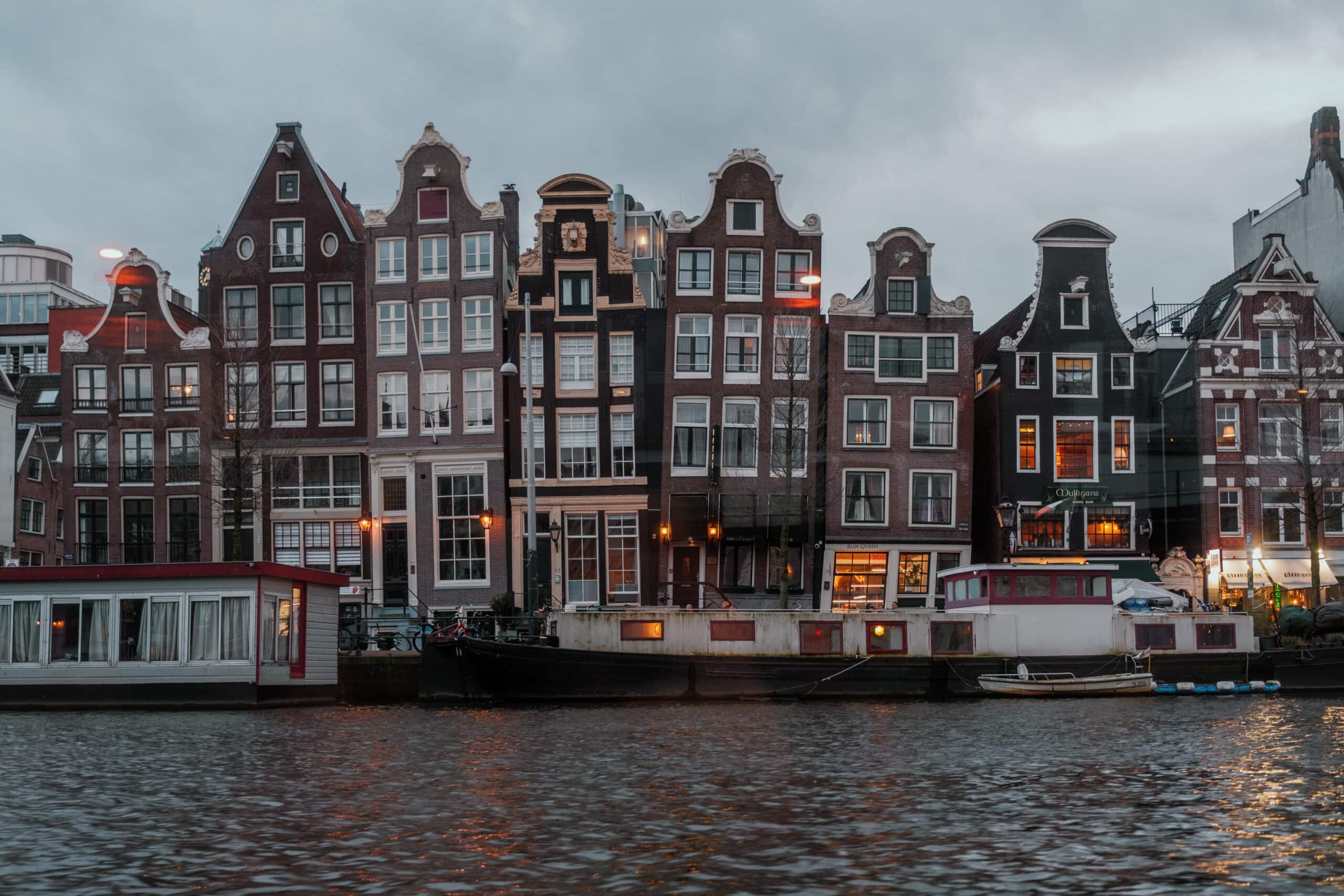
Grand city squares lined with glittering gold buildings. Fields dotted with centuries-old windmills. Ancient houses leaning toward the canals below.
All this and much, much more in the small countries of Belgium and the Netherlands. These neighboring countries are absolutely packed full with wonderful places to see. Plus, their excellent train systems make them a breeze to travel around, making this part of Europe a perfect choice for a getaway.
I spent 10 days in Belgium and the Netherlands and, while I could have happily spent much more time there, I found that 10 days was enough time to see the highlights and get a great sense of what these countries are like.
Here’s a detailed itinerary for how to spend 10 days in Belgium and the Netherlands.
10 Days in Belgium and the Netherlands: Itinerary at a Glance
Day 1: Arrive in Brussels
Day 2: Day trip to Ghent
Day 3: Day trip to Bruges
Day 4: Day trip to Dinant
Day 5: Train to Amsterdam (optional stop in Antwerp)
Day 6: Explore Amsterdam (Rijksmuseum, Van Gogh Museum)
Day 7: Day trip to Utrecht
Day 8: Day trip to Delft and/or Haarlem
Day 9: Explore Amsterdam (Anne Frank House, Our Lord in the Attic)
Day 10: Explore Amsterdam, depart
This post contains affiliate links. If you make a purchase or a booking through one of these links, I may receive a small commission at no extra cost to you. Thanks for supporting In Old Cities in this way!
10-Day Belgium and Netherlands Itinerary
Let’s dig in: here’s my detailed itinerary for 10 days in Belgium and the Netherlands.
By the way, if you’re curious, here’s how I much I spent on this exact itinerary!
Day 1: Brussels
On the first day of your trip, arrive in Brussels. Try to time your arrival for as early in the day as possible so you can maximize your time to explore Brussels.
If you are arriving by plane, it’s very easy to take the train from Brussels Airport to the city center. Just follow the signs to the train platforms, then buy a ticket to the Brussels central zone.
Where to Stay in Brussels
I stayed at an Airbnb that I can’t particularly recommend, but it did have one thing decidedly in its favor: its location. It was just a few minutes’ walk from Brussels Central Station (one of the city’s major train stations) and around the corner from Grote Markt.
If you follow this itinerary, you will be using Belgium’s train system quite a lot. Accordingly, I recommend that you stay within walking distance of one of Brussels’s train stations (Brussels Central, Brussels Midi, and Brussels North). For example, consider these options:
BUDGET | Latroupe Grand Place is just a few minutes’ walk from Grote Markt, but offers affordable spaces in dorms rooms (plus private room options too).
COMFORT | 9Hotel Central is just across the street from Brussels Central and gets great reviews for its clean design and quality breakfast.
LUXURY | The Warwick has midrange rooms too, but snag the Warwick suite for fantastic views of the Grote Markt.
With whatever time you have after checking into your lodging, wander around the historic center of Brussels. Here are my top recommendations for things to see.


Grote Markt
Of all the town squares I’ve seen in Europe, Brussels’s Grote Markt is one of the most impressive. Actually, the first time I saw it, it stopped me in my tracks.
Grote Markt is massive. Even full of tourists, as it usually is, it’s an obviously expansive space. Besides that, it’s lined with tall towers and gorgeous buildings covered in gold. They’re guild houses — former headquarters for various associations of merchants and tradespeople.


For your best chance at getting decent pictures of Grote Markt without approximately 5000 people in every shot, go there first thing in the morning. On one of my mornings in Brussels, I visited Grote Markt a little before 9 am and only a few other early birds were out in the square.
Mannekin Pis and Jeanneke Pis
Incredibly, one of Brussels’s best-known tourist attractions is a tiny fountain statue of a young boy peeing. It’s called Mannekin Pis, which — you guessed it — roughly means “Little Pissing Man.” Charming!
Mannekin Pis dates all the way back to the early 1600s, although the statue on the street today is a replica. (The original is displayed in the Brussels City Museum.) Mannekin Pis is often dressed up for holidays and other events, and allegedly has around a thousand different outfits (!). I visited Brussels in mid-March, and Mannekin Pis was dressed for St. Patrick’s Day.


For a strange form of gender equity, make sure to swing by Jeanneke Pis — a small fountain statue of a young girl peeing. “Little Pissing Joan” (sure!) was installed in the 1980s, and I’m not kidding about the gender equality: allegedly, that was one of the motivations for its creation.
Théâtre Royal de Toone
For a unique place to try some of Belgium’s famous beer, check out the bar at Théâtre Royal de Toone. Royal de Toone is a puppet theater that still puts on shows, but there’s also a cozy bar that’s decorated with plenty of puppets.

Day 2: Day trip to Ghent
For the next several days, you will use Brussels as a home base while you take day trips to some of Belgium’s wonderful smaller cities.
First up: Ghent. This college town is a real delight, with a row of imposing towers, a medieval castle with a gory history, lovely canals, and more.
Here are a few of the things I recommend doing in Ghent:
Gravensteen
Gravensteen is a 12th century castle that sits right in the midst of Ghent’s historic center. While Gravensteen originally served as the home of the Counts of Flanders, it later became a court, prison, and execution site.


A ticket to Gravensteen includes access to a self-guided audio tour, which is a must in order to understand what you’re seeing as you walk around the site.
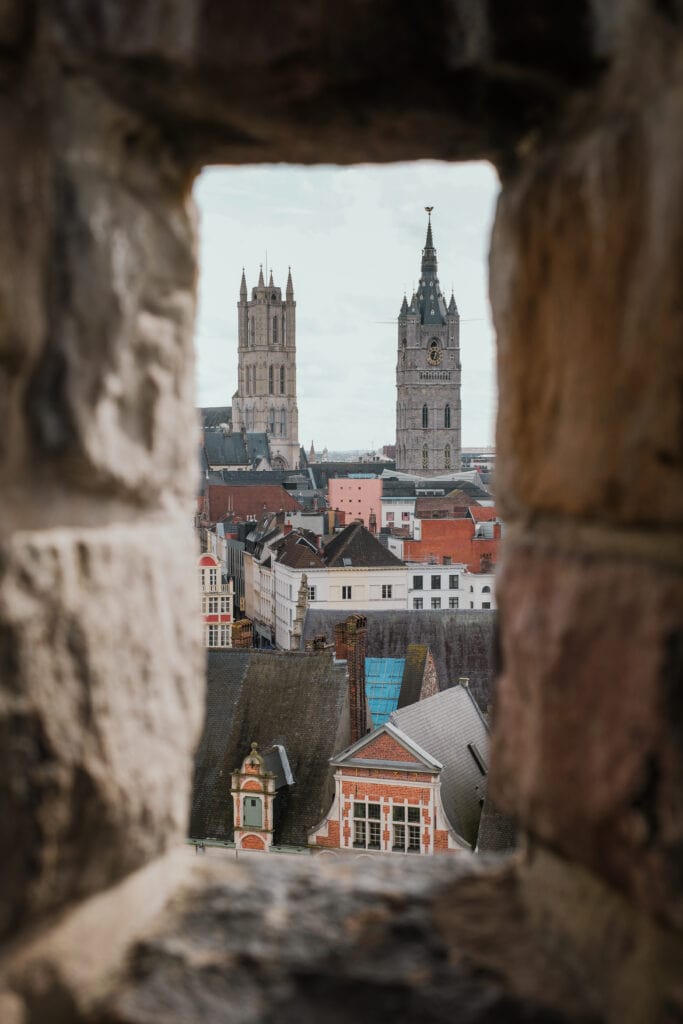
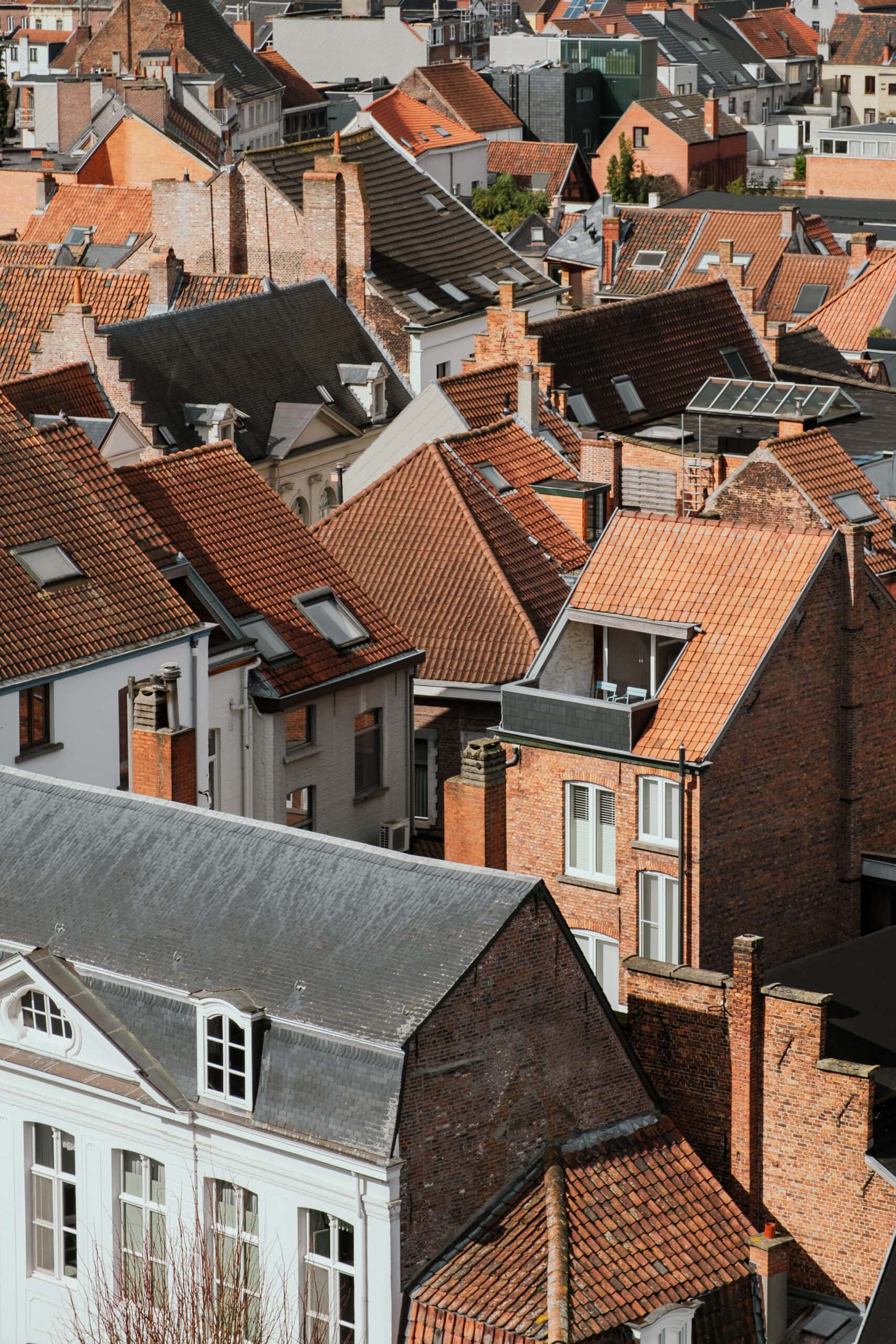
While the history you learn in the audio tour is interesting, I must admit that my favorite part of my visit was enjoying the views of Ghent from the rooftop.
St. Bavo’s Cathedral
St. Bavo’s Cathedral contains one of Ghent’s three famous towers, but it’s even more famous for holding one of Europe’s greatest works of art: The Adoration of the Lamb, more commonly known as the Ghent Altarpiece.
The Ghent Altarpiece was created by brothers Hubert and Jan van Eyck all the way back in the early 1400s. Since then, it has narrowly survived an incredibly tumultuous history, including a religious reformation, both world wars, and more.
Today, the Altarpiece is almost completely reunited in St. Bavo’s (one panel is still missing following an unsolved theft in 1934!), and it’s looking better than ever after a decade-long restoration process.

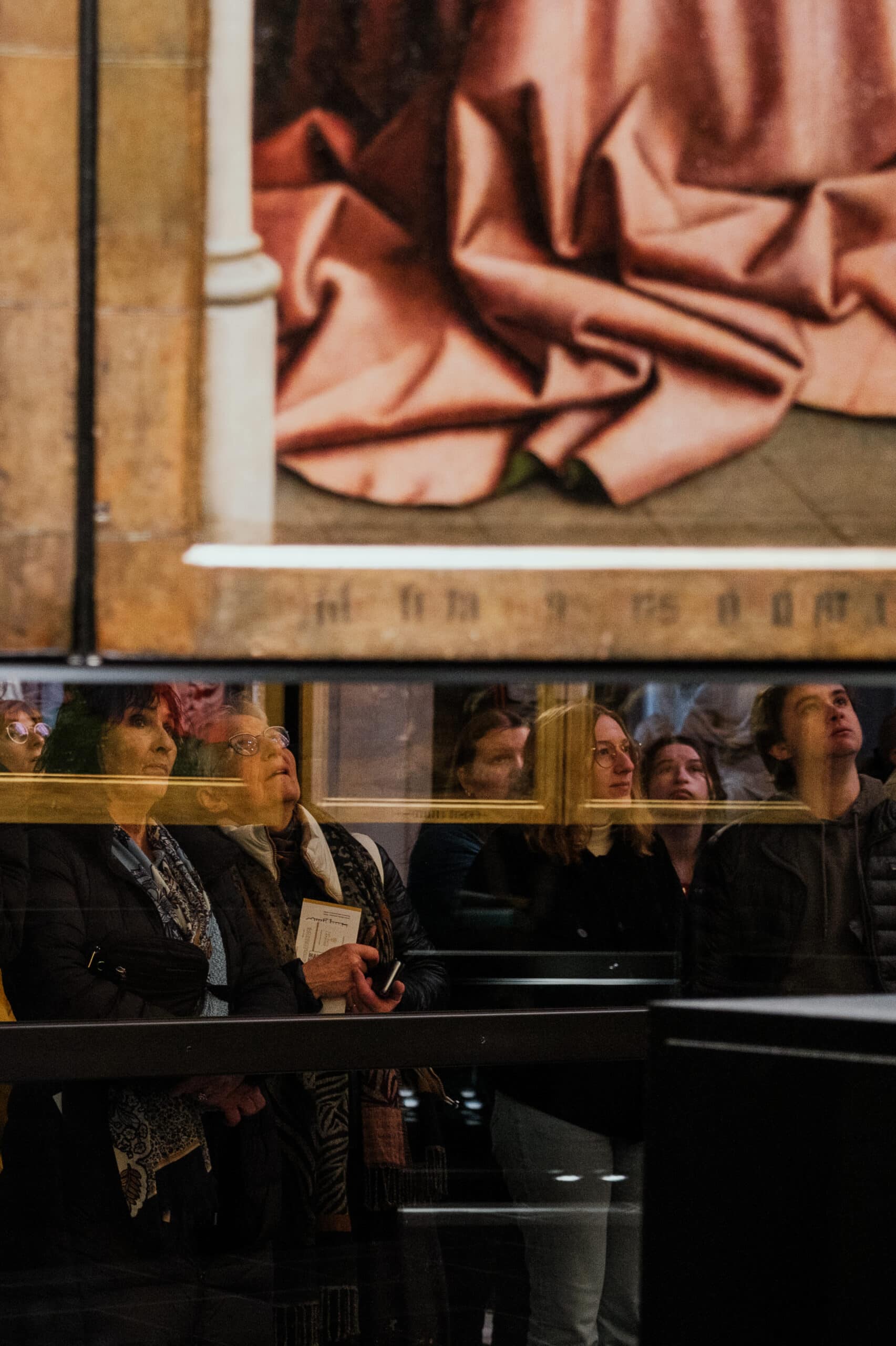
The Ghent Altarpiece is located in a restricted section of St. Bavo’s. To see it, you will need to purchase a ticket. Depending on your time and interest, you can choose a ticket that includes an augmented reality exhibit providing lots of history about the Altarpiece.
Belfry of Ghent
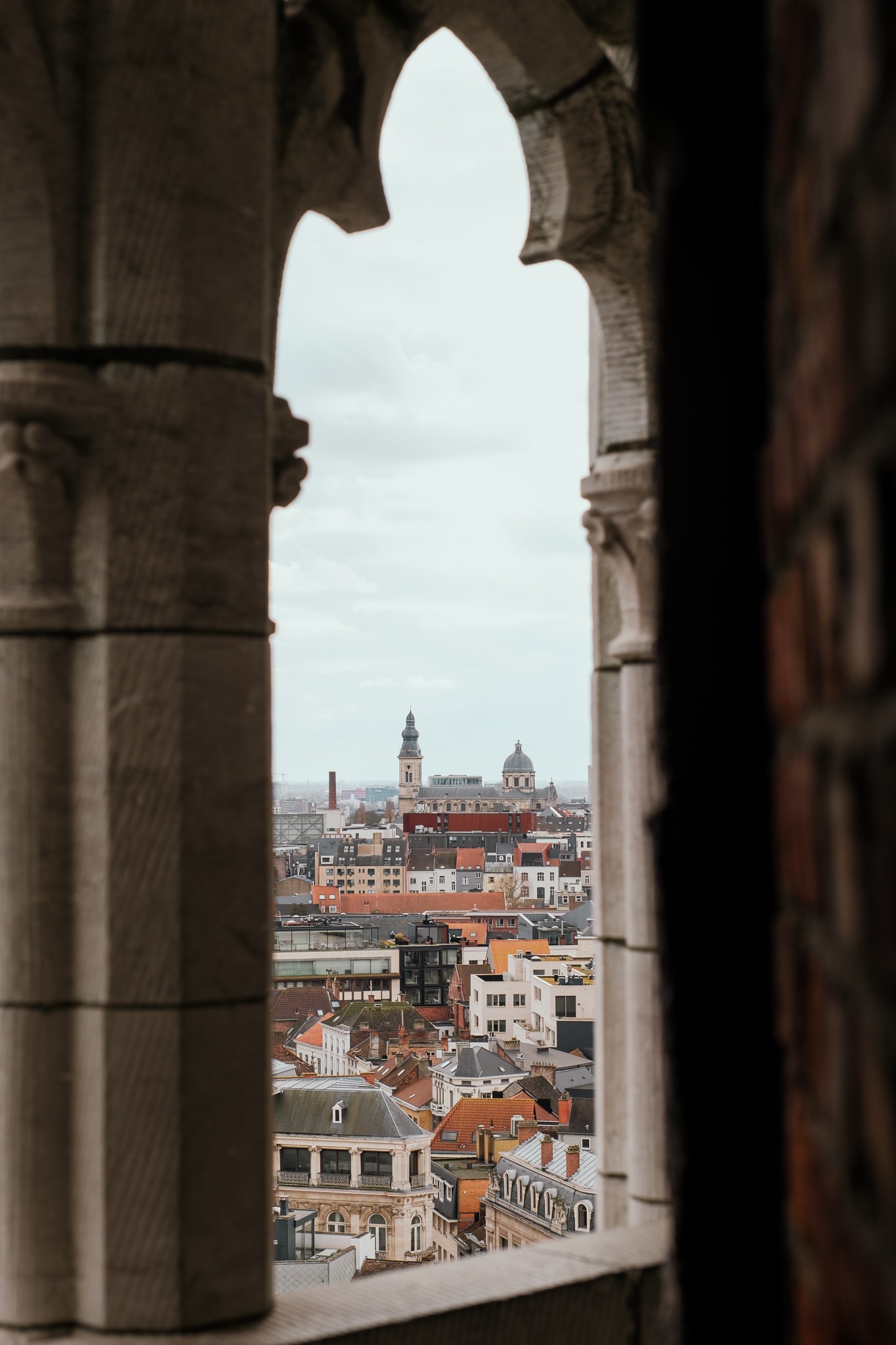
Don’t leave Ghent without visiting its belfry: a 300-foot tall bell tower with incredible views from the top.
Thankfully, you won’t need to climb the whole way up, as there’s an elevator that will take you much of the way. In fact, you’re explicitly instructed to take the elevator and NOT try to climb. That’s because the stairway is extremely narrow at parts and there would not be room for people to climb up at the same time that people are walking down.
At the top, there is a very narrow viewing area that goes the whole way around the belfry, so you get 360-degree views of the city.

Day 3: Day trip to Bruges
Another wonderful and very popular day trip from Brussels is the medieval city of Bruges. While Bruges will be full of tourists no matter when you go, it’s beloved for a reason: it’s exceptionally well-preserved. That’s largely because the city fell into poverty years ago and didn’t have the money to replace its medieval architecture with more modern buildings.
Though Bruges is small, there are lots of wonderful things to do during a day trip, including:
Walking Tour
Thanks to its compact center, Bruges is the perfect place for a walking tour. I recommend starting your day in Bruges with a walking tour so you can learn the relevant history for the things and places you’ll see as you explore the town.
Check availability for one popular Bruges walking tour here:
Belfry of Bruges
Unlike in Ghent, there’s no elevator to take you up the Belfry of Bruges: you’ll have to climb all 366 stairs yourself. It’s no easy task, especially if you’re short and afraid of heights like me (those stairs are slick, narrow, and steep!), but it’s doable for most people of average fitness or better.


Canal Cruise
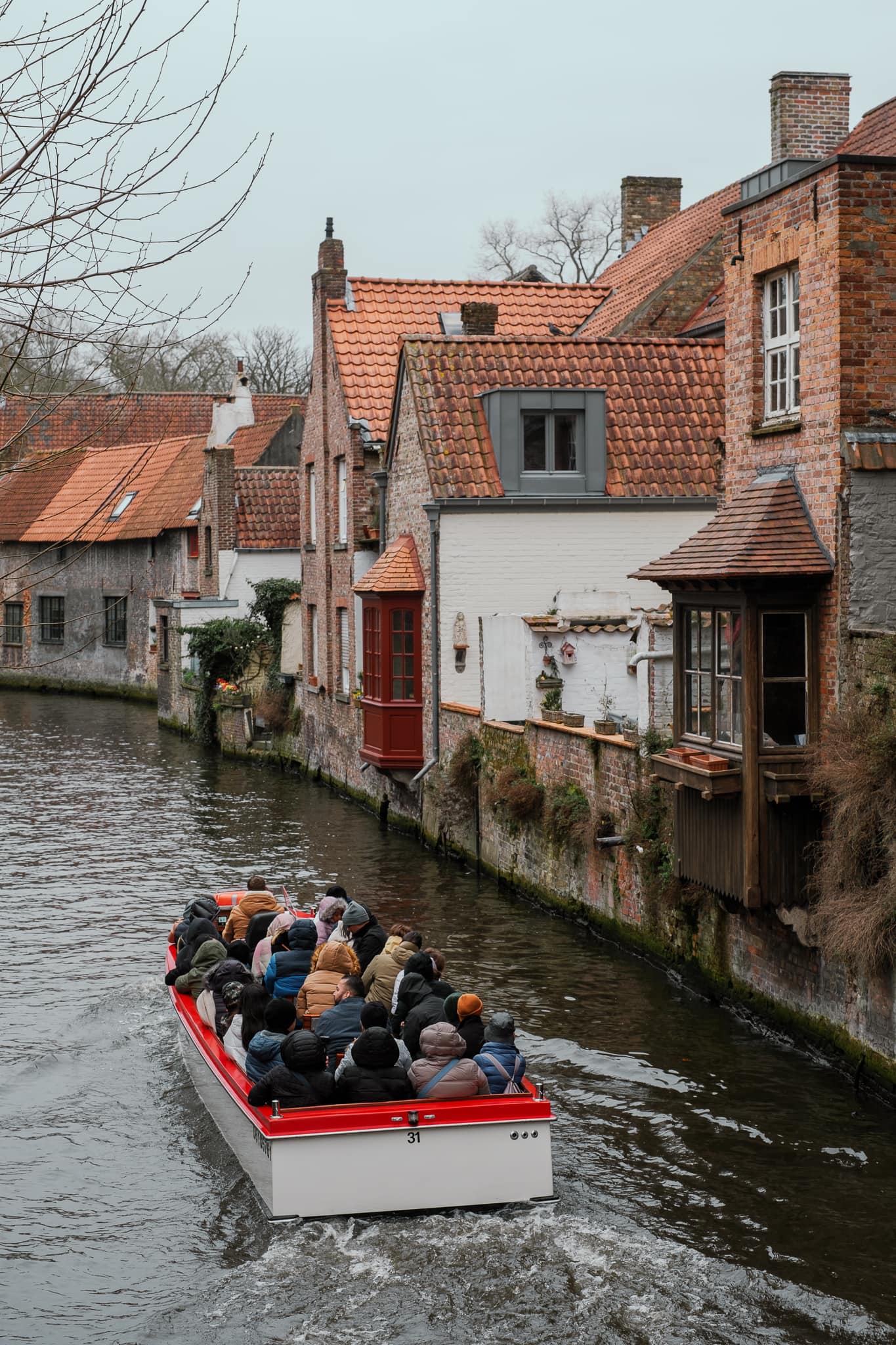
A classic way to spend 45 minutes in Bruges is to take a tour of its famous canals.
Canal tours depart from a handful of points throughout Bruges, and you will easily find one by just walking along the canals. (If that’s too stressful, head to Rozenhoedkaai.)
Every boat gives the same tour for the same price, so don’t worry about finding the best one. They also don’t leave at set times, but will depart when the boat is full enough.

House of Waffles
Gastronomically, Belgium is famous for (at least) four things: beer, chocolate, waffles, and fries.
If you like, go nuts taste-testing all of these things wherever you go in Belgium, but I highly recommend prioritizing the waffles at Bruges’s House of Waffles. They are wonderful: crispy, fluffy, and perfectly sweet, with the toppings of your choice.
If you’re given the choice between a Liege waffle or a Brussels waffle, go for the Liege.

Begijnhof
For a totally different vibe, visit Bruges’s Begijnhof, or Beguinage. This is a place where, centuries ago, unmarried women — who were religious, but unwilling to take the vows of a nun — formed a community where they could live pious lives within, but separate from, the greater city.
Today, the Beguinage is occupied only by a few elderly nuns. If you, like me, visit in the early spring, you may also be lucky enough to see that it is also occupied by lots of daffodils.

Day 4: Day trip to Dinant
Compared to Ghent and Bruges, Dinant is a lesser-known city in Belgium. It’s deep into the country’s French-speaking Wallonia region, lying just 20 kilometers away from Belgium’s border with France.
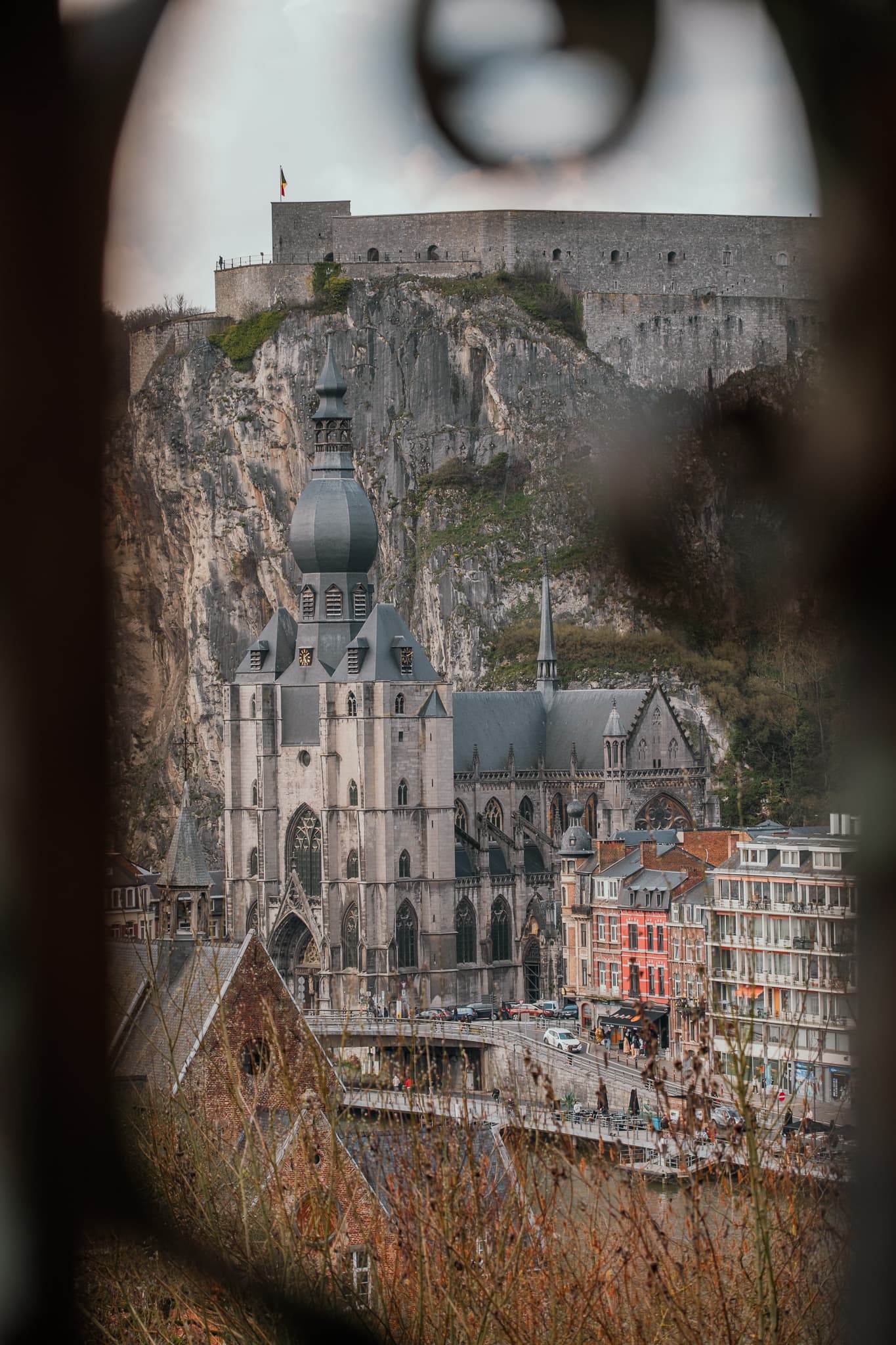
Dinant may not get as much attention as the larger cities of Ghent and Bruges, but I think it’s fabulous. It features one of the most striking city views I’ve ever seen, with a row of colorful buildings lining the river below the unique onion dome of Dinant’s Notre Dame Cathedral. Above it all, the Citadel of Dinant is perched on a steep cliff.

Technically, during your day trip to Dinant, you can also squeeze in a visit to the Belgian city of Namur. However, unless you’re a big military history buff, I don’t recommend this, and would suggest that you should spend the whole day in Dinant.
Here are a few of the things you can do in Dinant:
Notre Dame de Dinant
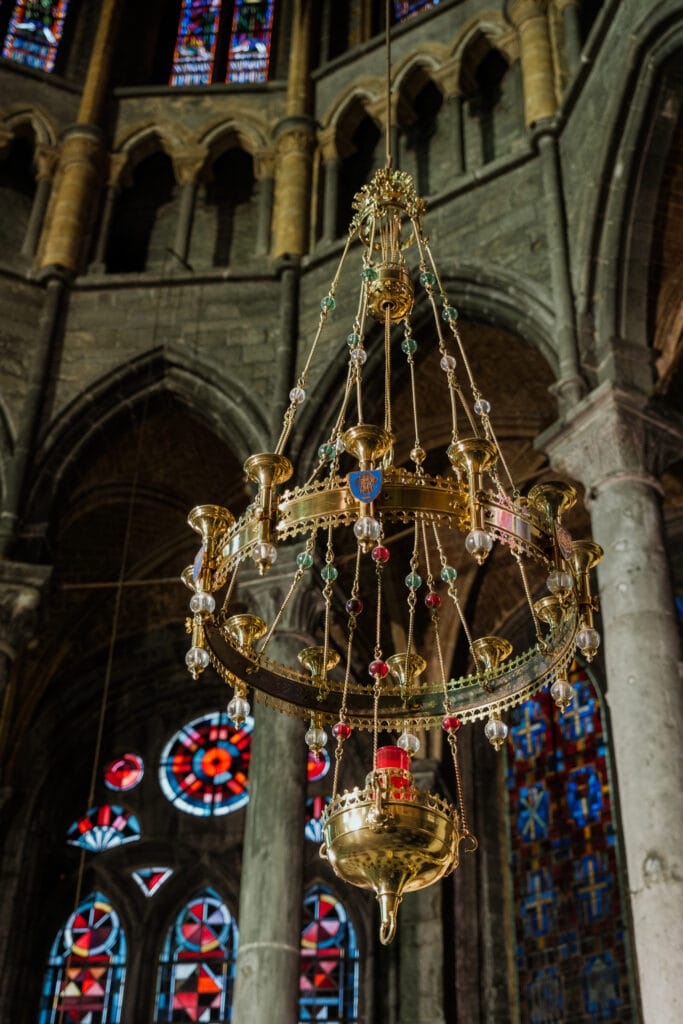
Dinant’s cathedral is most famous for its exterior, but take a few minutes to step inside as well and admire the massive stained glass window and moody Gothic design.

Citadel of Dinant
If you do one thing in Dinant, make it a visit to the citadel.
The Citadel of Dinant has presided over the city for centuries, playing a role in major world events such as World War I (when Dinant was invaded by the Germans). Today, you can tour the citadel and learn about its history through a wide variety of exhibits. The citadel also offers great views of the city.


You can reach the citadel in two ways: a brief cable car ride, or by walking up 408 (very) steep stairs. Note that the ticket price is the same, no matter what you choose.
Boat Ride on the Meuse River
For a more relaxing Dinant experience, take a boat ride down the Meuse River.
When you buy your ticket to the citadel, you can actually buy a combination ticket that includes a boat ride, which will save you a few dollars.
Otherwise, just head down to the water and look for departure points. I boarded a boat at Quai 4, and enjoyed a 45-minute journey down the river and back to town.

Maison Leffe
If you’re interested in beer — its history and creation, or just its taste — don’t miss Maison Leffe. This beautiful former monastery is now a hotel and a museum about Leffe beer (a Belgian abbey beer brand). You’ll even get to taste some beer at the end.
Maison Leffe sits up on a hill across the river from the cathedral and citadel, so it also provides some great views of the prettiest part of Dinant.
Day 5: Train to Amsterdam
It’s time to leave Belgium and head for the Netherlands. Your next home base will be Amsterdam, where you will spend several days exploring the city and other days taking day trips to other places in the Netherlands.
Trains from Brussels to Amsterdam take about two hours. If you like, you can stop for a few hours in the Belgian city of Antwerp.
Antwerp, the second-largest city in Belgium, is a very modern city. However, it’s retained some of its historic charms, and is worth a visit to see both sides.
It’s not difficult to stop in Antwerp on the way from Brussels to Amsterdam, even if you don’t want to drag your bags all around the city. There are luggage lockers in the (absolutely beautiful) Antwerp train station, where you can store whatever you want while exploring the city. I paid $11.81 to store my suitcase in the train station while I walked around Antwerp.


Here are a few things to see during your stop in Antwerp:
Grote Markt
Antwerp’s main square, Grote Markt, is famously beautiful, with a decked-out town hall and a row of magnificent guildhalls.
In the center of the square lies a large fountain commemorating Brabo, a local legend who is said to have cut off a giant’s hand and thrown it into a river. During my visit, the giant’s hand had been amusingly replaced by a large yellow hand — part of a fountain restoration project.

Cathedral of Our Lady
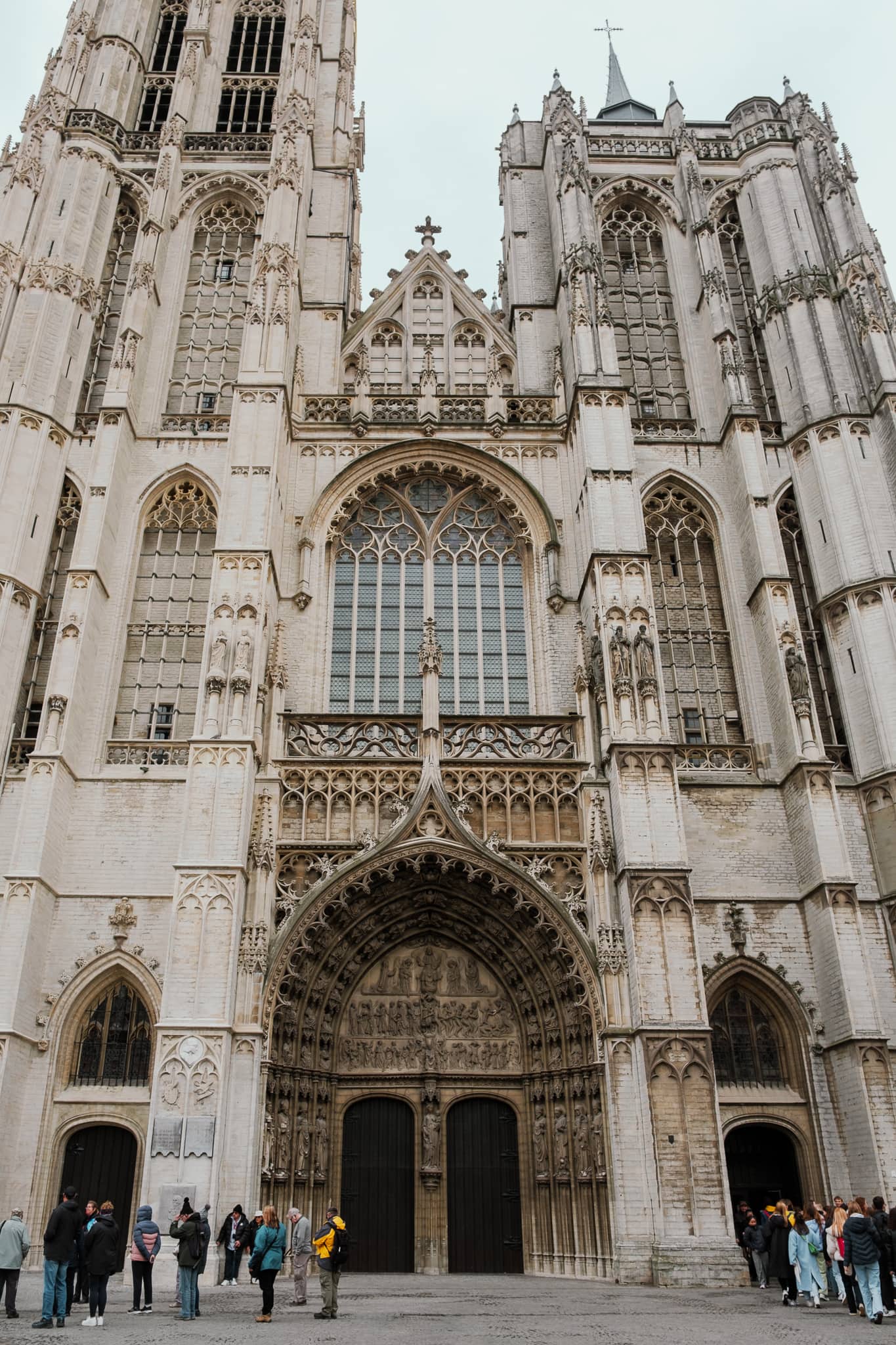
Antwerp’s oldest cathedral, the Cathedral of Our Lady, is a must-see. Just a few steps off of Grote Markt, Our Lady features asymmetrical towers and beautiful stained glass.
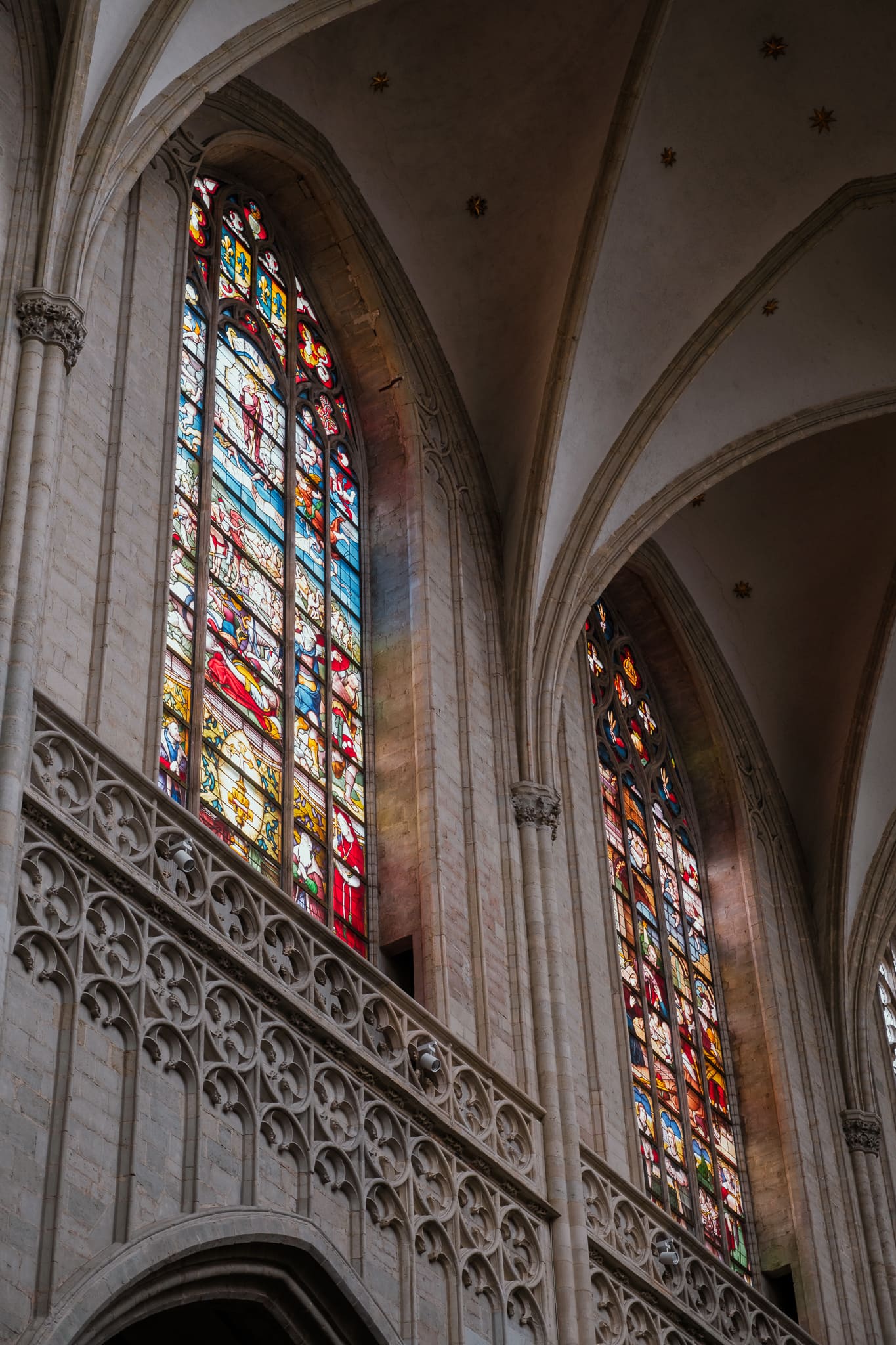
Het Steen
At more than 800 years old, Het Steen is Antwerp’s oldest surviving building. It’s a 13th-century castle that has served many purposes over the years.
Today, Het Steen (or “The Stone”) holds Antwerp’s visitors center and exhibits about the city. It also serves as a cruise terminal.
Arriving in Amsterdam
When you arrive in Amsterdam, check in at your lodging and drop off your luggage.
Where to Stay in Amsterdam
I stayed at Travel Hotel Amsterdam, an inexpensive hotel near the train station. I recommend it if you aren’t too fussed about the amenities or decor of your lodging, and prefer to prioritize cost and convenience.
For some other hotel options, consider these places:
BUDGET | Affordability is tough to find in Amsterdam, but Durty Nelly’s Inn offers inexpensive capsule beds and a super walkable location.
COMFORT | Snag a room with canal views at ibis Amsterdam Centre Stopera.
LUXURY | Located just steps from the Anne Frank House, The Pavilions hotel offers classic decor and plenty of amenities.
If you have the energy after your busy day of travel, head out and explore the city.
During my first evening in Amsterdam, I squeezed in a visit to Oude Kerk — Amsterdam’s oldest building, which now essentially serves as a very cool art museum. I also enjoyed a few hours of wandering along the canals, getting acquainted with the city for the first time.


Day 6: Explore Amsterdam
On your first full day in Amsterdam, gear up for some solid museum time. Today you’ll visit the Rijksmuseum — Amsterdam’s largest art museum — and the Van Gogh Museum. While I wouldn’t ordinarily recommend that you plan to visit two art museums in one day, these museums are located quite close to each other and not nearly as close to many of Amsterdam’s other top attractions, so it does make sense to visit them back to back.
Rijksmuseum
Start your day at the Rijksmuseum. I recommend buying a ticket ahead of time so you can get started as quickly as possible. Go for the earliest time slot, which ordinarily is 9 a.m.
Upon entering the museum, I recommend making a beeline for its most famous section, the Gallery of Honour.
This space is the star attraction of the Rijksmuseum, and it fills up with people quickly (and thoroughly). Give yourself the best chance to appreciate its artistic treasures without fighting through hordes of people by going there first thing in the morning.
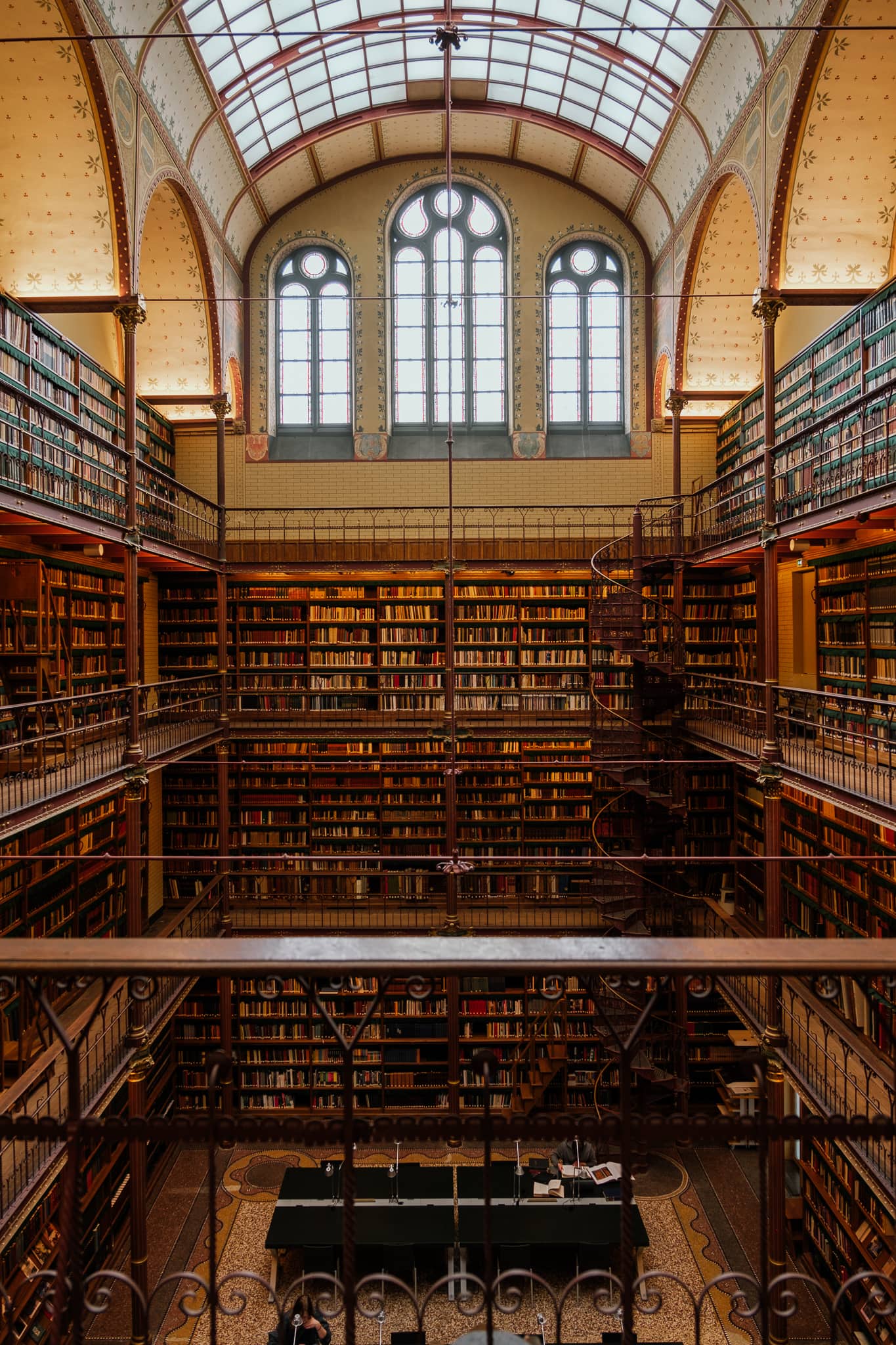
While you’re on the second floor, don’t miss the spectacular Reading Room — the stuff of dreams for big readers like me.

Lunch
In the early afternoon, find a place to eat lunch.
There are some street food options near the museums, which could be nice if the weather is good.
During my visit, it was raining, so I ate indoors at Blushing — a cafe that serves healthy, tasty food. This was a great place to rest my feet and take a break from art.
Van Gogh Museum
Next, head to the Van Gogh Museum.
Heads up that you should absolutely buy your ticket to the Van Gogh Museum in advance, especially if you are visiting in the afternoon, as it often sells out (it was sold out during my visit on a random weekday in March — the off-season).
In terms of timing, I went for the 2 p.m. entrance to Van Gogh. This forced me to leave the Rijksmuseum just a bit earlier than I would have preferred, but your mileage may vary. That said, the Van Gogh Museum is fairly small and does not require an enormous amount of time to thoroughly explore, so you could probably safely book a later time if you think you will want more time in the Rijksmuseum.
Amsterdam’s Van Gogh Museum holds the world’s largest collection of Vincent Van Gogh’s work. It’s a great place to get an overview of Van Gogh’s life and learn about what inspired his art.
Be warned, though, that the museum can get very full — so full that it may detract from the experience.
Because of this crowdedness, my favorite part of the museum was a special exhibit about Van Gogh’s family (located on a different, less-crowded floor). It explained how, after Van Gogh’s premature death, his brother, sister-in-law, and nephew, devoted themselves to preserving Vincent’s legacy and ensuring that the world saw his work. I found it very touching!


Relax at a brown cafe
Amsterdam is famous for its “brown cafes” — essentially, traditional pubs with cozy decor and, often, tobacco-stained wallpaper. They’re a lovely place to hole up and people watch, especially after a long day of looking at art.
My favorite cafe was the historic Cafe Papeneiland, though I also liked Cafe de Poort (which had the better apple pie!).


Day 7: Day trip to Utrecht
One of the many wonderful things about visiting Amsterdam is that it’s extremely easy to take day trips to other places in the Netherlands.
For your first day trip, I recommend heading to Utrecht, a charming college town with its own lovely canal system. It’s only about 25 to 30 minutes away from Amsterdam by train.
Here are a few things you can do in Utrecht:
Dom Church & Dom Tower
Don’t miss Utrecht’s most iconic feature, Dom Tower.
The tallest church tower in the Netherlands, Dom Tower was originally connected to the nearby Dom Church. However, during a major storm in the 17th century, the church’s nave (which was still under construction) collapsed and was never rebuilt.
Today, an empty plaza lies between Dom Tower and the remaining sections of Dom Church.

Climbing Dom Tower is one of the most popular things to do in Utrecht. It’s no easy task, at 465 stairs, but I’m told it’s well worth the effort!
Unfortunately, during my visit in March 2023, Dom Tower was in the midst of a major restoration project, and was completely covered in scaffolding. I read that the scaffolding partially blocked the views from the top of the tower, so I opted out of visiting the tower this time.
Thankfully, though, the restoration project was completed in 2024, so visitors are once again able to enjoy clear views from the tower!
Walk the Wharfs
Utrecht’s canals have an unusual feature: wharfs lining the water, where you can walk, eat, or even stay.

These wharfs were built to facilitate deliveries and unloading by water. Boats can pull up to the wharf and deliver goods directly to the cellars along the canal. Today, though, these cellars largely serve as restaurants, shops, and even homes.
Rietveld Schröder House
For something completely different, walk or take the bus to the Rietveld Schröder House. It’s a totally unique home built in 1924.
From the outside, it’s somewhat jarring: intersecting panels, lines, and beams form a wide array of 90-degree angles. Inside, the home is decorated in primary colors, and instead of traditional walls, much of the house has sliding panels, which can be moved around to create rooms.
The Rietveld Schröder House has been a UNESCO World Heritage site since 2000. If you want to visit, I recommend reserving your ticket in advance, as they are limited.
Day 8: Day trip to Delft and/or Haarlem
There’s no shortage of wonderful places to take day trips from Amsterdam. While you can’t go wrong, I recommend visiting Delft, Haarlem, or both!
Delft and Haarlem are on the same train line, making it totally possible to visit both in one day. If you choose to do this, it will be a very busy day and likely a tight schedule. However, you will get to see two wonderful cities.
You can visit Delft first, or Haarlem first, depending on your personal preference. If you want to visit the Corrie ten Boom House in Haarlem, where tickets are very limited, it will likely dictate the timing of your day.
Delft
Delft is an extremely charming little city with lovely, narrow canals and several impressive old churches. It’s also the home of Delftware — the world-famous blue and white pottery.
Top sights in Delft include Molen de Roos (Delft’s last surviving windmill), Oude Kerk (Old Church) and its leaning tower, Nieuwe Kerk (New Church) — where William of Orange and most members of the Dutch royal family are buried — and the Oostpoort city gate.


If you have the time, you can also visit the Royal Delft Museum and see how Delftware is created. If you just want to pick up some pottery while you’re in Delft, you can find it in any number of shops (including Royal Delft’s brand store on the main square, near Nieuwe Kerk).


Haarlem
Haarlem is a wonderful microcosm of what makes the Netherlands so memorable: windmills, gorgeous churches, expansive canals, historic city gates, hidden courtyards, busy town squares, World War II history, and more.
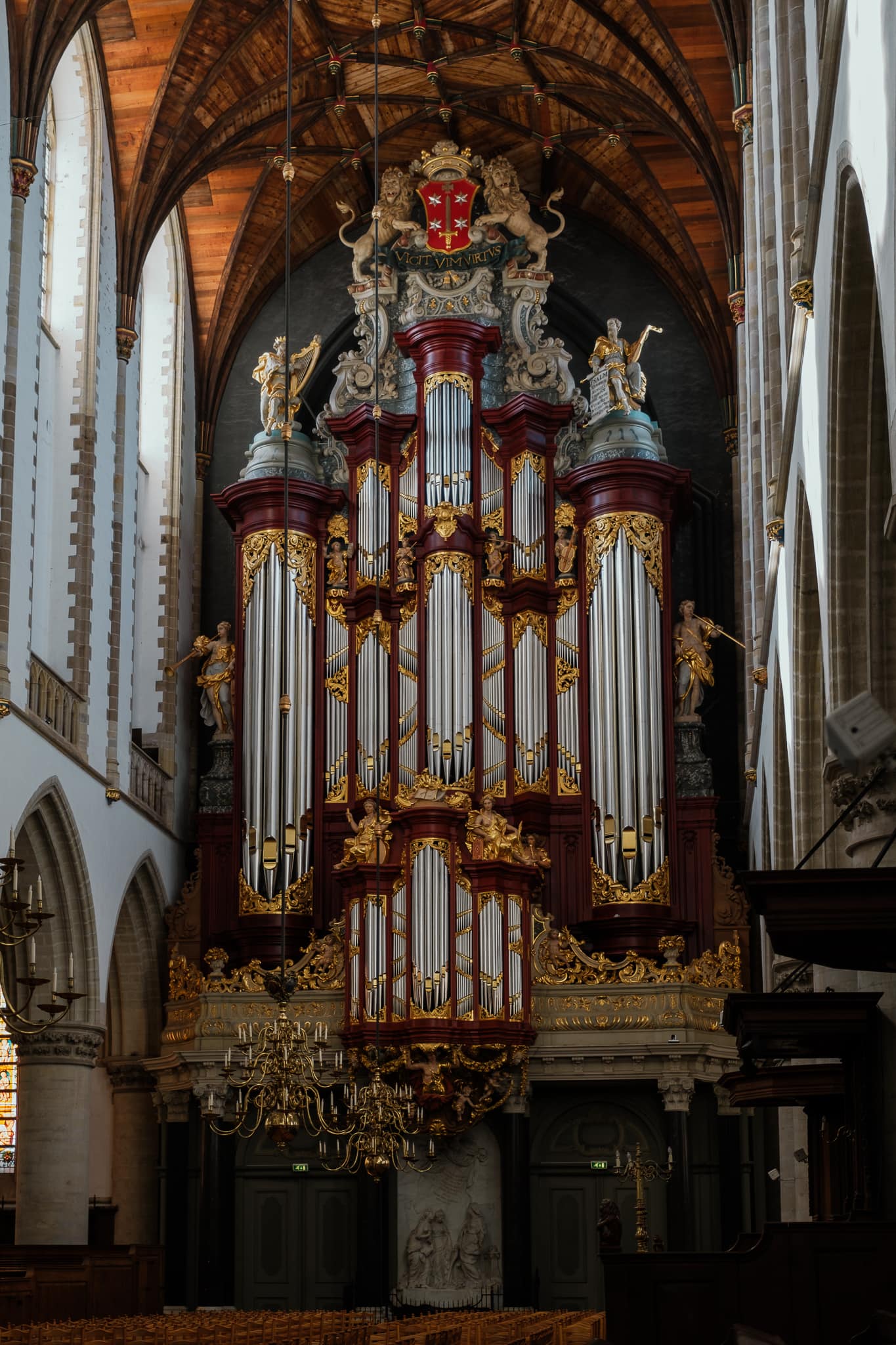
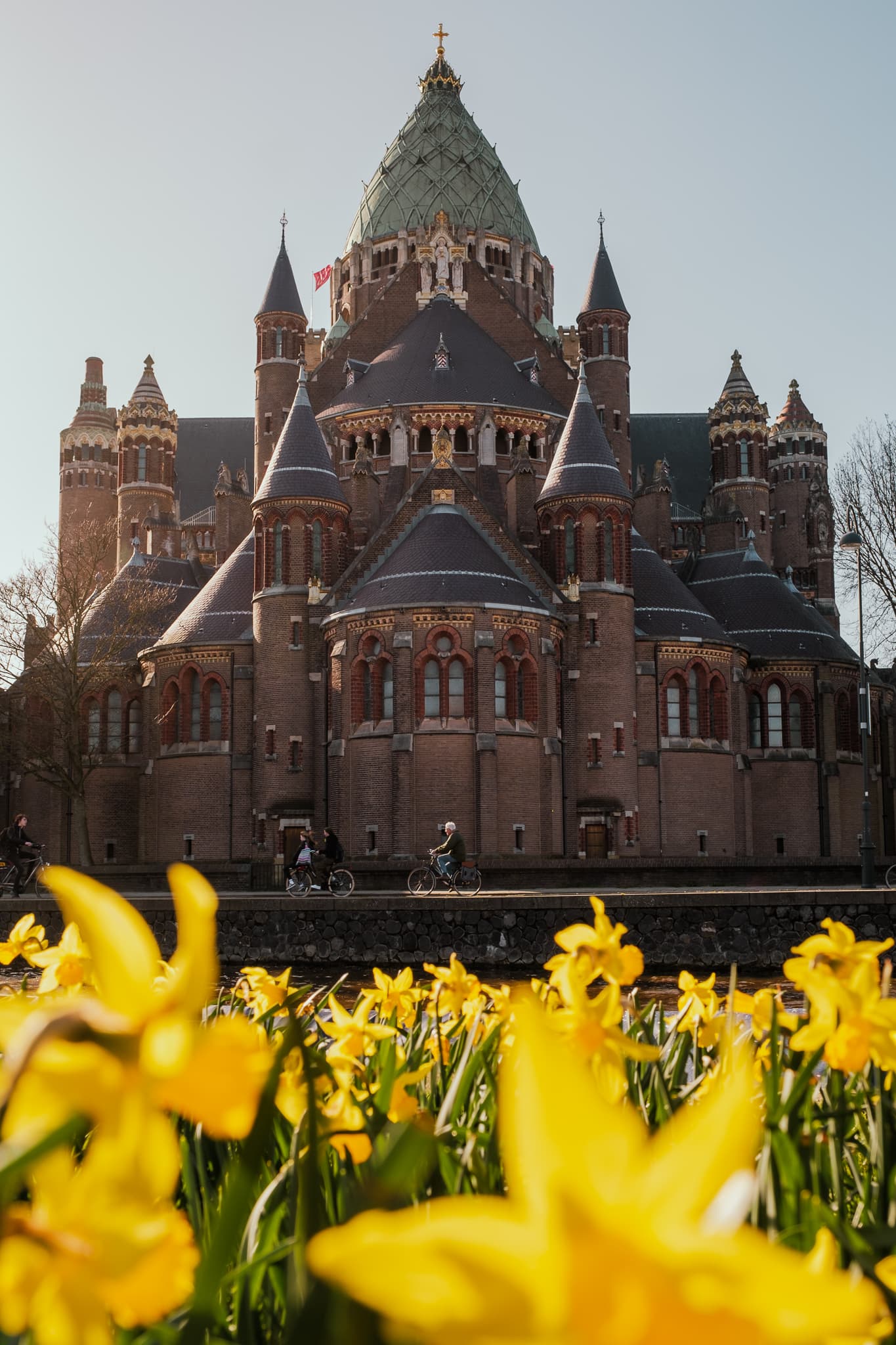
Some of the best things to do in Haarlem include visiting both of its churches named after St. Bavo: St. Bavo’s Church, or Grote Kerk, which boasts a hundred-foot tall organ, and the unusual St. Bavo’s Cathedral, which has a tower you can climb.
In Haarlem, you can also visit the Corrie ten Boom House, where the ten Boom family hid Jews and others in a secret room during the Holocaust. Tragically, after working to save hundreds of people, the ten Booms were turned in by a collaborator and sent to concentration camps, where Corrie ten Boom’s father and sister died. However, Corrie survived, and went on to write a bestselling book, The Hiding Place, and traveled the world to tell her family’s story.
If you want to visit the ten Boom House, you’ll need to book a ticket in advance, as tours are small and limited. (I do strongly advise that you read my review of my experience before deciding whether to visit.) Tickets to the ten Boom House are free, though you are invited to donate at the end of your tour.
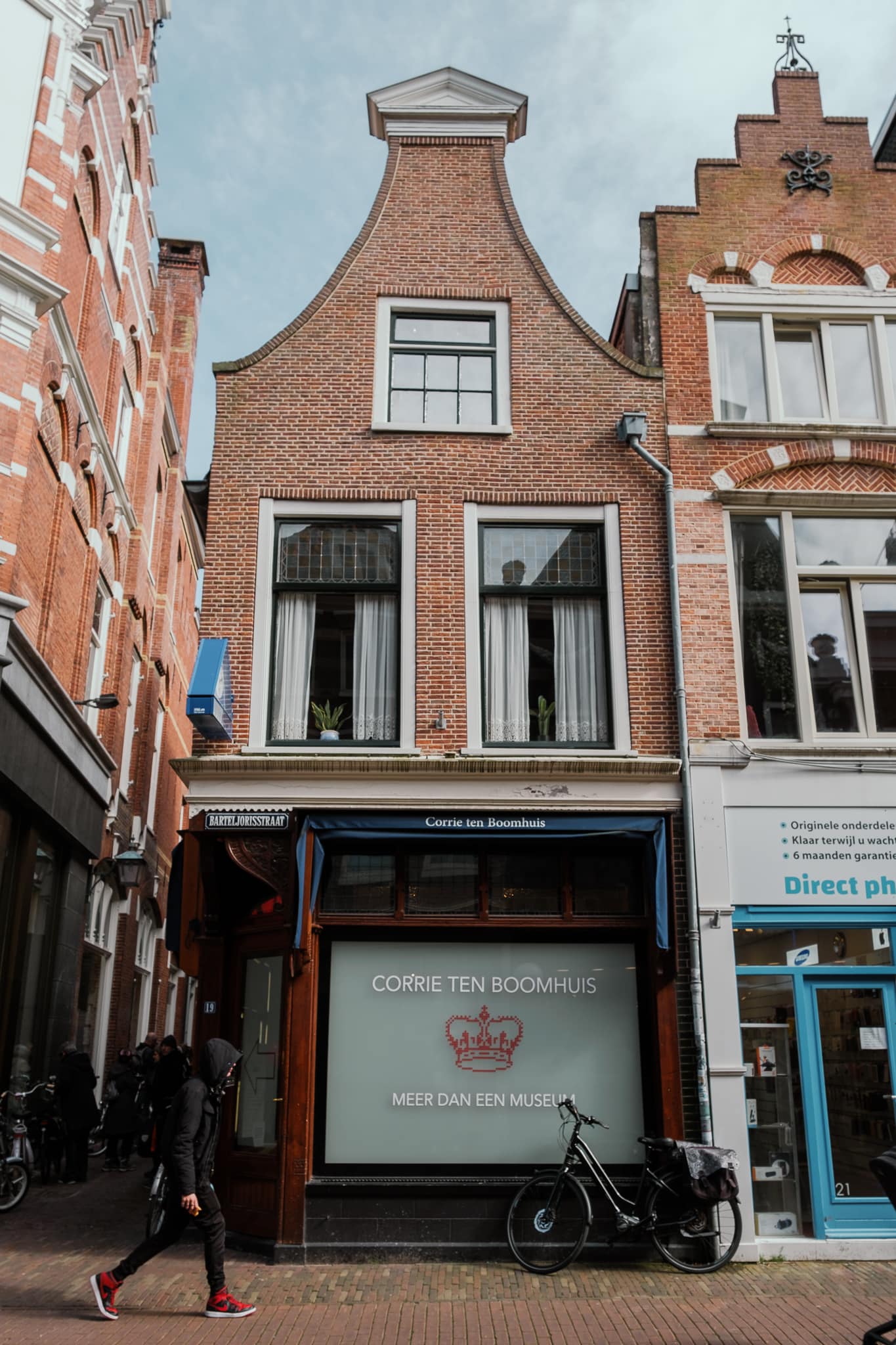
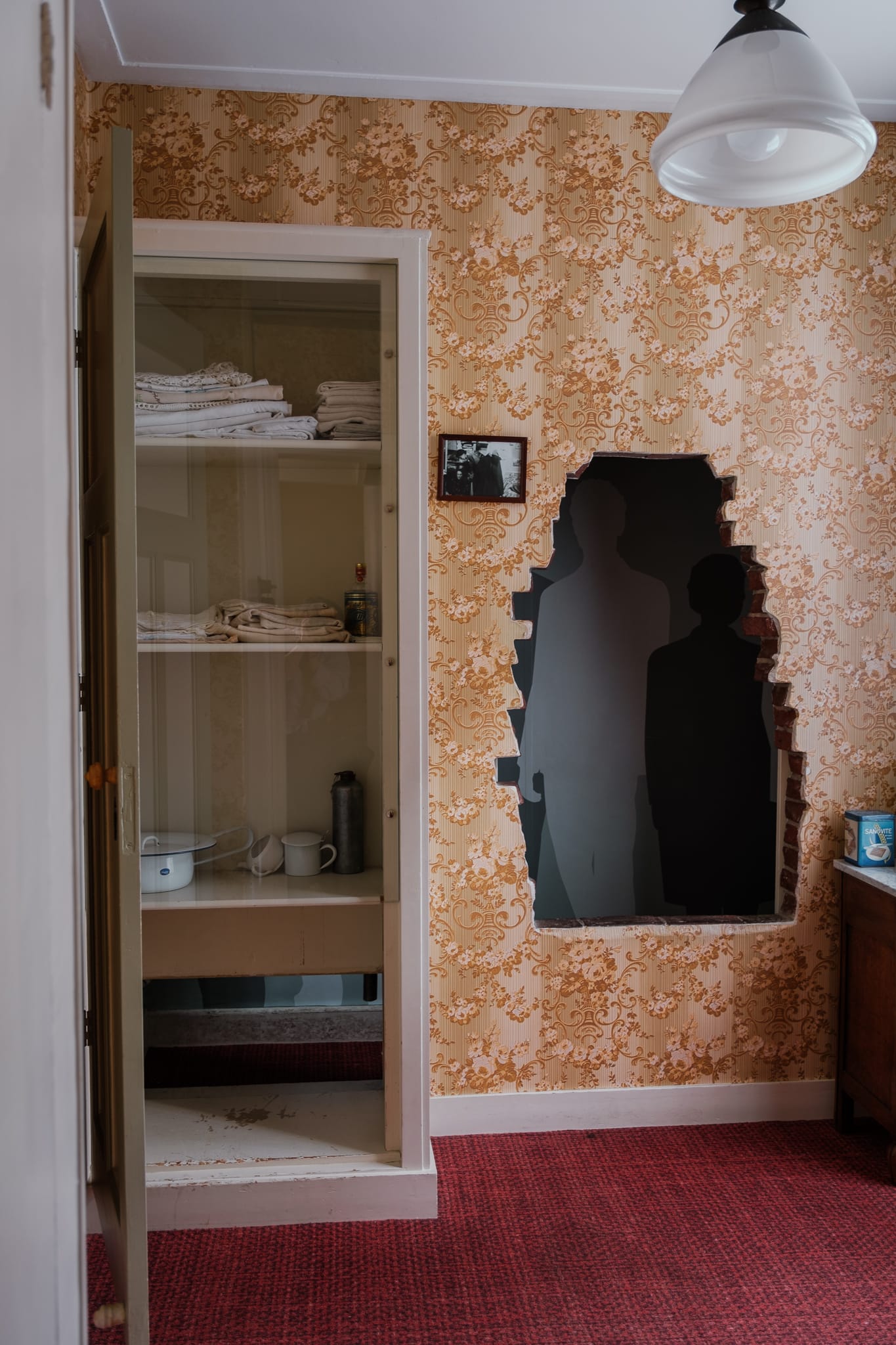
Plus, if you haven’t had your fill of museums in Amsterdam, Haarlem’s Frans Hals Museum and Teylers Museum get rave reviews.
Day 9: Explore Amsterdam
Begin your last full day in Amsterdam at the Anne Frank House.
You probably know the story, at least to some degree: in the early 1940s, after the German occupation of the Netherlands, the teenage Anne Frank and her family (plus four other people) began living in a secret annex in an Amsterdam building. After two years in hiding, the annex was discovered by Nazis and its residents sent to concentration camps, where nearly all of them were killed. Anne’s father Otto survived, and soon published Anne’s diary, which has become one of the most famous books in the world.
Today, you can tour the building where the Franks hid, including the secret annex. The annex and other rooms are mostly empty (and have been since the original Nazi raid), but a wonderful audio guide tour, as well as many videos and informational signs throughout the building, do an excellent job of conveying the history of the war, the space, and the Frank family.
If you want to visit the Anne Frank House, it’s essential to buy your ticket well in advance. Tickets go on sale every Tuesday at 10 am CEST for dates six weeks later. Make a note in your calendar for the Tuesday six weeks before the date of your visit, and buy your ticket as soon as possible.
I also recommend checking out Our Lord in the Attic, a museum featuring a small Catholic church in the upper floors of a regular Amsterdam home. This church was created during the Protestant Reformation, when Catholicism was outlawed in Amsterdam. Catholics still gathered to worship during this time, but they had to do it secretly, in hidden churches like this one and others.

With the rest of your day, you can relax at another brown cafe, visit the tranquil Begijnhof community, rent a bike and join the chaotic fray of wheeled vehicles in Amsterdam, or simply walk around and admire the beautiful views along the canals. I also highly recommend taking a boat tour on the canals and seeing the city from some new angles.

Check availability for the canal cruise I took here:
READ MORE | 10 Things to Do During Your First Time in Amsterdam
Day 10: Depart Amsterdam
On the final day of your trip, check out any other parts of Amsterdam you’ve missed before departing.
If you’re leaving by plane, it’s easy to reach Schiphol Airport by public transportation, with trains leaving from Amsterdam Centraal every few minutes.


Belgium and Netherlands Itinerary: Interactive Map
Below is a map with the locations included in this itinerary. To use this map during your own trip to Belgium and the Netherlands, click the star next to the map’s name (which saves the map to your account). You can then find and use the map from your Google Maps app by going to “Saved,” then “Maps.”
Final Thoughts
My 10-day trip to Belgium and the Netherlands was one of my favorite experiences in Europe to date — these are wonderful countries to visit and I could imagine returning again and again, if given the opportunity.
I hope this itinerary makes you love Belgium and the Netherlands as much as I do!
More Information About Belgium and the Netherlands
EXPENSES | Here’s how much I spent for 10 days in Belgium and the Netherlands.
MORE TRAVEL INSPIRATION | See which Belgian cities are among 8 fairy tale destinations to visit in Europe.
DAY TRIPS FROM BRUSSELS | Dig into a day trip to Ghent, a day trip to Bruges, or how to visit Namur and Dinant in one day.
GHENT ALTARPIECE | Everything you need to know about how to visit the world-famous Ghent Altarpiece.
THINGS TO DO IN AMSTERDAM | Find 10 excellent things to do during your first time in Amsterdam.
DAY TRIPS FROM AMSTERDAM | Decide whether to visit Delft, Haarlem, or Utrecht, or learn how to visit Delft and Haarlem in one day.
pin this post