

A Complete Guide to Visiting the Ghent Altarpiece
The Ghent Altarpiece: one of Europe’s great artistic masterpieces, with a wild history to boot.
Dating to the 1400s, this large painting is a complex series of 20 panels depicting a variety of people and scenes, including angels, Adam and Eve, the people who commissioned the piece, and a bleeding lamb. Indeed, the real name of the Ghent Altarpiece is the Adoration of the Mystic Lamb — the image depicted in the piece’s largest panel.
The Altarpiece is attributed to two painters: Hubert van Eyck designed and began the project, and his brother, Jan van Eyck, finished it after Hubert’s death. (Exactly how much of the work was done by which brother is a matter of ongoing debate in art history.)
Since the piece’s completion in 1432, it has suffered — and mostly survived — quite a lot of turmoil, including the 16th-century iconoclasm that resulted in the destruction of so much other Catholic art, mysterious theft (one of the original panels is still missing!), and both world wars.
Today, the Altarpiece is (mostly!) back where it started: in St. Bavo’s Cathedral in Ghent, Belgium. And, following a decade of major restoration work and the development of a brand new exhibit all about the Altarpiece (which opened in 2021), there’s never been a better time to experience the Adoration of the Mystic Lamb.
For better or worse, visiting this work of art is not as simple as waltzing into St. Bavo’s and walking up to the Altarpiece. While entrance to the cathedral itself is free, the only way to visit the area where the Altarpiece is located is to pay an entrance fee. However, there are several different levels of fees you can opt to pay, depending on the experience you want to have (as well as the amount of time you have).
Here’s everything you need to know about how to visit the Ghent Altarpiece, including my personal recommendations for which ticket to purchase.
What It’s Like to Visit the Ghent Altarpiece
Here’s what to expect when you visit the Ghent Altarpiece.

Entering St. Bavo’s Cathedral
St. Bavo’s Cathedral is located prominently in the old town of Ghent. It’s open between 8:30 am and 5:30 pm on Mondays to Saturdays, and between 1 pm and 5:30 pm on Sundays. However, note that the Ghent Altarpiece exhibit does not open until 10 am on Mondays to Saturdays, and the last entrance is at 4:30 pm every day.
You can enter the cathedral and visit the front half of the building for free, including the nave (where the main aisle is) and the transept (if you think of the cathedral as a cross, it’s the section that forms the arms).
Feel free to explore the nave and transept at your leisure, though I actually recommend heading straight for the area where Altarpiece tickets are sold — if there’s a line, you’ll want to join it as soon as possible.
As seen in the map of the cathedral above, the ticket line and entrance to the paid area are located in the left transept. From the entrance to the cathedral, simply walk down the main aisle and turn left.
Do not try to enter the paid area without purchasing a ticket; I saw a family attempt this and they were promptly spotted, scolded, and shooed away.


Purchasing Tickets to the Ghent Altarpiece
Once you are in line for tickets, a volunteer may explain your options to you. In short, you have three tickets to choose from:
| Standard Ticket | Master of Detail | Altarpiece Only |
|---|---|---|
| €16 | €16 | €12.50 |
| 40 minutes in total | 60 minutes in total | 25 minutes |
| 20 minutes of the Augmented Reality exhibit | 30 minutes of the Augmented Reality exhibit | No Augmented Reality |
Let me explain those options in a little more detail.
Standard Ticket
With the Standard ticket, your visit begins with an Augmented Reality exhibit in the cathedral’s crypt.
I discuss the Augmented Reality experience in more detail below, but in brief, you are given a headpiece that fits a visor over your eyes. The visor then displays holograms that teach you about the history of the cathedral, the creation and symbolism of the Altarpiece, and the Altarpiece’s turbulent history.
Then, you go back up to the paid area of the cathedral and can view the Altarpiece and other chapels within the cathedral as you wish.
With the Standard ticket, the Augmented Reality exhibit lasts for 20 minutes, and the cathedral estimates that you will spend an additional 20 minutes viewing the Altarpiece and other restricted areas of the cathedral — for a 40-minute visit in total.
A Standard ticket costs €16.00.
Master of Detail
The Master of Detail ticket is exactly the same as the Standard ticket, except a little bit longer. If you buy a Master of Detail ticket, the Augmented Reality exhibit lasts for 30 minutes (instead of the 20 minutes you get with a Standard ticket).
They estimate that people who purchase a Master of Detail ticket will spend an additional 30 minutes viewing the Altarpiece and exploring the restricted areas of the cathedral, for a 60-minute visit in total.
A Master of Detail ticket also costs €16.00.
Altarpiece Only
The Altarpiece Only ticket skips right past the Augmented Reality exhibit. You will go straight to the (non-crypt) paid area of the cathedral, which includes the chapel holding the Altarpiece.
This ticket is labeled as “25 minutes,” but this is just their estimate of how long you will want to spend in the paid area — don’t worry, they will not kick you out if you want to spend longer than 25 minutes.
The Altarpiece Only ticket costs €12.50.
Note that there is no signage or context provided at the Altarpiece itself. If you want any information about the history or meaning of the Altarpiece, you will need to look it up yourself or experience the Augmented Reality exhibit.
Note that there is also a kids’ version of the Augmented Reality tour, which is recommended for families and is appropriate for ages 6 and up. It costs €8 for kids under the age of 12, and €16 for everyone else.
Here’s what I did:
Because the price was the same, and I had both the time and interest, I opted for the Master of Detail tour.
NOTE: If you purchase your tickets in advance on the website, you’ll see that they list both the Standard tour and the Master of Detail tour as 60 minutes. This differed from the options presented to me in the cathedral (where it was clear that the Master of Detail tour typically takes longer), but it doesn’t really matter. The most important thing is to choose a tour based on your level of interest in information about the Altarpiece. (More on that below!)
Experiencing the Augmented Reality Exhibit
If you purchase either the Standard ticket or the Master of Detail ticket, you will head immediately to the crypt. There, show your ticket to the attendants and they will fit you with an augmented reality headpiece.
The headpiece will immediately begin talking to you and showing you holograms in the space around you. This is not like virtual reality, where you are completely immersed in a digital scene.
Rather, Ghent’s Augmented Reality program just adds holograms (some small, some large) to the space where you are standing. You can still see the crypt around you, and you can see where you are walking. This is important, because you actually will move from place to place throughout the crypt during the course of the exhibit.
Indeed, the first thing the headpiece will show you is where to stand so it can begin your tour. Holograms in the form of footprints will appear on the ground, directing you to the area of the first exhibit.
Throughout your tour, whenever it is time for you to move to a new part of the crypt, your headpiece will show you arrows and footprints to lead the way. Additionally, if you are ever standing in the wrong place, your headpiece will direct you back.
In this way, you simply follow the instructions of your headpiece for the remainder of your time in the crypt. It will lead you around the space, giving you plenty of information about how the Altarpiece came to be, what the panels depict, and what has happened to the work of art over the centuries.
For me, the most interesting part of the tour was near the end, when I learned about the many times the Altarpiece has narrowly escaped destruction, particularly during the world wars and during Europe’s major religious turmoil in the 16th century. Over the years, the Altarpiece has been taken and moved many times, and it feels slightly miraculous that it is safely back in Ghent today. (Well…mostly. During the tour, you’ll learn about the unsolved theft of one of the original panels!)
Each person’s tour is individual to them, because it is contained entirely within the headpiece. While you will often be standing near other people who are at roughly the same point in the tour as you are, you will move at your own pace and and your headpiece will conduct your tour just for you.

When you are done with the Augmented Reality tour, you will return your headpiece to the attendants and follow the signs up to the Altarpiece.
Viewing the Ghent Altarpiece
When you enter the paid area of the upper cathedral, you will be a few chapels away from the location of the Altarpiece. It’s up to you whether to head straight to the Altarpiece or to explore elsewhere in the paid area first. You will have a map that shows you the main points of interest throughout the cathedral.
Whenever you are ready, head toward the back center chapel to find the Altarpiece.
Flanked by stained glass windows in a dimly lit space, the Altarpiece is beautifully displayed behind protective glass. You will be free to examine it for as long as you like. Don’t forget to round the corner to see the back panels.
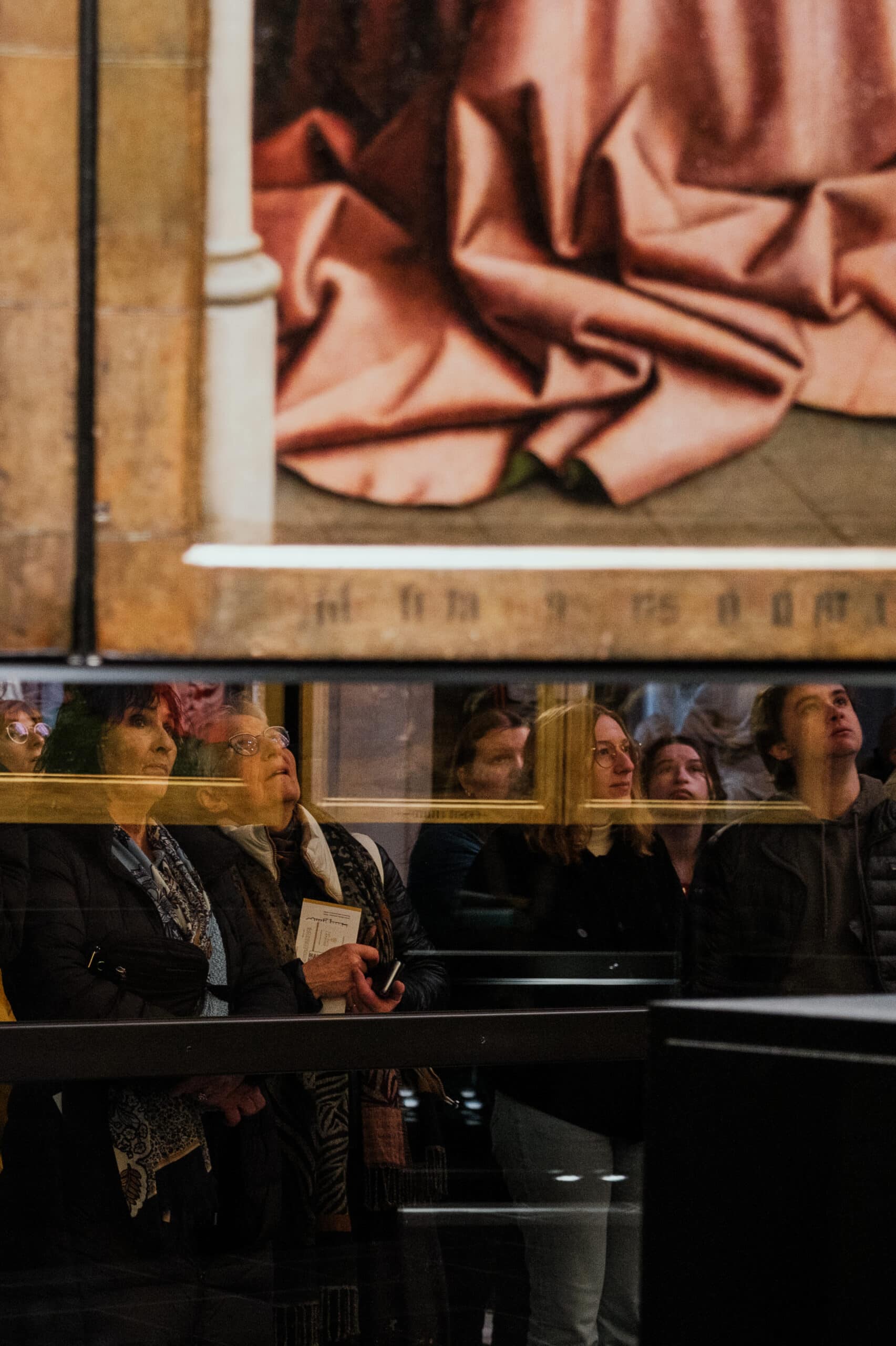

HEADS UP: Some of the Altarpiece’s panels are currently being restored at the Museum of Fine Arts. At present, those panels are replaced by high-definition images, so you’ll still get a sense of the overall experience of the Altarpiece.
If you’d like to see the restoration in action, visit the Museum of Fine Arts on a weekday, when you may be able to see the restorers at work. (They also display the panels on their own on the weekends!)
I also recommend that you spend some time exploring the remainder of the paid area in the cathedral (you did pay for the privilege!).
Among other things, there is a large Rubens painting called The Conversion of Saint Bavo. You can also see the chapel where the Ghent Altarpiece originally sat. Now, there is an empty metal frame in the shape of the Altarpiece. (You might reasonably guess that this is the original frame for the Altarpiece, but no: it’s a work of art by Kris Martin.)


As I said above, I chose the Master of Detail Augmented Reality ticket option, which is estimated to take 60 minutes — and it did take me almost exactly an hour, as predicted, from the time I entered the crypt to the time I left the restricted area of the cathedral.
Visiting the Ghent Altarpiece: What to Know
Here are a few more things you should know before visiting the Ghent Altarpiece, including my recommendations for which ticket to select.
How to Choose Your Ticket for the Ghent Altarpiece
Choose the 60-minute Master of Detail Augmented Reality ticket for €16 if you:
- Would like to learn as much as you can before viewing the Ghent Altarpiece
- Have plenty of time
- Are able to spend a few extra euros
Choose the 40-minute Standard Augmented Reality ticket for €16 if you:
- Want some information, but maybe not that much
- Have a little less time
- Are able to spend a few extra euros
Choose the Altarpiece-only ticket for €12.50, and skip the Augmented Reality tour, if you:
- Already know all you want to know about the Ghent Altarpiece
- Are especially limited on time
- Have a limited budget
Whether or Not to Buy a Ticket in Advance
If you are visiting at a time of particularly high tourism (June to August, around Easter, or during the Christmas season), I would definitely advise that you buy a ticket in advance, especially if you plan to see the Augmented Reality exhibit. There is a limited number of headsets and therefore only so many tickets the cathedral can sell.
And even if you only want to see the Altarpiece and plan to skip the exhibit, note that the cathedral still limits the total number of people who can enter during any given hour, so even the Altarpiece-only tickets can sell out.
If you are visiting during shoulder seasons (spring or fall), it would still be wise to get a ticket in advance if you are able to commit to your arrival time. I’ve read reports of people visiting in April or September and discovering that tickets were sold out.
I visited on a Saturday afternoon in mid-March and had no trouble getting a ticket on arrival, though I did have to wait a few minutes in line.
If you purchase a ticket in advance (click here), you’ll get to skip the line and head straight in when you arrive. You will need to select your entrance time when purchasing, so be certain about when you can reach the cathedral.
If you don’t purchase a ticket in advance, you might consider heading to St. Bavo’s early in the day. This way, if some but not all entrance times are sold out, you can still snag a ticket and organize your day so you know when to return to the cathedral later if necessary.
Bag Storage at the Ghent Altarpiece
If you have a large bag, you will be asked to store it in a locker (for free) beside the ticket line. Large is a relative term here; I was asked to store my regular-sized backpack. The process is easy and volunteers are available to help those who are struggling to figure out the lockers.
Accessibility at the Ghent Altarpiece
The Ghent Altarpiece is wheelchair-accessible, and the cathedral offers or is currently developing special services for those who are blind, deaf, or hard of hearing and would like to experience the tour in the crypt. For current information about the services that are available, please contact the cathedral at the email address listed here.
Final Thoughts
Though the ticket situation can be a little confusing, the Ghent Altarpiece is one of the world’s most important works of art and is well worth a visit during your trip to Belgium. Don’t skip it!
More Information About Belgium
ITINERARY | Follow my detailed itinerary for 10 days in Belgium and the Netherlands.
EXPENSES | Exactly how much I spent for 10 days in Belgium and the Netherlands.
DAY TRIPS FROM BRUSSELS | Learn how to visit Namur and Dinant in one day from Brussels, or how to take day trips to Ghent or Bruges.
MORE TRAVEL INSPIRATION | Learn which Belgian cities are amongst 8 fairy tale destinations in Europe, and which tourist destination in Ghent is a Mennonite history site.
pin this post





beautiful place, thank you for creating this article
This was so helpful with planning my visit – thank you
Wonderful — I’m so glad to hear it! I hope you have (had?) a fantastic time in Ghent.