How to Spend One Day on the Romantic Road
For many tourists, Germany’s famous Romantic Road is one of the most…well, romanticized destinations in the country.
In reality, the Romantic Road is a series of many destinations, with 30ish official stops. While the road is short enough to drive in one day, you’d need weeks to meaningfully explore each stop along the way. But what if you’re super short on time?
If you have just one day to drive the Romantic Road, you have enough time to make quick stops in a few of the road’s best destinations. I followed this itinerary with my family during a recent trip to Europe, and we thought it was a great way to get the highlights of the Romantic Road in a short amount of time.
Here’s what I recommend for one day on the Romantic Road.
This post contains affiliate links. If you make a purchase or a booking through one of these links, I may receive a small commission at no extra cost to you. Thanks for supporting In Old Cities in this way!
Romantic Road in One Day: Know Before You Go
- Morning: Rothenburg ob der Tauber, Dinkelsbühl
- Early afternoon: Nördlingen, Augsburg OR Ulm
- Late afternoon/early evening: Neuschwanstein Castle
What is the Romantic Road?
For a long time, my understanding of the Romantic Road was that it was a scenic drive down a beautiful road…maybe through forests, with beautiful mountains and picturesque villages around every corner??
That turned out to be partly true, but not in the way I had previously imagined.
The Romantic Road was the brainchild of clever travel agents in the 1950s, who observed that the route links lots of lovely German towns and cities. Allegedly, in medieval times, it was an important trade route.
Today, the Romantic Road is a busy road. While you’ll pass some lovely landscapes along the way, what’s most “romantic” about the Romantic Road is not the drive itself: it’s the towns, cities, and sights you can stop to see along the way. Primarily in Bavaria, these places are charming and historic, often conforming to tourists’ ideas of quintessential German towns. (Which is to say that they are generally full of old, half-timbered buildings, impressive cathedrals, and classic town squares.)
Who Is This Itinerary For?
This is a full, fast-paced itinerary intended for people who are limited on time. If you’re able to slow down and spend more time in each of these locations, rather than fitting them into one day, all the better.
This is NOT a way to see the entire Romantic Road in one day. While, as I said above, it’s certainly possible to drive the whole route in one day, it’s simply not possible (or worthwhile) to see every destination on the Romantic Road in one day. And since the destinations are the point, I don’t recommend driving the whole route just for the sake of the drive itself.
One Day on the Romantic Road: An Itinerary
Here’s the itinerary I recommend for seeing the best of the Romantic Road in just one day.
Stop One: Rothenburg ob der Tauber
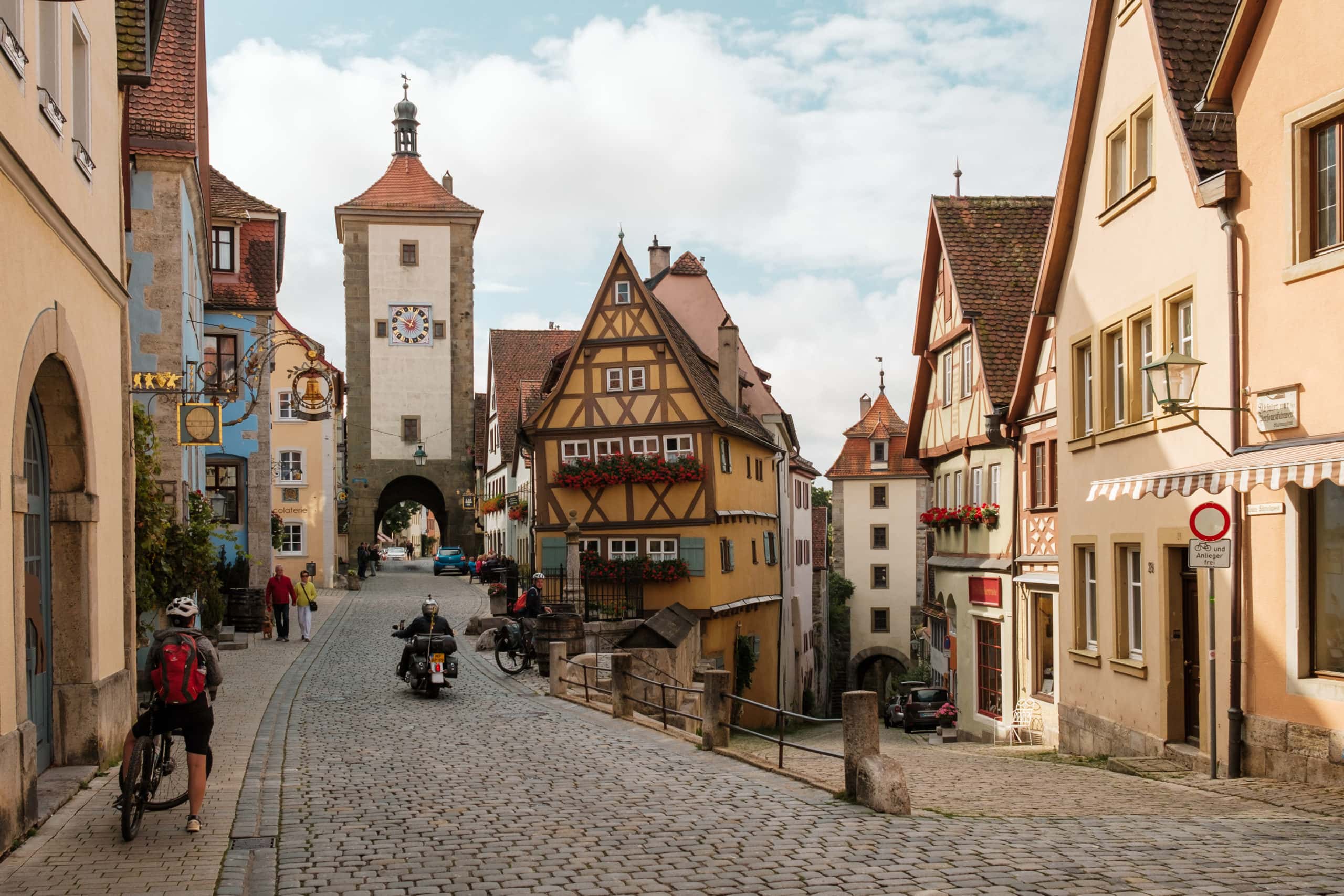
I recommend starting your day in Rothenburg ob der Tauber. And I do mean starting your day there: you should spend the night before in Rothenburg. This town deserves at least a full day of your time, and you’ll see almost nothing if you pop in for just an hour or two on your way down the Romantic Road. (To be fair, this is also true for the other stops discussed below, but when you’re short on time, choices must be made — and Rothenburg is a logical starting place for your day, given its location on the Romantic Road.)
Ideally, you will have spent the previous day (at least!) in Rothenburg odT, and can focus your morning on checking out sights you missed the day before. I recommend waking up early to visit the Plönlein and wander the empty streets before day trippers arrive. Other things you should make sure to do before you leave include climbing Röderturm — one of the few towers that are still accessible to visitors — and walking at least part of the town’s historic walls.


Stop Two: Dinkelsbühl
Next up: Dinkelsbühl, one of Bavaria’s few towns with its medieval wall intact. (Rothenburg odT is another, and spoiler alert: so is your third stop.) Dinkelsbühl is another picture-perfect small German town, with colorful architecture, half-timbered buildings, and an impressive church (St. George’s Minster).


Take some time to wander Dinkelsbühl’s charming streets and to admire the vaulted ceilings in St. George’s Minster. And, if you have the energy, pay a few euros to climb the church’s tower for a sweeping view over town.
Stop Three: Nördlingen
Nördlingen, your next stop, has the unusual distinction of being built in a crater. Unfortunately, you won’t be able to tell unless you…I don’t know, rent a helicopter or something? But the town has lots of virtues in addition to its unusual geological positioning.
Personally, I’m a big fan of some of the wonky buildings in Nördlingen. I can only hope their interiors are more level than their old half-timbered exteriors.


I’m an even bigger fan of Nördlingen’s central church (also called St. George’s!). It’s unusually bright and open, with more incredible ceilings and gorgeous woodwork.


Also, fun fact: Nördlingen is the town the glass elevator flies over at the end of Willy Wonka and the Chocolate Factory.
Stop Four: Augsburg OR Ulm
At this point in your day, you have a choice: you can either continue on the Romantic Road and stop in its largest city (Augsburg), or you can veer off the Romantic Road to see the tallest church in the world (in the city of Ulm).
My family opted for Ulm. Here was our thinking: Augsburg is a sizable city and, given our fast-paced schedule, by the time we got in there and found parking, we’d have barely enough time to see anything meaningful. Plus, we (okay…mostly me) love seeing interesting European churches, and “tallest church in the world” certainly qualifies.


Ulm Minster is simply stunning, and I’m glad we made the choice we did. (I only wish I had a wider lens with me! It’s really……………….so tall.) One of my favorite elements was the huge statue of the archangel Michael presiding over the back of the nave.


I must say, Ulm Minster is also the only church I’ve visited that displays a Lego version of itself.


Stop Five: Neuschwanstein Castle
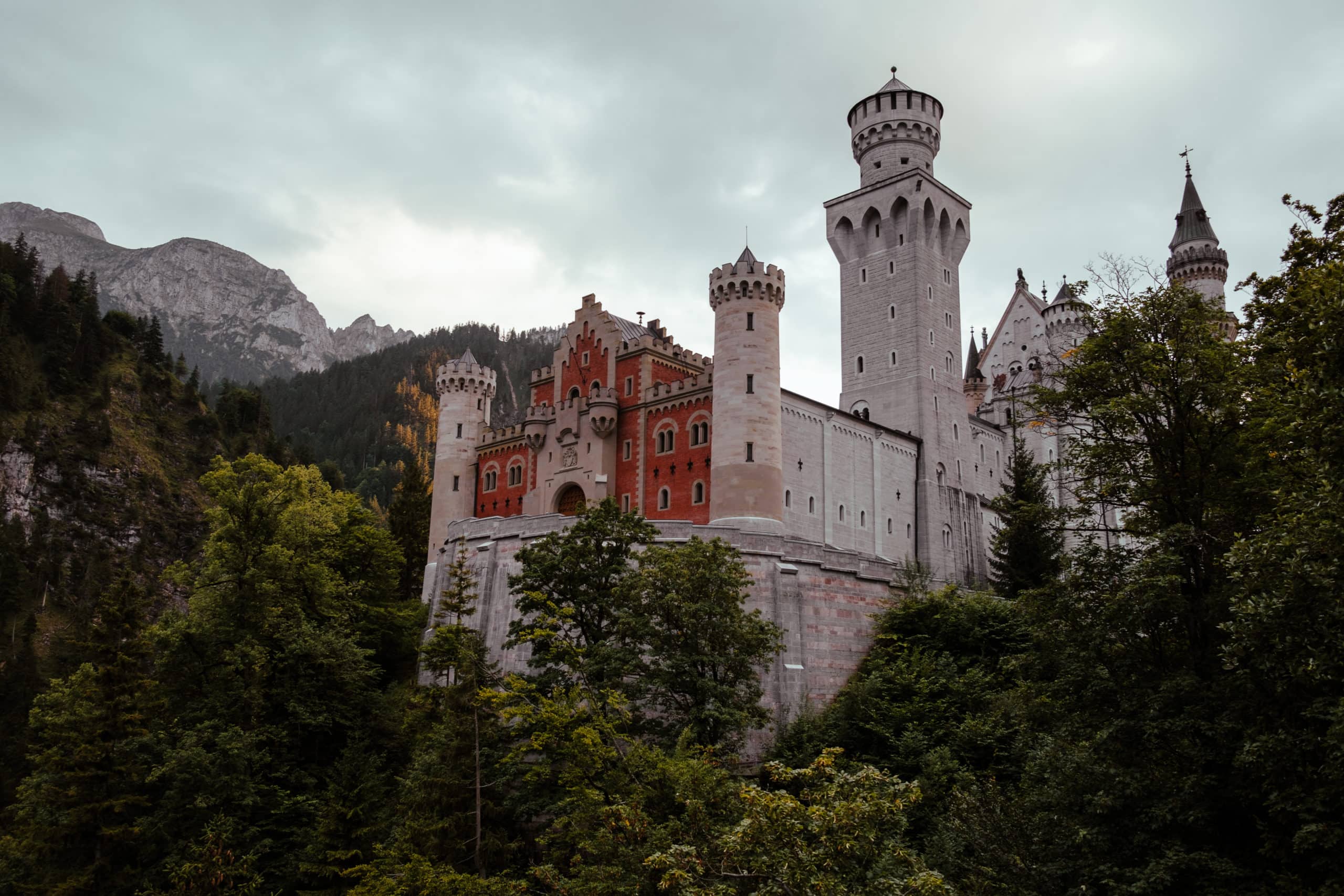
End your day in Schwangau with a visit to the most famous stop on the Romantic Road: the iconic Neuschwanstein Castle.
Neuschwanstein is actually a fairly young castle, with construction beginning in 1869. The castle was commissioned by Ludwig II, the troubled visionary who was King of Bavaria for several decades in the 19th century.
The interior was actually never completed: while construction was ongoing, Ludwig was deposed via questionable evidence of insanity, then died under mysterious circumstances shortly thereafter. However, you can see a few spectacular finished rooms on guided tours, and the castle itself is wonderfully perched on the side of a mountain with beautiful views all around.

There are a few ways you can structure your visit to Neuschwanstein, depending whether or not you want to tour the interior.
- If you want to tour the inside, and have a little wiggle room in your schedule, I recommend doing the tour on the following morning. You can spend your evening at Neuschwanstein admiring the sunset from outside the castle, then get up early and join the first tour of Neuschwanstein in the morning. (Spend the night in nearby Füssen or in one of the hotels located at the base of the castle, like Hotel Müller or Hotel Alpenstuben.)
- If you want to tour the inside, but don’t have time to do it the following day, you’ll need to book it to Neuschwanstein to join the last tour of the day. You may need to cut one of the earlier stops in this day in order to make this happen.
- If you don’t care about touring the inside, I recommend just getting to the castle before sunset. Ideally, you’ll get there at least an hour before so you have plenty of time to walk up to the castle and explore the exterior before it gets dark. If you are unable to walk up to the castle and need to catch one of the shuttle buses, you’ll need to arrive a little earlier, as the buses don’t run throughout the evening. (Alternatively, you may be able to hire a taxi to drive you most of the way up.)
I’ve visited Neuschwanstein twice.
The first time, I joined a group bus tour from Munich, and we toured the castle’s interior. It was okay! I’m glad I did it once, and the completed rooms really are very impressive (especially the throne room and the weird little grotto), but frankly — my favorite parts of Neuschwanstein are all outside the castle.
(You can get a good sense of what the interior tour looks like here, and check current hours and pricing here. I strongly recommend buying tickets well in advance; if you show up hoping to buy tickets for immediate entry, you’re very unlikely to get in.)
On my second visit, I was with my family, and we opted not to tour the interior. Accordingly, we didn’t need to reach the castle before it closed — we just needed to get there before sunset. We ended up arriving maybe an hour before sunset, and immediately walked up the road to the castle.

TIP: The walking path to Neuschwanstein Castle begins across from Hotel Müller. It is a paved road that vehicles (including the shuttle bus) and carriages also traverse for most of the way. It’s a steady climb for about a mile (or 1.5 kilometers) — not especially steep, but a solid 30-40 minute uphill walk. There are also trails through the woods, though in my experience (I walked down through the woods on my first visit), you’re better off sticking to the road.
Once you reach the castle, there’s a platform with a great view of the entrance .
If you like, you can then walk around the side of the castle for a few minutes to another viewing platform behind the back of the castle. From there, you can look over incredible lakes and mountains, as well as Hohenschwangau Castle.


From there, keep walking away from the castle, following signs to Marienbrücke (Mary’s Bridge). Ludwig had this bridge constructed over a gorge behind the castle, and it’s there that you’ll find perhaps the most famous view of Neuschwanstein:

Now, I do have a fear of heights, and I found this bridge…sort of alarming! It’s quite narrow and, if you visit during peak hours, extremely crowded. I think other people felt the same way, because when I visited the bridge, the first half was absolutely packed with people quickly taking photos and then getting off the bridge, while the second half of the bridge was much emptier. Just, you know, be careful up there.
(Heads up that Marienbrücke is OFTEN closed due to poor weather or restoration work!)
Also, if you do visit the castle’s interior (or at least its courtyard), make sure to turn and look for the bridge. You’ll get a good sense of why the whole thing feels a little precarious.


Finally, if you have the time, when you return to ground level, be sure to take a quick walk to Alpsee — the larger lake near Hohenschwangau Castle.


Final Thoughts
You could spend weeks exploring Germany’s Romantic Road — and, truth be told, that’s the amount of time this experience deserves.
But if you’re short on time, you can give yourself a wonderful taste of the Romantic Road in just one day. With proper planning, that day can include fairy tale towns, astounding churches, famous castles, and more!
More Information About Germany
ROTHENBURG OB DER TAUBER | Learn about the perfect 24 hours in my favorite place in Bavaria: Rothenburg ob der Tauber.
FAIRY TALE DESTINATIONS | Discover which German town is one of Europe’s top fairy tale destinations.
MENNONITE HISTORY | Learn how to visit Mennonite history sites in Germany and elsewhere.
pin this post