What to Know About Visiting Giant’s Causeway
They say it’s so giants could fight.
Here’s how the legend goes: a Scottish giant, Benandonner, challenged an Irish giant, Fionn mac Cumhaill, to a fight. Accepting the challenge, Fionn built a causeway — a path over the strait between Ireland and Scotland — out of basalt columns so the two could meet.
But Fionn was clever, tricking Benandonner to believe that Fionn was much larger than he actually was. Benandonner turned in fear, tearing up the causeway as he fled back to Scotland, and left the coast of Northern Ireland with what we can see today: an outcrop of bizarre hexagonal columns of stone.
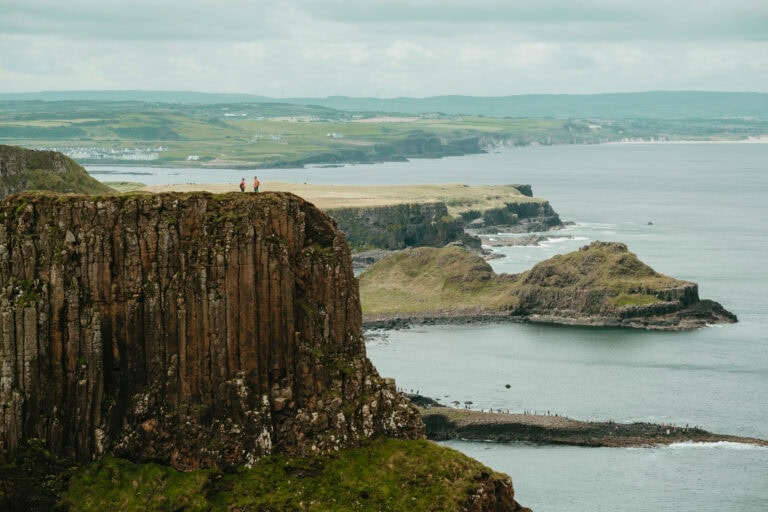
Of course, there’s a more scientific explanation for the unusual geological phenomenon we know as Giant’s Causeway: approximately 60 million years ago, volcanic lava flowed through the area. As it cooled, it contracted and cracked, creating hexagonal columns because the cracks formed most efficiently at those angles.
Naturally, this bizarre coastal feature is one of the most popular tourist destinations in Northern Ireland. Despite the crowds, though, it’s absolutely worth visiting.
Here’s what to know about visiting Giant’s Causeway.
This post contains affiliate links. If you make a purchase or a booking through one of these links, I may receive a small commission at no extra cost to you. Thanks for supporting In Old Cities in this way!
Arriving at Giant’s Causeway
Here are the basics of arriving at Giant’s Causeway: how to get there, where to park, and how to enter the site (including what to know about tickets).
How to Get to Giant’s Causeway
There are three main ways to reach Giant’s Causeway: driving, taking a guided day trip from elsewhere in Northern Ireland, and using public transportation.
If you choose to drive, parking will likely set you back a pretty penny, but more on that in a minute! Giant’s Causeway is located just off the A2 and B147 motorways, near the town of Bushmills. It’s also within easy driving distance of the coastal towns of Portstewart, Portrush, and Ballycastle, as well as the larger town of Coleraine. However, Northern Ireland is quite small and you can also reach Giant’s Causeway in about an hour from Derry, or a bit over an hour from Belfast.
A guided tour is a great option if you’d like to leave the logistics up to someone else, and simply go along for the ride. Keep in mind, though, that unless you are taking a private tour, you’ll be restricted by the timing and itinerary of your group and tour guide, and won’t necessarily be free to explore as long as you’d like. If that sounds fine, check out this highly rated group tour from Belfast.
You can also take public transportation to the Giant’s Causeway site. If you are staying nearby, this is a no-brainer, as there are several buses that will get you to Giant’s Causeway. But even if you are staying a bit farther away, Northern Ireland has a good system of trains and buses, and I highly recommend taking public transportation to Giant’s Causeway if you can! Plan your transit journey to Giant’s Causeway at https://www.translink.co.uk/. The closest bus stop is just across the street from the entrance to the site — it’s the “Aird Giants Causeway Nook” stop (here on Google Maps).
You can also walk to Giant’s Causeway from elsewhere on the coast, via the Causeway Coastal Route, which I strongly recommend. I walked most of this trail during my time in Northern Ireland and absolutely loved it!
Parking
No two ways around it: parking for Giant’s Causeway can be expensive. Let’s run through the primary options:
Entering the Site
After considering some expensive parking options, here’s the good news: entry to the Giant’s Causeway site is totally free.
Yes, you can choose to buy the Visitor Experience tickets and get a guided tour or an audio guide — but those are entirely optional. You do not need to purchase or show a ticket of any kind to enter Giant’s Causeway.


To see the basalt columns, you will need to walk down a long hill. The walk takes 10-15 minutes, but is not too steep.
If you cannot walk down the hill yourself, you can ride a shuttle bus. It costs £1 per person.
Exploring the Giant’s Causeway Site
When you reach the bottom of the hill, take some time to walk onto the large outcrop known as the Grand Causeway and examine the basalt columns. Look at the way the hexagonal columns lock together and form cascading pillars that you can climb up and down.


Explore this fascinating area to your heart’s content (give yourself at least 30 minutes!). When you are done, be sure to check out these other interesting features of the Giant’s Causeway site:
Giant’s Gate
From the paved loop beside the Grand Causeway, walk through the gap in the stones. This is known as the Giant’s Gate, and gives you a great view of the way these basalt columns look from the side.

Organ Pipes
Continue along the path on the other side of the Giant’s Gate. It will take you up a hill, where you can see the Organ Pipes — tall basalt columns set into the cliff.

Amphitheatre
The walking path at Giant’s Causeway ends at the Amphitheatre — a bowl-shaped section of cliff face.
From the existing path, you can see that the walking trail used to continue around the Amphitheatre. However, due to rockslides and treacherous conditions, that part of the trail has been firmly blocked off.

Shepherd’s Steps
When you return from visiting the Amphitheatre, I recommend taking the path that leads up toward the top of the cliff, rather than the path that returns down to the Grand Causeway.
This path will take you up the Shepherd’s Steps, which are infamously steep and narrow. Take your time going up these stairs, and be patient, as you may have to wait for visitors who are walking in the other direction.


Hiking Trails
Your reward for tackling the Shepherd’s Steps is the glorious hiking trails that line the cliffs over Giant’s Causeway. If you have the time, I highly recommend exploring these trails for a while. They offer absolutely spectacular views of Giant’s Causeway, the coastal cliffs, castle ruins, distant towns like Portrush, and even Rathlin Island.
Both directions are worth walking, but I was most impressed by the views toward the east of Giant’s Causeway.


Giant’s Causeway: Interactive Map
Below is a map with the locations included in this itinerary. To use this map during your own trip to Giant’s Causeway, click the star next to the map’s name (which saves the map to your account). You can then find and use the map from your Google Maps app by going to “Saved,” then “Maps.”
Final Thoughts
It sounds like a cliche, but it’s true: no trip to Northern Ireland, or Ireland generally, would be complete without a visit to Giant’s Causeway. These bizarre basalt columns form one of the most special spots on an absolutely spectacular coastline, and were a highlight of my own time in Northern Ireland.
Still have questions about visiting Giant’s Causeway? Leave a comment below — I’d love to help!
More Information About Northern Ireland
ITINERARY | Here’s your perfect itinerary for one delightful week in Northern Ireland.
GETTING AROUND | It’s refreshingly easy and inexpensive to travel Northern Ireland without renting a car. Here’s how.
COST OF TRAVEL | Find out exactly how much I spent for 10 days of travel in Northern Ireland.
THINGS TO DO | Learn all about some of my other favorite things to do in Northern Ireland, including hiking along the glorious coast and taking a day trip to Rathlin Island.
DERRY | Spend two wonderful days in my favorite city in Northern Ireland: Derry.
BELFAST | Northern Ireland’s small capital city, Belfast, is a complicated and lovely place. Here’s how to spend one day there.
pin this post