How to Spend One Day in Rome
Rome wasn’t built in a day, and — let’s be honest — you can’t see Rome in a day, either.
The Colosseum, the Vatican Museums, Borghese Gallery…the list of places in Rome demanding hours of your time could go on and on, and you could spend days exploring much of what Rome has to offer.
But even if you have just one day in Rome, you can still get a fantastic overview of the city and see many of the world-famous sights that bring in visitors from all over the world. In this post, I’ll recommend exactly how to organize your day in Rome so that you maximize your time and see as much as you can (without running yourself ragged!).
So lace up your sneakers (or other comfy walking shoes — you’ll definitely be putting them to use!) and get ready to explore one of the world’s most historic cities in one busy but exciting day.
This is how to spend one day in Rome.
This post contains affiliate links. If you make a purchase or a booking through one of these links, I may receive a small commission at no extra cost to you. Thanks for supporting In Old Cities in this way!
One-Day Rome Itinerary
7 am: Breakfast
With just one day in Rome, you should plan to get started as early as possible. If you’re not an early bird, sorry! (I empathize: me either.)
Eat breakfast at your hotel if it’s offered there, or check out Capitan Cono, just south of Vatican City.
If you’re not much of a breakfast person, or you’d rather eat a little later, that’s fine — I’ll tell you about a few places you can find some mid-morning snacks as you sightsee. I’d still recommend getting to St. Peter’s (your first stop) as early as possible, so if you skip breakfast, you should still wake up early and get to the Vatican ASAP.
8 am: St. Peter’s Basilica
Your first sightseeing stop of the day is St. Peter’s Basilica. Aim to be in line by 8 am at the latest. Depending when you’re visiting, there may already be a substantial line! (For example, during my last visit, I got in line at 8:15 and it took me 45 minutes to get through the security line and enter the building. This is precious time you don’t want to waste during your short visit to Rome!)

If you’d like to visit the top of the basilica’s dome — which I do recommend! — head straight there after getting through security. You’ll find the ticket booth and entrance to the left.
To reach the top, you have a choice: you can take an elevator to the first level (skipping about 230 steps), then climb the rest of the way, or you can climb the entire way (about 550 steps in total). The elevator is slightly more expensive, and may involve another long line, even fairly early in the morning. The first set of stairs is also quite easy: a wide, gradual spiral with occasional steps. I’d recommend taking the stairs unless you need to reduce the number of stairs you climb for medical or other reasons.
Either way, after you climb the first set of stairs or ride the elevator, you will land on the rooftop — it’s behind the statutes and at the base of the dome, when you’re looking up at the basilica. From here, you can get your first glimpse of St. Peter’s Square from above (you can’t get close to the edge though, so the view isn’t good). There is also a very small cafe where you can purchase drinks and light snacks before continuing on to the top of the dome.
When you’re ready, follow the signs to begin climbing the dome. You will first walk along the interior of the dome (at the base), where you can look down to part of the basilica and up at the golden decor inside the dome.


From here, the stairs get much more difficult. The walls curve inward for much of the walk, because you are climbing within the walls of the dome (and along their slope). The last set of stairs, in particular, are extremely narrow, steep, and spiraling.
The reward for this effort, when you reach the top, is a wonderful and extremely famous view of St. Peter’s Square and much of Rome beyond it.

From the top of the dome, you can also see Vatican City, the Vatican Museums, and more.
When you finish admiring the views, walk back down to ground level and explore the interior of the basilica. No surprise: it is magnificent.
Unlike many churches in Europe, St. Peter’s does not typically contain any seating inside. This not only leaves much more space for crowds to walk around inside, but also amplifies the sheer size of the interior. It’s simply cavernous.


By the way, if the line to get into St. Peter’s is extra long, and the three hours I’ve allotted for St. Peter’s in this post aren’t enough, don’t worry, and don’t shortchange your St. Peter’s experience — you can make up that time in the afternoon!
11 am: Castel Sant’Angelo
When you’re done exploring St. Peter’s, walk a few minutes directly east to Castel Sant’ Angelo — an ancient building that’s served as a mausoleum, a fortress, a castle, and now a museum.


There’s plenty of history and art to find inside the castle, if that strikes your fancy — plus, a small cafe where you can grab drinks and snacks if you need them — but my favorite part of Castel Sant’Angelo is the rooftop platform. There, you’ll find some of the best views of St. Peter’s Basilica, plus other highlights of Rome (including the Altar of the Fatherland).


You can buy a ticket on arrival, but to save time, consider buying a skip-the-line ticket in advance here:
1 pm: Lunch on Via dei Coronari
From Castel Sant’Angelo, walk across the famed Ponte Sant’Angelo (a bridge lined with statues of angels) and find Via dei Coronari — which, if you ask me, is one of the prettiest streets in Rome.
For lunch, I recommend that you stop at one of the restaurants along the narrow Via dei Coronari. Great options include Pasta Imperiale, Cucina del Teatro, and I Supplì dei Coronari.


2 pm: Pantheon
After lunch, walk to the Pantheon — one of the oldest buildings in Rome. Originally constructed as a Roman temple in the 2nd century (yes, really!), the Pantheon has served as a Catholic church for most of its history.
Though if you ask me, the Pantheon feels more like a small museum than a church. Inside the round space, you’ll find tombs, chapels, and statues — including the final resting places for King Vittorio Emanuele II, King Umberto I, and the painter Raphael.
But the Pantheon is best known for what you’ll find when you look up, not around: a magnificent dome (still the largest unreinforced concrete dome in the world!) with a giant hole in the middle. This hole — the “oculus” — provides the only natural light in the Pantheon and contributes to the structural stability of the dome. If I lived in Rome, I’d visit the Pantheon at every hour of the day, just to see how the light coming through the oculus moves around the space throughout the day.


3 pm: Spanish Steps, Trevi Fountain, Altar of the Fatherland, Roman Forum, Palatine Hill, and Colosseum
After the Pantheon, it’s time for a whistle-stop tour of some of the most famous sights in the world.
First, stop at the Spanish Steps — a famous staircase that connects two piazzas at opposite ends of a hill. Take a seat on the steps if you need a break from all your walking, or just enjoy the views looking up toward the church at the top of the steps.


Next, walk to the magnificent Trevi Fountain. At this time of day (like nearly all times of day), you can expect it to be thoroughly overrun by visitors, but it’s worth seeing nonetheless. If you like, fight your way through the crowds to reach the base of the fountain, where you can toss a coin into the water (use your right hand over your left shoulder!) — which, according to legend, will ensure you return to Rome in the future.


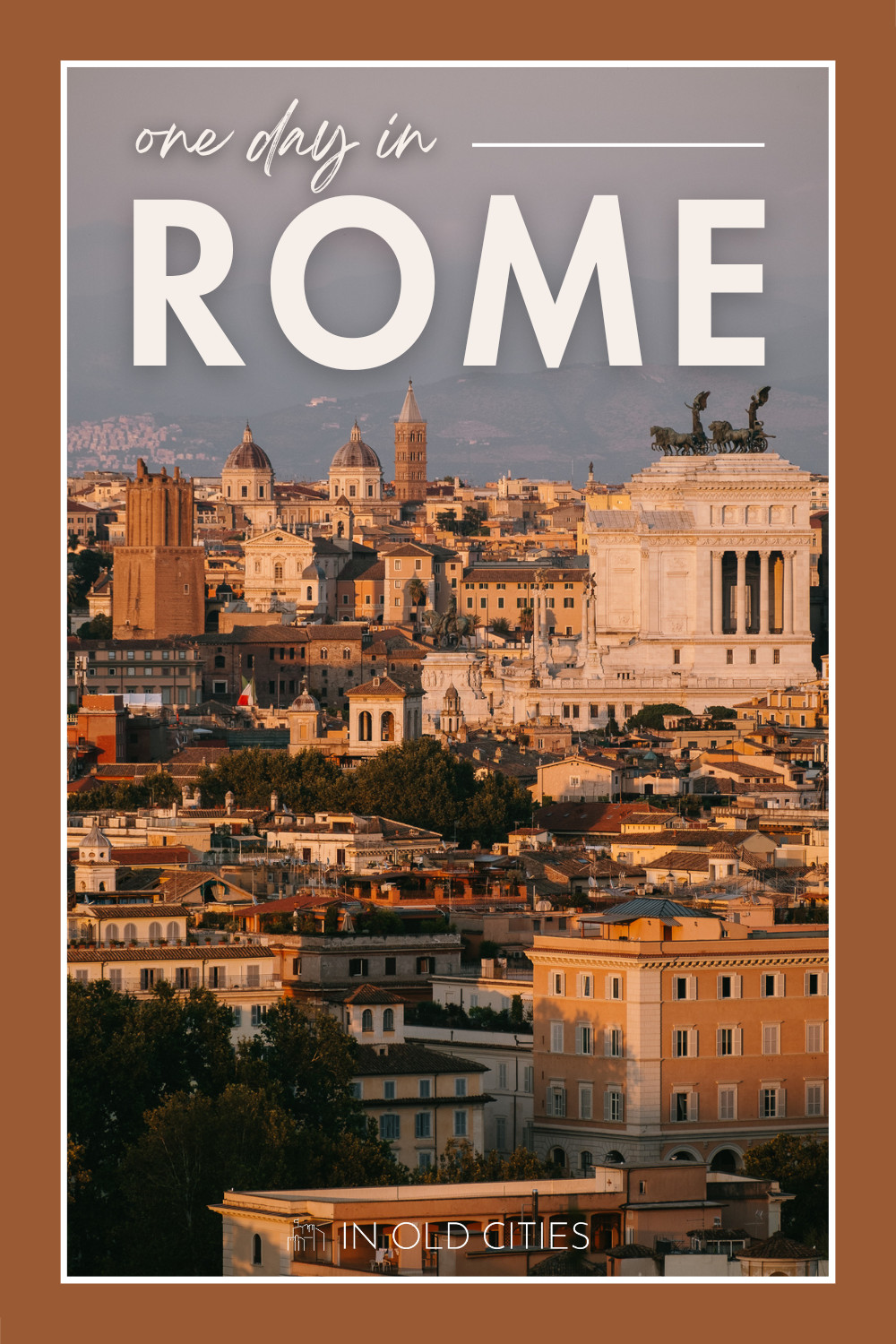
Your next stop is the Altar of the Fatherland — more formally known as the Victor Emmanuel II National Monument — a massive monument celebrating the unification of Italy.
Portions of the Altar of the Fatherland, including the panoramic terrace at the very top, require an entrance ticket, but you can climb up to the first level of the monument for free.


Finally, head over to the most historic area of Rome: the Roman Forum. Now in ruins, this plaza was the heart of ancient Rome. Be sure to climb up Palatine Hill and admire the views of the Forum and the Colosseum beside it.
If you have the time and interest, you can also visit the interior of the Colosseum. Otherwise, admire it from the outside. In addition to the views from the Roman Forum and Palatine Hill, you’ll find a great view from a small plaza above the Colosseo metro stop.


You can purchase a combination ticket for the Roman Forum, Palatine Hill, and Colosseum here. If they’re already sold out when you go to purchase them, try buying from a reseller like this:
6 pm: Trastevere
Wind down from all your exploring in Trastevere, one of the most charming parts of Rome.
Trastevere is the perfect place to find a cafe for a pre-dinner drink, shop for souvenirs to take home with you, or just to wander the streets.
Eventually, find a nice restaurant for dinner. Popular options include Nannarella, Tonnarello, and Meridionale — but it’s hard to go wrong!


9 pm: Piazza Navona
End the day in my favorite Roman piazza: Piazza Navona.
This vast, oblong square contains three fountains — including Bernini’s famous Fountain of the Four Rivers, which is topped by an ancient obelisk — the beautiful Church of Sant’Agnese in Agone, and plenty of overpriced restaurants.
Though I don’t recommend eating dinner in Piazza Navona, it’s a lovely place to sit with an after-dinner drink and watch the world go by.

Best Places to Stay in Rome
During my most recent trip to Rome, I stayed at Relais Palazzo Taverna. I liked this hotel a lot — there was no air conditioning (not unusual for Rome), but my room stayed fairly cool on those insanely hot August days (I often retreated back to my room rather than sightseeing in the afternoon!). It wasn’t large, but it was clean. And it was wonderfully located just a few feet off of Via dei Coronari — a central area that allowed me to walk absolutely everywhere. (In fact, during six days in Rome, I exclusively got around by walking!)
For this one-day Rome itinerary, I strongly recommend staying around the same area, which is quite near both the first stop (Vatican City) and last stop (Piazza Navona) of your day. Check out these options:
BUDGET | Campo Marzio is nothing fancy, but it offers affordable apartments in a convenient location.
COMFORT | Terrazze Navona offers rooms with private balconies, so you can enjoy your coffee with a gorgeous view over the rooftops of Rome.
LUXURY | Snag a suite at Lifestyle Suites Rome for a room with a direct view of Piazza Navona!
One Day in Rome: Interactive Map
Below is a map with the locations included in this itinerary. To use this map during your own trip to Rome, click the star next to the map’s name (which saves the map to your account). You can then find and use the map from your Google Maps app by going to “Saved,” then “Maps.”
Final Thoughts
Rome deserves much more than one day, but I get it — sometimes, for whatever reason, you only have one day to spend in a city (even Rome!).
If that’s the case for you, I hope this post helps you plan your day in Rome efficiently — and that you’re able to see all you want to see!
More Information About Rome AND ITALY
ITALY ITINERARIES | Spend 10 days in Rome, Florence, and Venice, or two weeks seeing the best highlights of Italy (COMING SOON!)
ROME ITINERARY | Learn how to spend 3 days in Rome (COMING SOON!).
VIEWS | Find the best free views of Rome, including the most unique view you’ll see.
COSTS | Here’s how much I spent for one month in Italy.
pin this post