9 Unusual Things to Do in Ljubljana
If you ask me, Ljubljana — the capital of Slovenia — is one of Europe’s most underrated cities.
It’s small and unassuming as capital cities go, but it packs a punch: with quirky public art, a castle perched high on a hill, boat cruises down a picturesque river, and easy access to the gorgeous lakes, mountains, and seaside towns elsewhere in Slovenia, Ljubljana is a gem.
And it seems to specialize in unique sights that you won’t find in other cities, which adds to the feeling that when you’re in Ljubljana, you’re somewhere special.
Here are 9 unusual things to do in Ljubljana.

1. Hunt for dragons.
Ljubljana’s connection to dragons dates back centuries — uh, to the extent we can measure a connection to mythical creatures (not to mention mythical heroes), that is.
As the story goes, Ljubljana was founded by the Greek legend Jason, who once sailed up the Danube and Sava rivers to the source of the Ljubljanica River, where Jason fought and killed a dragon that was living there.
Of course, dragons weren’t real, and Jason wasn’t real, but Ljubljana’s attachment to dragons is real nonetheless. You’ll see symbols of dragons throughout Ljubljana — on the city’s coat of arms, guarding the famous Dragon Bridge, and scattered elsewhere too.


2. Find the faces of Locksmith Street.
Ljubljana is full of quirky public art — and one of the best examples is on Locksmith Street, a narrow alley in Ljubljana’s old town.
There, running the length of the alley, is a gutter filled with little bronze faces. Created by Slovenian sculptor Jakov Brdar, these 700-some faces express an array of emotions: some are happy, some are sad, some are simply bizarre.


The faces of Locksmith Street were inspired by Rainer Maria Rilke’s The Notebooks of Malte Laurids Brigge, which includes these lines:
“To think, for instance, that I have never been aware before how many faces there are. There are quantities of human beings, but there are many more faces, for each person has several. There are people who wear the same face for years; naturally it wears out, it gets dirty, it splits at the folds, it stretches, like gloves one has worn on a journey. These are thrifty, simple people; they do not change their face, they never even have it cleaned. It is good enough, they say, and who can prove to them the contrary? The question of course arises, since they have several faces, what do they do with the others? They store them up. Their children will wear them. But sometimes, too, it happens that their dogs go out with them on. And why not? A face is a face.”
3. Greet the tongueless dogs.
At the end of a grand promenade within Ljubljana’s largest park, Tivoli Park, lies a mansion. Over the centuries, it’s belonged to the Jesuits, the Catholic church, Austrian emperor Franz Joseph I, and others — but Ljubljana owns it now, and it holds the International Centre of Graphic Arts.
In the mid-19th century, while the marshal was under the stewardship of Habsburg marshal Joseph Radetzky von Radetz — who renovated the mansion into its current Neoclassical appearance — an Austrian sculptor, Anton Dominik Fernkorn, created four cast iron dogs that still sit in front of the building.
However, Fernkorn didn’t give the dogs tongues — a mistake that inspired a local urban legend. According to rumor, Fernkorn was so distraught by the tongue omission that he shot himself after the statues were unveiled.
This legend is false, but the true story is still dark: rather than dying by suicide, Fernkorn was institutionalized.

4. Stand under rain no matter the weather.
Outside Ljubljana’s famously pink Franciscan church, in Prešeren Square, you’ll find more public art: a small plaza where overhead sprinklers spray water over a circular area. Regardless of whether it’s raining or not, walk through this area — with signage labeled “The Area with Ljubljana’s Own Weather” — and experience the illusion of rain.


The Area with Ljubljana’s Own Weather was created by Slovenian artist Zmago Modic in 2008, and it’s been a regular art installation in Prešeren Square since 2015.
While in Ljubljana, I spent some time in Prešeren Square just watching people interact with The Area with Ljubljana’s Own Weather, which is something I recommend if you have some time to kill. I observed a fun combination of locals purposefully walking around the rainy area, cyclists zipping through it, kids splashing around in the puddles, people engrossed in their phones accidentally walking into it and unexpectedly getting wet, and so on.
Visit Prešeren Square (and many of the other destinations on this list!) on this well-reviewed Ljubljana walking tour:
5. Solve a puzzle at a castle.
If you’re the type of person who loves escape rooms and other puzzle-based activities, consider playing Escape Castle at Ljubljana Castle. In groups of two to four, you’ll solve five different puzzles throughout the castle — all with the goal of reviving the dragon at the heart of Ljubljana’s folklore.
Playing Escape Castle can be a fun way to jazz up your experience at Ljubljana Castle — which, while worth visiting, is admittedly pretty demure as castles go. Learn more about the game and tickets here.

6. Walk under bishops’ heads.
One of several notable churches in Ljubljana is the Cathedral of St. Nicholas, an 18th-century Baroque treasure.
Though much of the church is wonderfully historic, the doors to the cathedral are much newer than the rest of the building. Installed in the 1990s, the front door — called the “Slovenian Door,” contains an elaborate relief sculpture commemorating a millennium of Christianity in Slovenia.
And, on the side of the cathedral, the “Ljubljana Door” features six bishops standing over the body of Christ. As you walk through the door, you’ll pass under the looming bishops’ heads.


7. Walk across a glass-bottom bridge.
From the Dragon Bridge to the Triple Bridge (which is exactly what it sounds like: three bridges all in a row), Ljubljana’s old town is full of interesting bridges.
That includes Butcher’s Bridge, a wide footbridge that was finally built in 2010 — a mere 80 years after construction of a bridge on that spot was first planned! Butcher’s Bridge contains several notable features, including railings with long steel wires — which people have used to hang love locks.
And…along the railings, the bottom of the bridge is glass. It’s an unusual opportunity to look straight down on the river that you’re crossing.
However, be warned that boat tours of Ljubljana leave from under Butcher’s Bridge, so people who are sitting on a boat, waiting for it to leave, can look directly up at anyone who’s walking on the glass. I don’t recommend walking along the glass sections of Butcher’s Bridge with a skirt on!


8. Measure the blueness of the sky.
In the midst of a wide sidewalk beside a busy street sits a strange, mirrored object. At the top, a color wheel displays a wide spectrum of shades of blue around a hole through the object. The rest of the rectangular monument is covered in panels that are simultaneously taking in data about the sky and air quality — information that’s stored on the Cyanometer website — and reflecting images of the world around it (including the sky, of course!).
This is the Cyanometer, which has been installed in Ljubljana since 2016. All at once a work of art, a scientific tool, and an archival system, the Cyanometer is one of the most recognizable objects in Ljubljana.


9. Try a traditional dumpling.
I’m a big fan of dumplings — but who isn’t, I guess? If you’re also a dumpling aficionado, be sure to try Slovenian dumplings in Ljubljana.
These squishy, tasty dumplings feature layers of dough rolled — or really, sort of scrunched — along with fillings or other flavorings. You can find sweet or savory varieties, and they can be eaten on their own (as a snack or a small meal), or alongside other food, like stew. Honestly, I’m getting hungry just writing about it.
My favorite dumpling in Ljubljana was the lemon dumpling I ate at Moji štruklji Slovenije — a dumpling house!
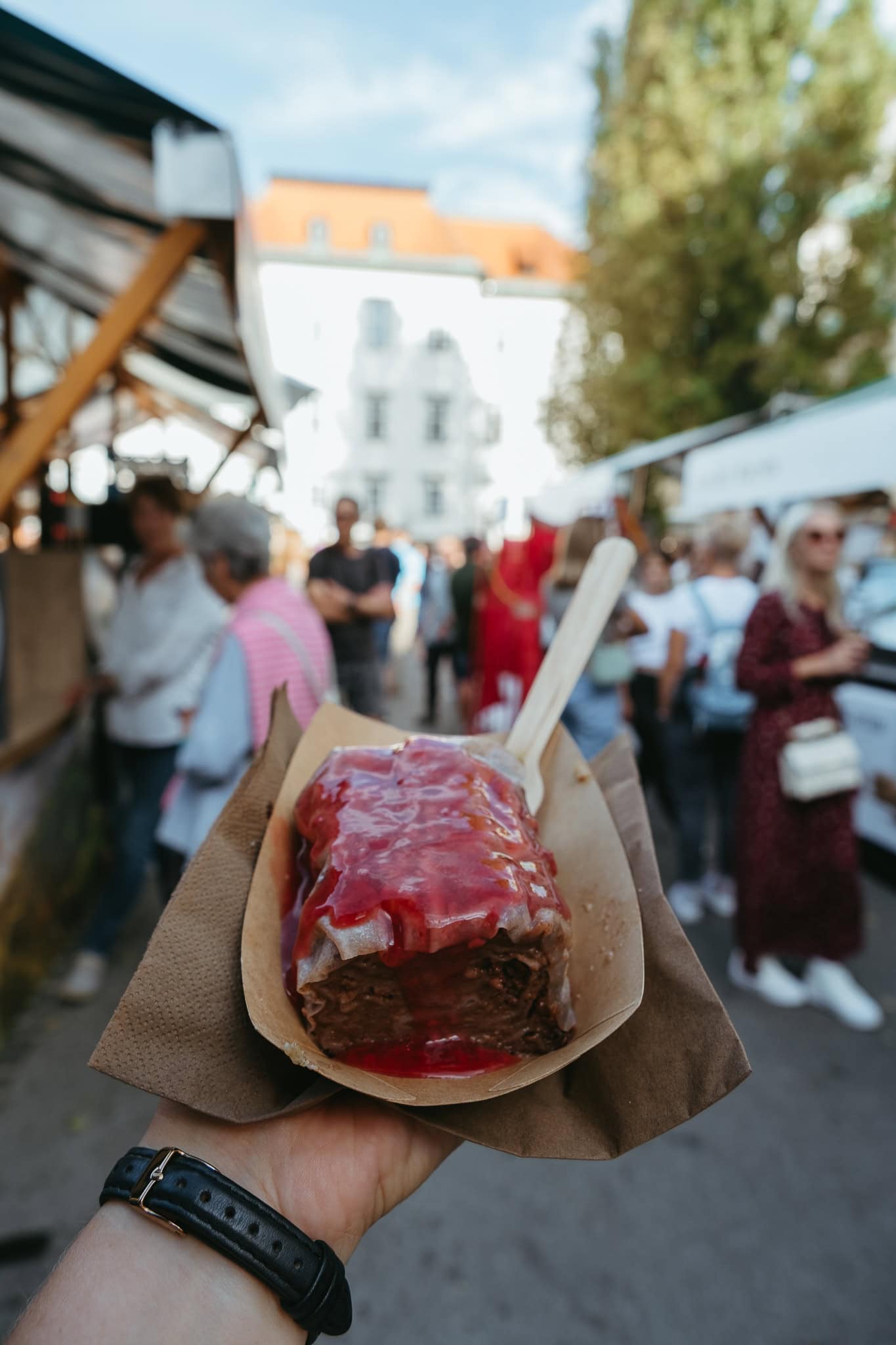

Though Ljubljana obviously isn’t the only place in the world where you can eat a dumpling — to say the least — it is the only place where I’ve had dumplings quite like this. That’s unfortunate, since I loved them, and Ljubljana is far away from my home!
More Information About Slovenia
ITINERARY | Here’s your perfect itinerary for four days in Slovenia.
COSTS | Discover how much I spent for five days in Slovenia.
LJUBLJANA | Learn how to spend one day in Ljubljana.
PIRAN | Take a delightful day trip from Ljubljana to the coastal town of Piran.
BLED | Spend one day at the incredible Lake Bled.
pin this post