How to Spend 3 Days in Venice
In my travels, I’ve discovered that people are fond of comparing cities to Venice. (Usually, this just means that the other city has canals.) “Amsterdam is the Venice of the North,” I’ve heard. (Or is it actually Colmar, or Bruges, or maybe St. Petersburg?) Same with “Venice of the East,” which might be Udaipur, or is it maybe Kyoto?
I say: all of this is nonsense. In truth, there’s nowhere else like Venice.
With its extensive canal system, twisty, maze-like design, island setting, and zero cars (!), Venice is totally unique in the world.
For some visitors, Venice is unique in a bad way — uniquely crowded, uniquely hot, uniquely touristy.
But I don’t feel that way at all. In fact, during my first trip to Venice, I was lucky enough to spend an entire, glorious week there — far more time than the one or two days many visitors to Venice allot — which allowed me time to experience the most popular attractions in Venice, discover plenty of hidden gems too, and just get lost in the city (literally).
From that week in Venice, I’ve narrowed down my discoveries to my top recommendations: the things I would prioritize if I had just a few days to spend in Venice. In this post, I’ll provide you with the perfect itinerary for 3 days in Venice, plus I’ll recommend a few places to eat without breaking the bank and show you the best places to stay. I’ll also tell you how to get around Venice, so you’ll be ready to take off running (that is: walking…or boating) right when you arrive in Venice.
This is how to spend 3 days in Venice.
This post contains affiliate links. If you make a purchase or a booking through one of these links, I may receive a small commission at no extra cost to you. Thanks for supporting In Old Cities in this way!
Itinerary for 3 Days in Venice
Below is a detailed itinerary for three days in Venice.
But first, here’s a map of the locations I include in the itinerary, as well my lodging recommendations (which you’ll find later on in this post).
TIP: This map contains the locations discussed in this blog post. To save it to your own Google Maps account, click the star next to the map’s name. You can then find and use the map from your Google Maps app by going to “Saved,” then “Maps.”
DAY 1: Top Venice Attractions
On your first day in Venice, you’ll see many of the city’s top tourist destinations and world-famous sights.
St. Mark’s Square
Start your day in St. Mark’s Square — the heart of Venice, in many ways.
The focus of St. Mark’s Square is the Basilica di San Marco — a vast, multi-domed cathedral that sits at the end of the square. In front of the basilica is a free-standing campanile, or bell tower, which is Venice’s tallest building.


Because virtually every visitor to Venice passes through St. Mark’s Square once, or twice, or fifteen times, it tends to be quite busy, particularly in the middle of the day. I recommend getting to St. Mark’s Square by the time the campanile opens at 9:30 am. This way, you should be able to walk right into the campanile and take the elevator to the top before a line starts to form.
From the top of the campanile, you’ll have wonderful views of the square, the rooftops of Venice, and some of the outlying islands (particularly San Giorgio Maggiore, just south of the square).


When you return to the ground after experiencing the campanile, head into the basilica.
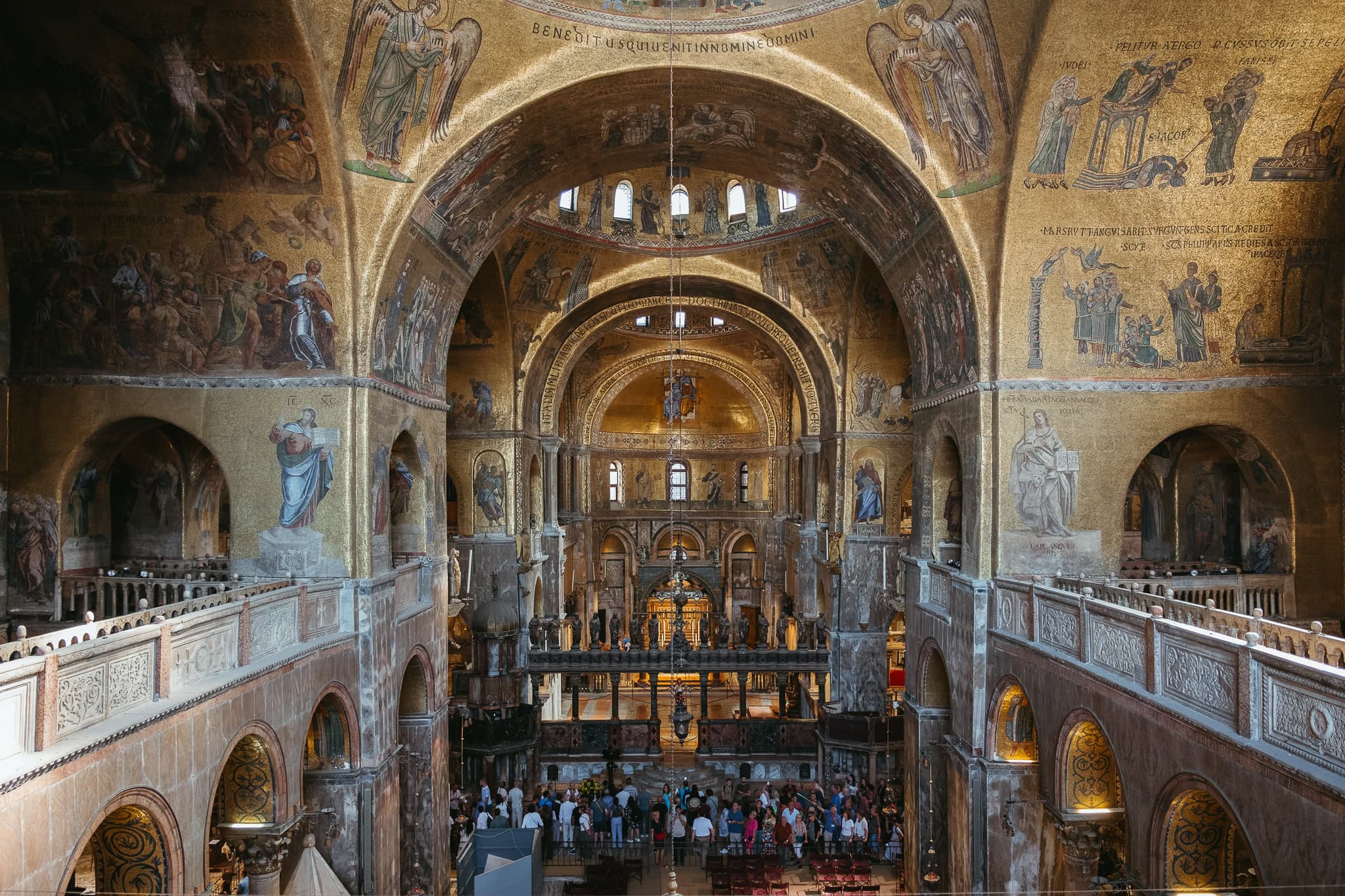
It’s truly remarkable: lined with thousands of square meters of mosaics, many of them glimmering gold, the basilica is one of the most impressive cathedrals in Italy.
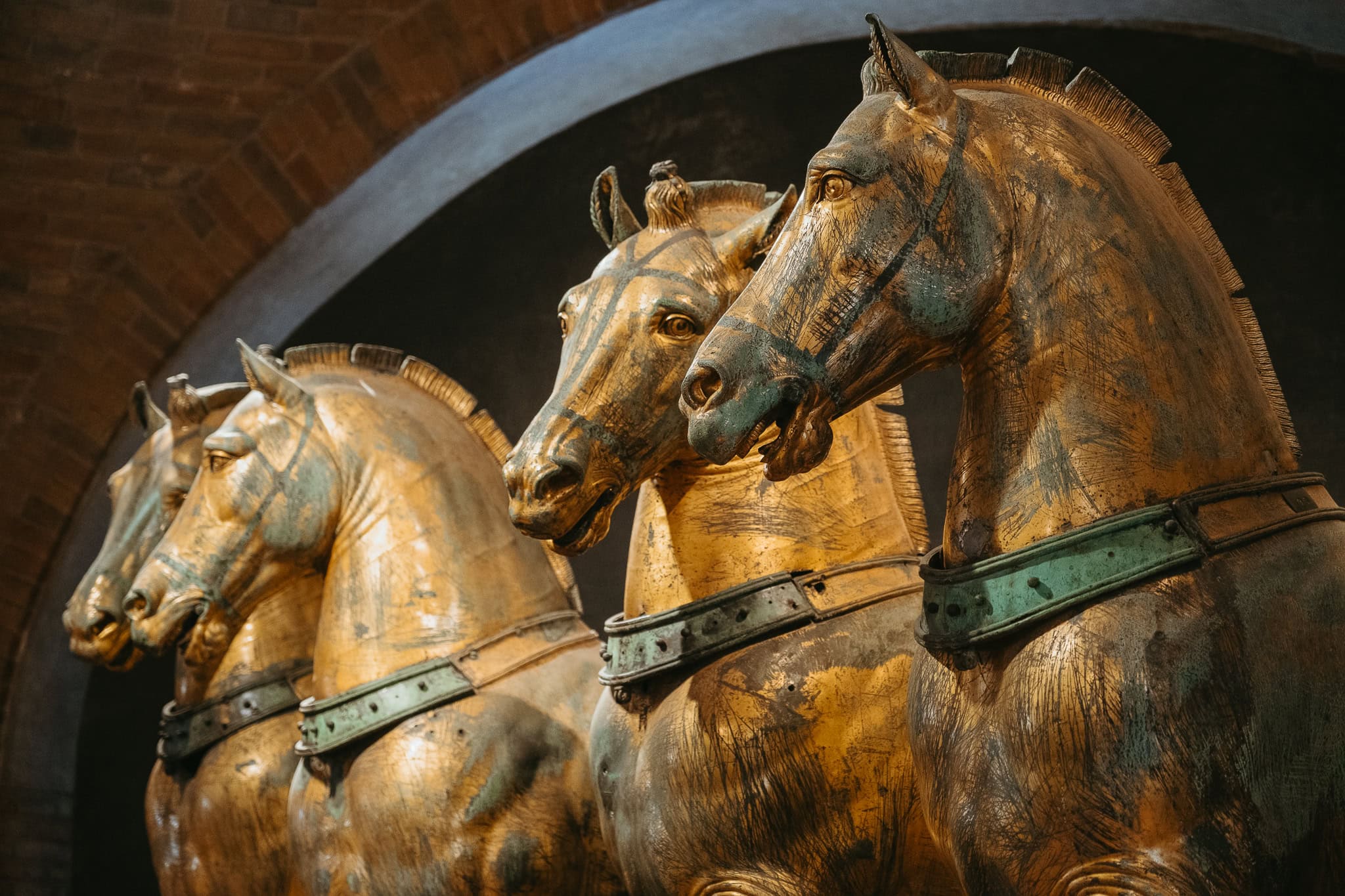
I recommend paying for access to Museo di San Marco, which is located on an upper floor of the basilica. You will see the original bronze horses of St. Mark’s (the horses currently perched on the front balcony of the basilica are replicas), enjoy unique views of the interior of the basilica, and get access to the front balcony of the basilica and its lovely views over the square.




Bridge of Sighs
When you’re satisfied with your St. Mark’s Square experience, walk around the corner to Ponte della Paglia — a bridge with one of the best views of the Bridge of Sighs, one of Venice’s best-known bridges (and sights).
The Bridge of Sighs is perched high above the water, connecting a former prison with interrogation rooms. It’s said that during the time of the prison’s operation, convicts would be led over the bridge from the interrogation rooms to their cells in the prison, sighing as they caught their final views of beautiful Venice through the bridge’s tiny windows.


If you have the time and the interest, consider visiting the Doge’s Palace, which sits right beside the basilica. While touring this museum, which once served as the residence of the ruler of Venice (among other things), you will walk through the Bridge of Sighs and see the same views that allegedly made those prisoners sigh.


If you need lunch about this time, consider Dal Moro’s — a popular nearby spot that serves up made-to-order pasta in containers you can eat out of as you walk. Honestly, eating on the go is sort of contrary to the core Italian ethos, but this is a busy day and it’s understandable if you don’t have time to sit for a leisurely lunch. (I got food from Dal Moro’s a couple of times during my time in Venice, and I thought it was pretty decent!)
San Giorgio Maggiore
In the afternoon, take the number 2 vaporetto line from the San Marco stop to the nearby, tiny island of San Giorgio Maggiore.
San Giorgio Maggiore is best known for its church, which has a bell tower with wonderful views of the main islands of Venice. In particular, San Giorgio Maggiore offers some of the best views of St. Mark’s campanile and other features of St. Mark’s Square, as well as the Basilica of Santa Maria della Salute, which sits at the end of the Grand Canal.


Rialto Bridge
Return to the main island the same way you came, and walk to Rialto Bridge.
The remarkable Rialto was built in the 16th century to some skepticism about the bridge’s longevity. The critics were wrong, though: the Rialto has not just lasted, but it’s also become world-famous.
Indeed, you’ve probably seen photos of Rialto Bridge before, or maybe you’ve seen it featured in movies like Spider-Man: Far From Home? The extra-wide Rialto arches high over the Grand Canal, with twin porticos at the top and rows of shops running down the center. On either side of the bridge, wide stairways provide space for visitors to stand and enjoy the views over the canal.


Grand Canal Vaporetto Ride
End your day of sightseeing with a ride on Venice’s most popular vaporetto (water bus): the number 1 line.
The number 1 vaporetto traverses the length of the Grand Canal and beyond, from Piazzale Roma in the north to the Lido (an outlying island in the Venetian Lagoon) in the south.
Riding the entire route of the number 1 vaporetto (which takes about an hour) is an excellent way to see some of the highlights in Venice and to get new views of the Grand Canal.
From Rialto, I would recommend boarding a number 1 vaporetto heading toward the Lido. Stay on the vaporetto when it turns around at the Lido (this may be a great opportunity to snag one of the few seats in the open-air back of the water bus, where you’ll get the best views) and ride it back to the Grand Canal — as far as you like. If you can time it so you’re on the vaporetto about an hour before sunset, you’ll get to see San Giorgio Maggiore, Santa Maria della Salute, and other top Venice sights all aglow.


DAY 2: Underappreciated Gems
Now that you’ve seen the main sights, your second day in Venice is all about discovering some of the less-visited (but equally wonderful) places that Venice has to offer.
Libreria Acqua Alta
Acqua alta — high water — is a routine part of life in Venice. In the winter (and occasionally during other times), natural forces can cause the city to flood. Inches or even feet of water fill the streets and the squares, and spaces at ground level have to fend off the pernicious effects of water appearing where it isn’t wanted.
The famous bookstore Libreria Acqua Alta is named after this phenomenon. And parts of the space seem to pay homage to it, with books piled in gondolas and bathtubs — protected from the water that is inevitably coming sooner or later.
You’ll find books everywhere you look in Liberia Acqua Alta, though, including in stacks on the floor. Stop in for a book (or a piece of art, or a postcard, or a bookmark) and take a piece of Venice home with you.


Teatro La Fenice
Next, head to one of my very favorite places in Venice: Teatro La Fenice.
This storied theater, which is named after the mythological phoenix, has a troubled past: twice it’s burned down and been rebuilt. A phoenix indeed.
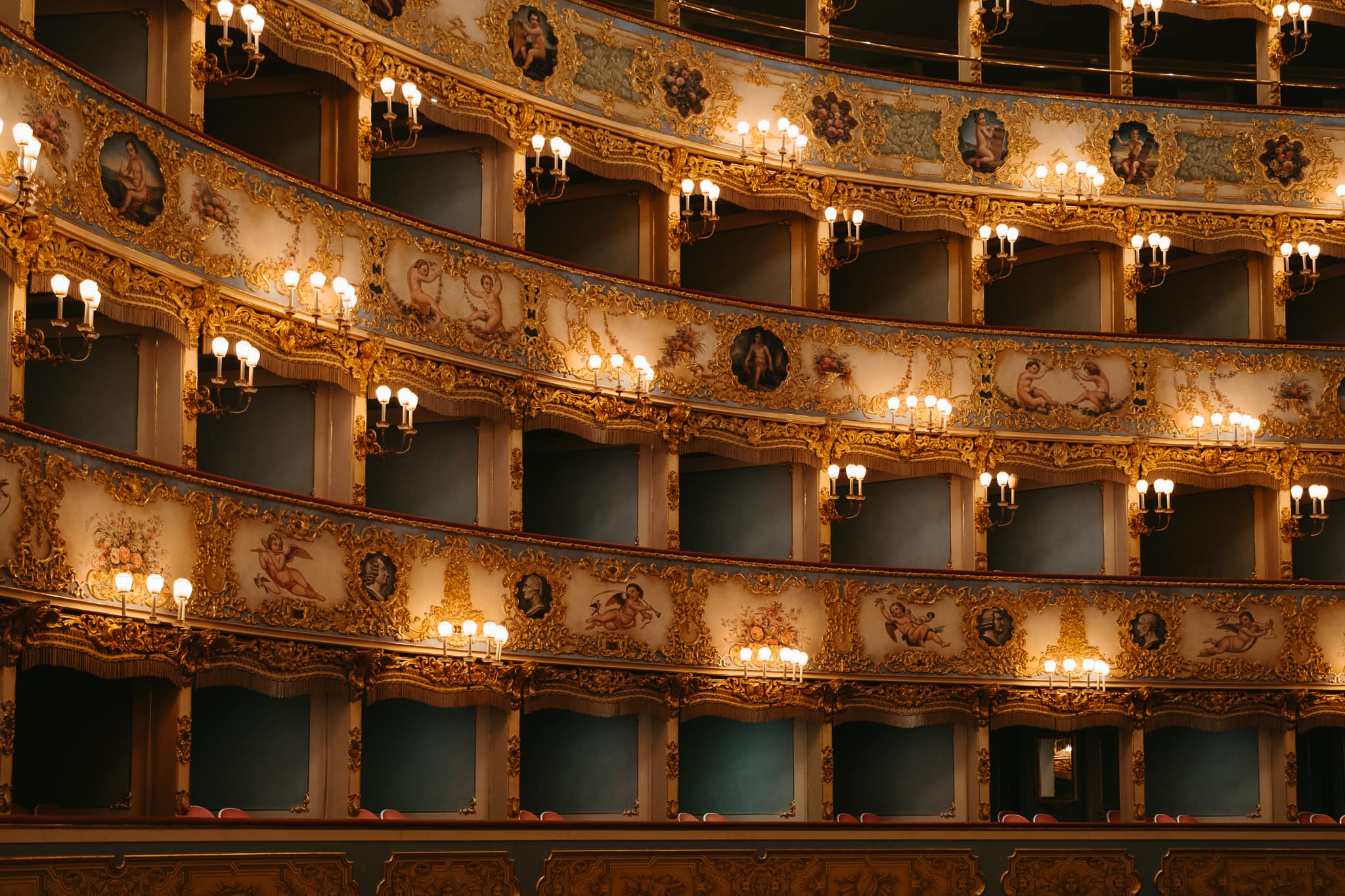
I highly recommend the audio tour at Teatro La Fenice. Following this tour, you’ll walk through the public portions of La Fenice, learning about the theater’s history (and one of its most famous performers, Maria Callas) and admiring its gorgeous main space. The uniform rows of boxes, ornate lighting, and blue ceiling are all truly remarkable and worth seeing.
Plus, while you’re not likely to be the only visitor touring the theater, it’s relatively undiscovered by tourists compared to the often overwhelming crowds at popular spots like St. Mark’s Square and Rialto Bridge — a huge plus in a busy city like Venice.


If you’re hungry for lunch after visiting the theater, I recommend going to Bacareto da Lele — a small shop that offers up small sandwiches and wine for practically pennies (just €1 for a glass of wine and €1.20 for each sandwich!). It’s a bit out of the way for this itinerary, but well worth it given the cost savings (plus, Bacareto da Lele is just as popular with locals as it is with tourists, which you won’t find just anywhere in Venice!).
Peggy Guggenheim Collection
In the afternoon, head to the Peggy Guggenheim Collection — an art museum in the former home of Peggy Guggenheim, a 20th-century wealthy socialite and art patron.
Peggy, who was the niece of Solomon Guggenheim (the namesake of New York’s Guggenheim Museum), inherited millions when she entered adulthood and spent the rest of her life, in part, using her money to support and acquire art. As she approached the end of her life, she donated her home and collection to her uncle’s foundation, and the Peggy Guggenheim Collection was opened as a museum after her death in 1979.
Take some time to appreciate the collection inside the Guggenheim. For fans of 20th-century art, in particular, it is magnificent. During her life, Peggy Guggenheim substantially advanced the careers of artists whose names will hold weight for centuries to come — Jackson Pollock, Max Ernst, and others — and she amassed an incredible collection full of works by Picasso, Dalí, Duchamp, Klee, Magritte, Mondrian, and others.


That said — though I do really like art museums — my favorite part of the Guggenheim is not hanging on any of its walls.
Instead, it’s the back terrace — an austere space that has a spectacular view over the Grand Canal. With limited seating (and stone bench seating, at that), it’s not a terribly comfortable place to hang out, but nonetheless, I spent an hour on the Guggenheim’s terrace, just admiring the views and watching gondolas, vaporetti, and lots of other boats float on by.
This is one of my favorite places to simply relax in Venice.


Ponte dell’Accademia
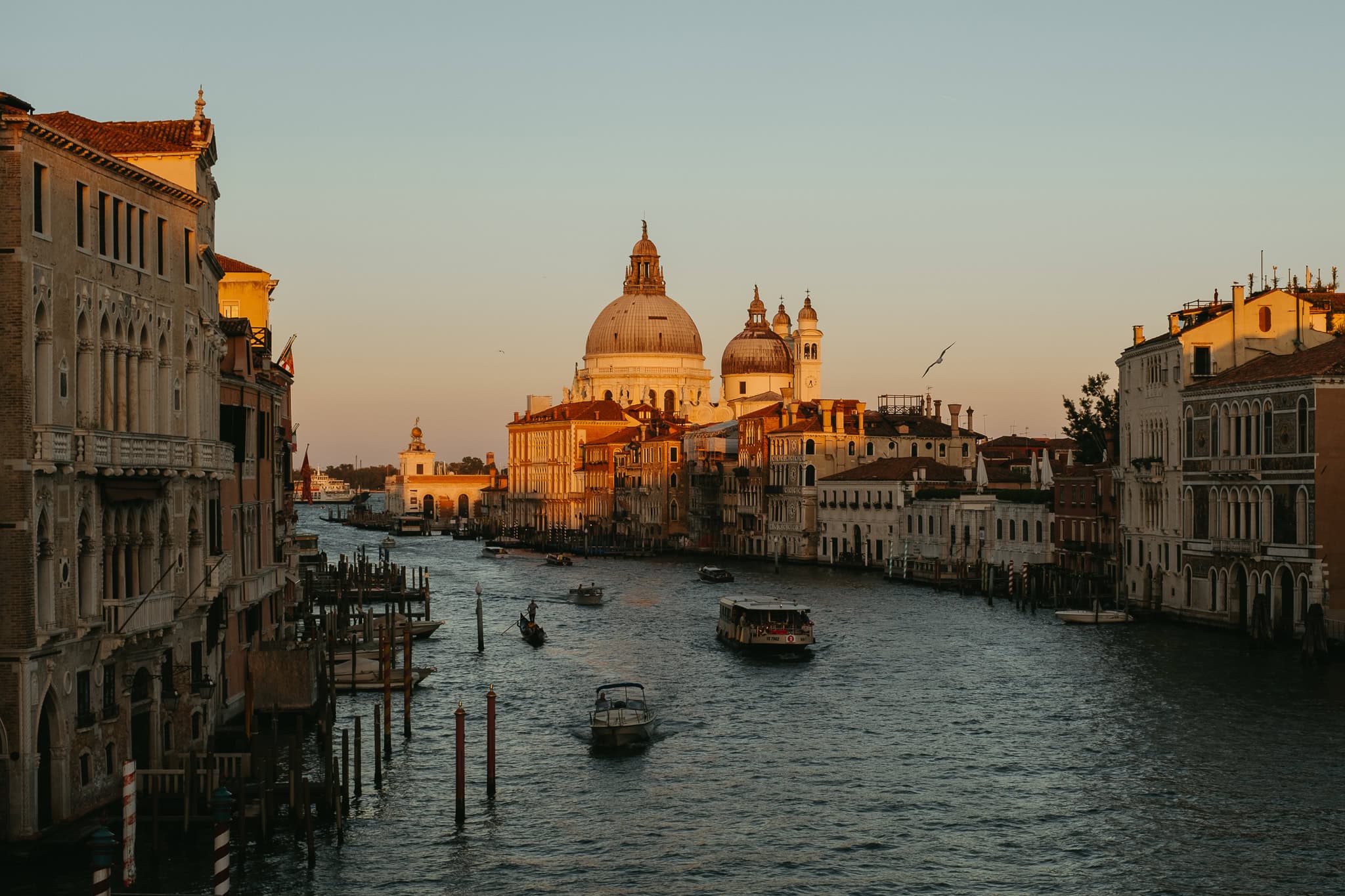
Cap off your day by watching the sun set from Ponte dell’Accademia.
One of just four bridges across the Grand Canal, the simple, wooden Ponte dell’Accademia isn’t winning any awards for its design or appearance. But the view from the bridge — at least the one looking south — is one of the best in Venice.
Facing south on the Ponte dell’Accademia, you’ll look toward the end of the Grand Canal, where boats of all types (well, at least all types that are present in Venice) cruise in and out of the Venetian Lagoon, surrounded by classic Venetian architecture (including the Guggenheim’s terrace!). And, at golden hour, the domes of Santa Maria della Salute glow warmly in the light of the setting sun.
The Ponte dell’Accademia is one of my favorite places to watch the sun set in Venice.
DAY 3: Outlying Island (& More!)
On your final day in Venice, you’ll venture off the main islands to a small, outlying island — then return to explore one of the most historic areas of the city.
Burano
The main islands of Venice are so delightful to explore that you might not want to leave, but I recommend that you muster up the motivation to take a ferry to Burano — a small island north of Venice in the Venetian Lagoon — where you should plan to spend the morning.
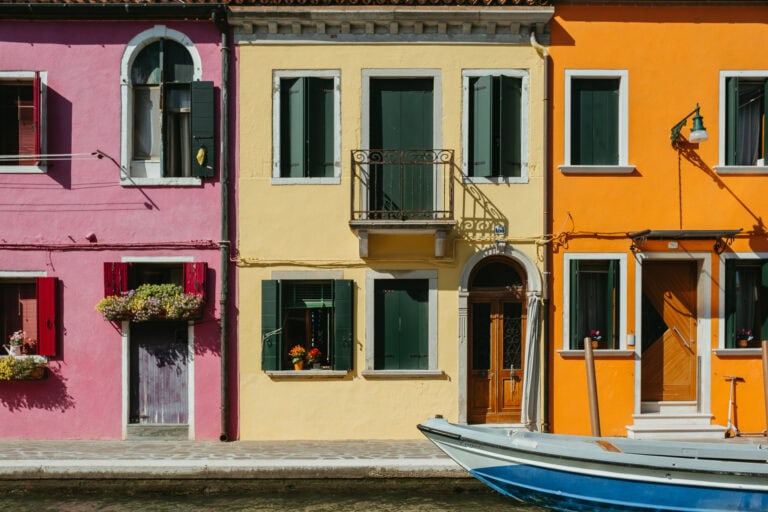
Burano is primarily known for two things: its plethora of brightly colored houses (and other buildings), and its history of lace-making. Both are good reasons to visit Burano, which is a delightful place to spend a leisurely morning wandering beside canals, simply enjoying the views. You can shop for lace — it’s everywhere on Burano — but be warned that unless you’re shelling our for an expensive piece, you’ll encounter plenty of mass-produced, machine-made lace created far away from Italy. There’s also a lace museum (Museo del Merletto), where you can learn about the island’s lace-making history.


To reach Burano, take the number 12 ferry from the Fondamente Nove stop. The ferry ride to Burano takes about 45 minutes, and you’ll want to arrive by 10 am or so in order to see the island without overwhelming crowds — the island really starts to fill up with day trippers by 11ish — so I recommend leaving no later than the 9:10 am ferry.
On your way back to Venice after exploring Burano, you might consider stopping off at Murano, another island on the number 12 ferry line. Murano is larger than Burano and is world-famous for its glassblowing craft. Personally, I think Murano is nice but not a must-see destination; it’s worth a stop if you leave Burano earlier than anticipated, but I wouldn’t skip the next stop on this itinerary in order to see Murano.
Venetian Ghetto
Return to Venice by early afternoon. For lunch, I recommend Puppa Bar, which is located right by the Fondamente Nova ferry stop (where you’ll arrive back in Venice). It’s a cozy spot where you can get a pasta dish, plus a (non-alcoholic) drink, plus a coffee after dinner for €15 — an absolute steal for a sit-down restaurant in Venice.
After lunch, head to the Venetian Ghetto — a historic area of Venice where, in the 1600s, the doge of Venice forced the city’s Jewish residents to live. The segregation of Venice’s Jewish population was strict, with penalties for residents who were caught outside the area after curfew, surveillance of the neighborhood, and gates that were locked at night to keep the residents inside.
Though Venice’s Jewish citizens are of course no longer segregated into the Ghetto, the area remains a thriving neighborhood and a touchstone for the Jewish community.


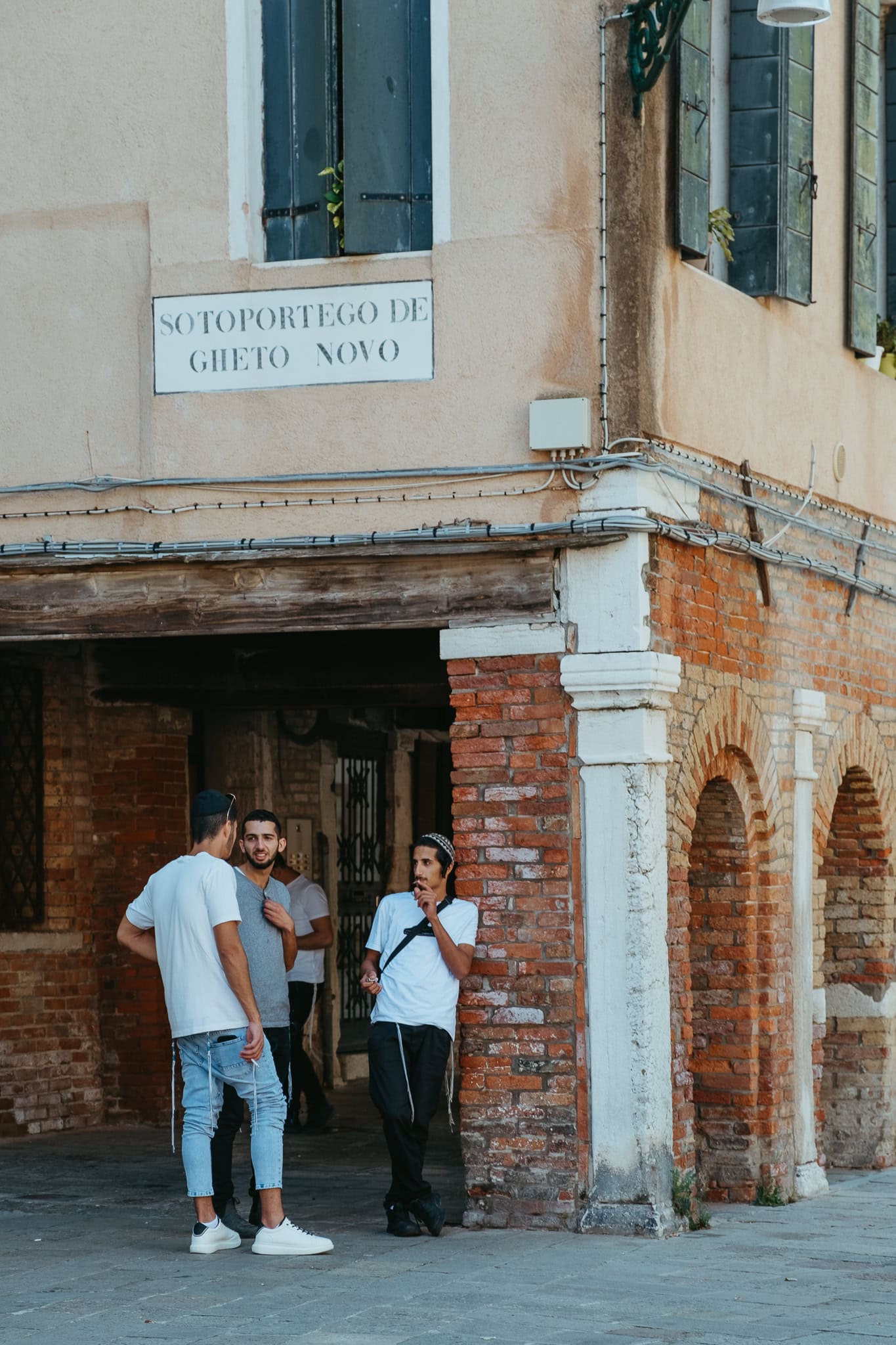
The best way to visit the Venetian Ghetto is to take a tour, which will both give you helpful information about the history of the area and give you access to certain of the buildings in the Ghetto, including beautiful and historic synagogues.
For official tours of the Jewish Ghetto of Venice, there are two options: take a guided tour (look here for a timetable) or a self-guided audio tour. I opted for the latter and enjoyed it a lot — I could go at my own pace and spent plenty of time just sitting in the main square and people watching, in addition to proceeding through the tour. Either way, head to the Jewish Museum of Venice to get started with your tour.
You can also book a tour of the Ghetto with external guides. For a really in-depth experience, consider booking a private tour, where you can ask as many questions as you want and dig into what interests you personally.
Cannaregio
End your day, and your 3 days in Venice, by exploring more of the Cannaregio district (where the Ghetto is located).
As Venice goes, Cannaregio is relatively residential and quiet, at least in the areas away from the Grand Canal. It’s a lovely place to simply get lost (which is, after all, one of the very best things to do in Venice!).


For dinner, I recommend joining a food tour in Cannaregio! You’ll start with cocktails, wine, and snacks at local cafes and bars before sitting down for dinner at a Cannaregio restaurant — and then you’ll cap it all off with dessert. It’s an excellent way to get to know the area, as well as Venetian food.
Check availability for a Cannaregio food tour here:
Where to Stay in Venice
During my first trip to Venice, I stayed at Hotel Dalla Mora, which is wonderfully located on a canal within walking distance of the train station — and everything else. (In fact, I walked absolutely everywhere — except to other islands!)
This was a great hotel for me. It’s certainly not anything fancy — my room was small, and I don’t think anything had been updated in a while — but it was quite inexpensive by Venice standards, and the staff was super helpful. Plus, breakfast was included, and I loved sitting on the canalside balcony just outside my room.


The entrance to Hotel Dalla Mora (left), and the hotel’s balcony as seen from across the canal (right)
During my next visit to Venice, which will be with several of my family members, we’ll be staying at Ca’ de l’Oca in Cannaregio. I’m optimistic that this apartment will be a lovely, spacious spot for us in a quiet but easily accessible area — but I’ll be sure to come back here and update you about whether I was right!
Here are some other excellent lodging options to consider in Venice:
BUDGET | Casa Accademia is conveniently located near Ponte dell’Accademia and the Peggy Guggenheim Collection, and is within walking distance of St. Mark’s Square.
COMFORT | The well-reviewed Hotel Al Codega is wonderfully located right between Rialto Bridge and St. Mark’s.
LUXURY | Rooms at the gorgeous Palazzo Keller include an excellent breakfast and easy, walking-distance access to all the top sights in Venice.
How to Get Around Venice
Truth be told, Venice is so small that it’s exceptionally walkable (which is one of the things that makes me love it so much!). During my week in Venice, I almost exclusively got around by walking. This can sometimes be a bit slower than traveling by boat, but by walking Venice, you truly come to understand what a twisty little maze of a city it is.
That said, some of the destinations in this itinerary can only be reached by boat, and some visitors to Venice may need to travel mainly or exclusively by boat for reasons of ability.
If you need to get around Venice by boat at any point, you can always hire water taxis. However, at least within the Grand Canal and the Venetian Lago, the much more economical option is to ride vaporetti — water buses. Venice’s vaporetto system is extensive and reasonably easy to navigate.

You can purchase tickets for individual vaporetto rides — or multi-day passes, which may make sense if you plan to use vaporetti throughout your 3 days in Venice.
Final Thoughts
Ignore the naysayers — Venice is awesome. And thankfully, with three days in Venice, you have enough time to see both the world-famous tourist sites and some underappreciated gems.
But here’s my very best tip for visiting Venice: give yourself time to get lost. If you can’t decide whether to squeeze more plans into your itinerary, always err on the side of doing less, and fill that space instead with time to wander. Many of my very favorite moments in Venice were times when I was doing nothing in particular other than seeing where my feet might take me.
More Information About VENICE AND ITALY
ITALY ITINERARIES | Spend 10 days in Rome, Florence, and Venice, one week in Bologna, Venice, and beyond, or two weeks visiting some of the highlights of Italy. (COMING SOON!)
THINGS TO DO | Discover 21 of the best things to do in Venice, including 3 of my favorite hidden gems and riding the most popular vaporetto.
LODGING | Discover the best areas to stay in Venice, plus hotel recommendations for a variety of budgets (COMING SOON!).
VIEWS | Learn where to find the very best views of Venice.
DAY TRIP | Find out how to spend one day exploring the islands of Burano and Murano.
COSTS | Here’s how much I spent for one month in Italy.
pin this post