10 Days in Switzerland by Train // A Detailed Itinerary
When it comes to incredible sights within short distances, few countries pack more of a punch than Switzerland.
It’s not even the size of West Virginia, but Switzerland is chock full of stunning mountains, historic cities, and much more. And, thanks to its compact size, it’s easy to see much of Switzerland — even in a short visit — without spending a lot of time on transit.
Personally, my favorite way to travel through Switzerland is by train. The trains are frequent and reliable, and the views are often wonderful. (Plus, some places are car-free and can only be reached by train!)
Here’s a detailed itinerary for how to spend 10 days in Switzerland if you’re traveling by train.
10 Days in Switzerland: Itinerary at a Glance
Day 1: Arrive in Zurich
Day 2: Day trip to Lucerne
Day 3: Travel to St. Moritz
Day 4: Glacier Express
Day 5: Explore Zermatt
Day 6: Travel to the Jungfrau region
Day 7: Explore the Jungfrau region
Day 8: Explore the Jungfrau region
Day 9: Day trip to Bern
Day 10: Return to Zurich
This post contains affiliate links. If you make a purchase or a booking through one of these links, I may receive a small commission at no extra cost to you. Thanks for supporting In Old Cities in this way!
Know Before You Go
Before we dig in, here are a couple of things to know about this itinerary.
Swiss Travel Pass
If you’re planning a train trip through Switzerland, you need to know about the Swiss Travel Pass.
The Swiss Travel Pass is a prepaid pass that includes unlimited travel on much of the transit options throughout Switzerland (most notably, the rail network). If you buy the Swiss Travel Pass, you will not need to buy individual tickets for nearly all of your train travel (some specialty trains are not included, or are only discounted rather than fully covered), as well as certain other forms of transit, such as some boats and buses.
The Swiss Travel Pass may or may not be the economical choice depending on how many trains/boats/etc. you intend to take during your trip. If you will be taking train trips every day of your trip, and plan to take one or more expensive special journeys that is covered or discounted by the Swiss Travel Pass (such as the Glacier Express), the Swiss Travel Pass may be less expensive than buying all your tickets individually.
The best way to work this out is to look up the price of each journey you plan to take and compare the total to the cost of the Swiss Travel Pass. (You can look up prices for regular train travel here.)
During my first trip to Switzerland, I used the Swiss Travel Pass, and it worked smoothly the entire time. Instead of buying a ticket for the trains I needed, I just walked onto the train and showed the conductor my pass when they came to collect tickets.
Accordingly, I think it’s a no-brainer to get a Swiss Travel Pass if it will save you any money. Even if the travel pass is slightly more expensive than buying individual tickets, or you’re not sure exactly which train trips you might or might not take, you might consider getting it for the convenience.
Learn more about the Swiss Travel Pass — or buy one — here.
What if you don’t have 10 days?
If you need to cut a day from this itinerary, spend one fewer day exploring the Jungfrau region. If you need to cut more days, depending on the timing of your flights, consider spending less time in Zurich as well.
10 Days in Switzerland by Train
Here’s your day-by-day itinerary for traveling Switzerland by train.
DAY 1 // ARRIVE IN ZURICH
On the first day of your time in Switzerland, arrive in Zurich.
Try to arrange your transport so you arrive in the morning and have time to explore the city for the remainder of the day. Here are some things I recommend seeing:
Lindenhof
Zurich’s Lindenhof is a lovely elevated park area with a perfect view over the Limmat River and much of the historic city.

Lindenhof is a wonderful place to relax with a book or to people watch. On my first visit to Zurich, in the fall, I enjoyed the glorious smell of the autumn leaves blanketing the park while I watched locals play chess with giant sets.
Fraumünster
The Fraumünster has one of Zurich’s most visible church steeples, but it’s most famous for containing 5 stained glass windows created by Marc Chagall — who was then in his 80s!
Entrance to the Fraumünster costs 5 CHF.
Niederdorf
Go for a wander through the Niederdorf, one of the most charming parts of Zurich’s old town. This car-free area is full of cobblestones, cafes, restaurants, and shops.
Grossmünster
Zurich’s most iconic landmark is the Grossmünster, a church that features rounded twin towers.
The Grossmünster’s origins date all the way back to the 12th century, though it became much more historically significant in the 16th century, when it was a central site in the Reformation and the beginnings of the Anabaptist movement.


Where to Stay in Zurich
BUDGET | “Budget” is a relative term in Switzerland, where just about everything is flat-out expensive. But for a reasonable deal, check out Fred Guest House, which is conveniently located right by the train station.
COMFORT | Boutique Hotel Wellenberg has beautiful rooms in a super-walkable location.
LUXURY | Hotel Adler, where I stayed on a trip to Switzerland with my family, is located right in the midst of the Niederdorf — and has a good breakfast to boot.
DAY 2 // DAY TRIP TO LUCERNE
Today, take the train from Zurich to another beautiful lakeside city: Lucerne. It’s a reasonably quick trip at 40-50 minutes — and well worth it, as Lucerne is a delight, with a beautiful old town, a historic wooden bridge, old city walls (that you can still climb), and more.
Swiss trains are frequent, reliable and easy. You can search for the train schedule, and buy tickets, here. (Search for “Luzern,” the Swiss spelling of Lucerne, as the destination!)
When you arrive in Lucerne, here are some things I recommend seeing and doing.
Kapellbrücke
It’s impossible to visit Lucerne without seeing Kapellbrücke — it’s the (nearly) 700-foot-long wooden bridge spanning the Reuss River just before the river joins Lake Lucerne.

Kapellbrücke is remarkable, dating back to the 14th century. Unfortunately, it suffered a devastating fire in 1993 — but the bridge was restored and reconstructed, and looks beautiful today.
Don’t miss the opportunity to walk across Kapellbrücke and look at the paintings lining its ceiling!
Mount Pilatus
The 7000-foot Mount Pilatus stands tall beside Lucerne, and journeying to the top is one of the best things to do in Lucerne.
I recommend the Golden Round Trip, which takes you up to and back from Mount Pilatus via five different forms of transportation:
- Take a boat from Lake Lucerne to the railway station
- Ride the world’s steepest cogwheel railway to the summit, where you can enjoy the view and eat a meal if you want
- Descend via cable car to a stopover point, where you can buy a ticket to ride Switzerland’s longest alpine slide
- Return to ground level via gondola
- Ride the bus back to Lucerne
The Golden Round Trip is expensive, but it’s heavily discounted if you’re traveling with a Swiss Travel Pass. Find information about tickets here.
The Musegg Wall
One part of Lucerne’s centuries-old city defenses is still standing: the Musegg Wall.
This wall dates back to the 15th century or so, and you can still walk along it today — and climb nine of its towers. The views of Lucerne and the lake are great, and well worth the effort!

Lion of Lucerne
The most famous monument in Lucerne is a controversial one: a lion, built to honor Swiss guards who died protecting the royal family of France. Unsurprisingly, some Swiss citizens protested the construction of a statue honoring people who died for a foreign monarchy.
The Lion of Lucerne lays mournfully in an alcove over a small pond. Regardless of its origins, it’s quite beautiful, and is well worth a visit.
DAY 3 // TRAVEL TO ST. MORITZ
The main thing on your schedule for today is to travel to St. Moritz.
St. Moritz is best known as a luxury resort town. It’s an especially popular spot for winter sports like skiing — in fact, St. Moritz has hosted the Winter Olympics twice.
But we’re here for a different reason: St. Moritz is the beginning of the wonderful Glacier Express train, which you’ll ride tomorrow.
It’s up to you whether to travel to St. Moritz early in the day, and spend the afternoon exploring town, or to instead spend your morning in Zurich and head to St. Moritz later.
Or, here’s another option: journeying between Zurich to St. Moritz generally requires you to change trains in the town of Chur. If you’d like, you can purchase separate tickets from Zurich to Chur and then Chur to St. Moritz, giving yourself time in Chur to go out and explore that city for a few hours.
Either way, once again, check train schedules and buy tickets here. Trains from Zurich to St. Moritz take between 3 and 3.5 hours.
Where to Stay in St. MOritz
BUDGET | St. Moritz can be egregiously expensive even for Switzerland, so the St. Moritz Youth Hostel is not cheap, but it’s a reasonable deal compared to most options in St. Moritz.
COMFORT | When I visited St. Moritz, I stayed at the Hotel Steffani — which is conveniently located near the train station — and had no complaints.
LUXURY | Rooms at the Crystal Hotel, which is also near the train station, include spa access.
DAY 4 // GLACIER EXPRESS
Today offers something spectacular: a journey on the Glacier Express.
Mile for mile, Switzerland may offer more (and better) unique sightseeing train opportunities than any other country, and the Glacier Express is one of its best.
This eight-hour journey takes you from one resort town to another — St. Moritz to Zermatt. You’ll pass through scenic Alpine valleys, over a famous arched bridge, emerge from mountain tunnels into white winter wonderlands, and more. All the while, you sit in train cars with huge, panoramic windows.


The Glacier Express is an expensive train ride, at 159 CHF for second-class seats and 272 CHF for first-class seats — plus a mandatory 48 CHF seat reservation fee.
The good news if that if you have the Swiss Travel Pass, your ticket will be half-price (the seat reservation fee will still be full price, though).
Find more information about tickets and booking here.
Where to Stay in zermatt
BUDGET | If you’re willing to share a dorm room with other travelers, the Zermatt Youth Hostel will save you some serious bucks.
COMFORT | Annex Antika is conveniently located near the train station.
LUXURY | Snag a balcony room at Mountain Paradise and admire the Matterhorn from the breakfast room.
DAY 5 // EXPLORE ZERMATT
Cross your fingers that the skies will be clear today, because this day is all about the Matterhorn.
Really, Zermatt is a lovely town in lots of ways — among other things, the car-free streets are lovely to walk and there’s a beautiful river of glacier water running through town. But nothing quite compares to the sight of the unmistakable Matterhorn shining in the sun above the town.

But please moderate your expectations: the Matterhorn is very, very often hiding behind stubborn clouds, and there’s no guarantee that you’ll see the mountain while visiting Zermatt.
Personally, when I visited Zermatt, clouds concealed the mountain the entire afternoon and evening of my arrival. But then I woke up in the morning, immediately looked out the window, and the very first thing I saw was the Matterhorn glowing brightly in the rising sun, not a cloud in sight.
Here are my top recommendations for things to do in Zermatt.
Gornergrat
If you have time to do only one thing in Zermatt, this is it: take the Gornergrat Railway up to the summit of the Gornergrat — an Alpine ridge above the town of Zermatt. There, you’ll find a railway station with wonderful views of surrounding mountains (including the Matterhorn) and glaciers, a restaurant, and a number of hiking trails.

Find more information about prices and tickets here.
Riffelsee
On the way back to Zermatt from Gornergrat — just beside the train track — lies Riffelsee, a small lake.
If you’re lucky with clear skies and reasonably still air, you can see the Matterhorn reflecting in the lake. It’s gorgeous.

The Gornergrat Railway stops at Riffelsee, but I recommend walking down from Gornergrat to Riffelsee — just follow the hiking trail signs. The path is somewhat steep, but otherwise easy and all downhill.
Matterhorn Glacier Paradise
As an alternative to Gornergrat — or, perhaps, in addition to, if you’re efficient with your time — you could consider visiting the Matterhorn Glacier Paradise.
There, you’ll find a platform with spectacular views of snow-covered mountains and glaciers, an ice palace, the highest mountain restaurant in Europe, and more.
Find more information about tickets here.
DAY 6 // TRAVEL TO THE JUNGFRAU REGION
Today, take a train (or, more likely, several trains) from Zermatt to your home base in Switzerland’s beautiful Jungfrau region.
Once again, you can check train schedules and buy tickets here.
First, though, you’ll need to decide which part of the Jungfrau region to stay in and use as a home base.
Interlaken is most central, with the best train options, but the smaller towns (Lauterbrunnen, Wengen, Mürren, and Grindelwald, most notably) are more charming.

Personally, my favorite town to stay in is Lauterbrunnen, but Interlaken is also an excellent choice.
Whether you stay there or not, I recommend stopping off in Interlaken and exploring town a little bit. Interlaken is known for adventure sports, as it’s one of the top places in the world for paragliding. Even if you’re not up for that particular adrenaline rush yourself, if the weather is good, you’re virtually guaranteed to see dozens of paragliders above town and landing in a huge, central field.

Interlaken is also home to Harder Kulm — a mountain with an incredible view of the whole area, including the town of Interlaken below, the lakes of Thunersee and Brienzersee on either side of town, and the mountains of the Alps across from Harder Kulm.
Where to Stay in the Jungfrau Region
INTERLAKEN | Hotel Bernerhof is conveniently located near one of Interlaken’s two train stations, and has rooms for surprisingly reasonable prices.
LAUTERBRUNNEN | I absolutely love Hotel Staubbach, where I stayed during my last trip to the Jungfrau region. Don’t miss the perfect waterfall view from the breakfast room!
WENGEN | Speaking of views, the Hotel Jungfraublick — with sweeping mountain vistas — is hard to beat.
MURREN | Hotel Eidelweiss takes advantage of the incredible mountainous setting of Mürren with views of the Jungfrau mountain massif.
GRINDELWALD | The beautiful Hotel Gletscherblick pairs a classically Alpine building with the charming mountain village of Grindelwald.
DAYS 7-8 // EXPLORE THE JUNGFRAU REGION
Spend the next two days exploring the absolutely wonderful Jungfrau region.
This is my favorite part of Switzerland, and one of my favorite places to travel in the world. There’s unbelievable hiking, gloriously blue lakes, unique trains, and even a castle, just for starters.
Here are some of my top recommendations for things to do in the Jungfrau region.
Walk from Grütschalp to Mürren
The Jungfrau region is full of wonderful hiking opportunities, but in my opinion, it’s hard to beat the walk from Grütschalp to Mürren: it’s reasonably inexpensive to get to the starting and ending points (at least compared to some of the other hikes in the area!), the views are unbelievable, and the trail is easy enough for anyone of average fitness and ability to complete without difficulty.


Admire the view from Wengen
Whether or not you use Wengen as a home base, it’s worth a visit to see the town’s view of the Lauterbrunnen Valley, which can’t be beat.
Just a quick 12-minute train ride from Lauterbrunnen, a church in Wengen boasts a small viewing area where you can look down to the Lauterbrunnen Valley and out to the snow-covered mountains in the distance. It is simply spectacular.

Visit Thun and Brienz
Interlaken sits between two gorgeous lakes — Thunersee and Brienzersee. Thanks to the effects of glacier water, the lakes are beautiful blue colors, with Brienzersee an almost unbelievable turquoise.
Wonderfully, it’s possible to visit both lakes — and the towns at their respective ends, Thun and Brienz — in one day.
Here’s what I recommend: first, take the train from Interlaken (or wherever you are staying) to Thun, where you can explore a historic castle and watch surfers from a gorgeous wooden bridge.

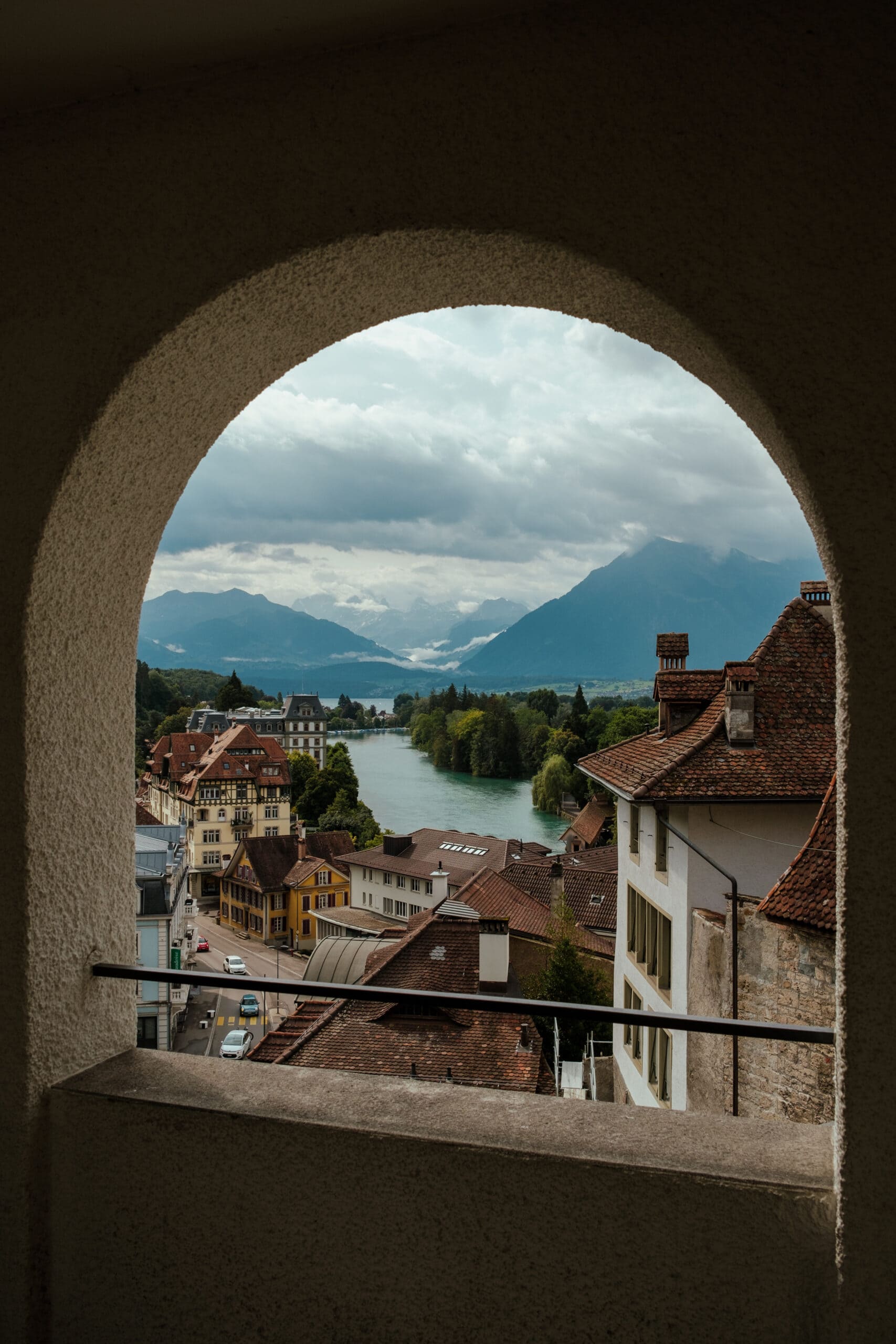
Then, take the train back toward Interlaken and beyond — all the way to Brienz. Brienz is a teensy tiny town, but it’s lovely to walk around. If you have time, you can take the Brienz Rothorn Bahn — a scenic railway that travels up the mountain.
Finally, take a boat from Brienz back to Interlaken. This is a lovely boat ride, especially if you manage to time it for sunset. Small villages cling to the side of the lake as mountains tower above the brightly colored water.

READ MORE: How to Visit Thun and Brienz in One Day
Go hiking on Schynige Platte
For another incredible hiking option, check out Schynige Platte — a ridge between Interlaken and the snow-capped mountains to the south. From Schynige Platte, you have an amazing view of both Interlaken (and its lakes) on one side, and the Eiger, Monch, and Jungfrau mountains on the other side. It is spectacular.
READ MORE: 10 Incredible Things to Do in Switzerland’s Jungfrau Region
DAY 9 // DAY TRIP TO BERN
Don’t leave Switzerland without visiting Bern! It’s the capital of Switzerland, so there are plenty of modern features, but the city’s Altstadt (Old Town) is one of the most charming you’ll find in the country.
Here are some of my favorite things to do and see in Bern.
Zytglogge
Don’t miss the opportunity to welcome in a new hour at the foot of Zytglogge — an 800-year-old clock tower with a centuries-old astronomical clock and various figures that pop out and perform a routine a few minutes before the top of each hour.


You can even tour the inside of the clock tower and learn more about how the figures work. Get more information about tickets here — and be sure to book in advance, since the tour happens infrequently!
Bern Minster
Bern’s most impressive cathedral is notable not only for being Switzerland’s tallest cathedral, but also for its ornate depiction of the Last Judgment at the front entrance. Inside, Bern Minster is unusually simple and undecorated — an artifact of Switzerland’s Protestant Reformation.


Outside the cathedral, be sure to check out the Munsterplattform — a terrace with beautiful views of the river and the buildings at the edge of Bern’s Old Town.
Rosengarten Park
Get a great view of the Aldstadt from above by walking up to the Rosengarten, a park perched high above the old town. There, in addition to lovely gardens and a viewing platform, you’ll find a restaurant where you can admire the town below.
To get to the Rosengarten, cross the Nydegg Bridge over the Aare River and walk up the hill to the left. As you climb the hill, be sure to look back for great views of town on the way.

DAY 10 // RETURN TO ZURICH
On the last day of your trip, return via train to Zurich. Explore more of the city if you have time before departing for home.
10-Day Switzerland Itinerary: Interactive Map
Below is a map with the locations included in this itinerary. To use this map during your own trip to Switzerland, click the star next to the map’s name (which saves the map to your account). You can then find and use the map from your Google Maps app by going to “Saved,” then “Maps.”
Final Thoughts
Switzerland is one of my very favorite countries to visit.
Though it can be incredibly expensive, Switzerland is worth a splurge or two — the incredible snow-covered, charming mountain towns, and spectacular hiking opportunities are hard to beat.
I hope this 10-day Switzerland itinerary helps you make the most of your trip, and that you love Switzerland as much as I do.
And if you still have questions about visiting Switzerland, please leave a comment!
More Information About Switzerland


pin this post